Artificial Intelligence-Based Analytics Help Utilities Weather the Storm
This article originally appeared on July 2, 2019.
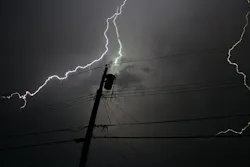
Technology might be changing the way electric utilities operate to some degree, but the things keeping utility operators up at night really haven’t changed—they’re still very sensitive to outages and the need to get customers back online as quickly as possible. But record-setting storm occurrences and the speed of communication in a world of social media puts those operators under more of a microscope than ever.
“Whether or not the weather is getting worse—but I think it is—utility operators are more cognizant that people are watching them,” commented John Eason, outage management system (OMS) product lead for GE Power. They’re grappling with how they respond as they work to get power restored. Needless to say, they’d rather avoid those outages altogether.
With a recent release that combines domain expertise with artificial intelligence (AI) and machine learning (ML), GE Power is providing new analytics to tackle challenges in electric grid operations. The three grid analytics packages use data from across transmission and distribution networks to help utilities manage storm readiness, network connectivity, and transmission operations.
“The energy industry today is leveraging a small fraction of their operational data,” said Steven Martin, acting CEO for GE Digital and chief digital officer for GE Power. “Our Grid Analytics enable utilities to use more of that data and orchestrate their networks and the workers who operate them in ways previously unimagined—not only for current processes, but also for future unforeseen scenarios.”
How utilities prepare for storms looks different than it did 10 years ago, according to Eason, who manages a part of GE Power’s Advanced Distribution Management Solutions (ADMS) that is specifically focused on outage response. “It’s much more advanced, much more complex than a few years ago,” he said, describing situations in which dispatchers will have to spend weekends in a war room environment getting ready for storms, getting a more realistic view of what an outage might look like.
A big piece of the ADMS—which is an order of magnitude more complicated than before—is training and simulation, Eason said. Utilities like to run events that they’ve seen before in their service territory and rerun how their grid actually performed. It requires having a system that can capture all the devices on the grid and assemble the information in a way that can be replayed in real or accelerated time.
“It sounds simple. It’s not simple because every time one of those activities occur, it changes the power flow on the grid,” Eason said. “Those events kind of cascade on each other."
The Storm Readiness package that GE Power has now released uses high-resolution weather forecasts, outage history, crew response, and geographic information system (GIS) data to accurately forecast storm impact and prepare response crews and equipment ahead of impending weather. GE’s Storm Readiness analytic helps reduce outage restoration time, predict future outages, reduce operational spend, and improve crew safety.
Network Connectivity corrects and maintains network data integrity. Data errors, which are often caused by manual information input at the customer or equipment level, can hinder emergency and outage response and lead to poor customer experience. GE’s Network Connectivity algorithms use GIS and other operational system data to detect, recommend, and correct pervasive errors. Armed with better data, utilities can more efficiently dispatch crews, reduce outage restoration time, and avoid incorrect outage notifications to customers.
“When it comes to storm restoration, it will enable the utilities to become more surgical in prepositioning crews in advance of weather events—saving time, money, improving customer satisfaction, and enhancing safety for employees,” said Brian Hurst, vice president and chief analytics officer for Exelon Utilities, an early adopter of GE’s new Grid Analytics. “We are just beginning to scratch the surface on the value of analytics, and when we look at distributed energy resources and the Internet of Things, it becomes increasingly important for the future.”
Effective Inertia, which gives enhanced visibility into transmission system operations, is increasingly important for the distributed energy resources of renewable energy platforms. The influx of renewables leads to a displacement of system inertia, a property of the grid that controls the rate of change of frequency when there is a power imbalance. Ineffective management of a transmission system could result in blackouts and major financial and reputational penalties. GE’s Effective Inertia analytic uses ML to facilitate the measurement and forecasting of system inertia and enable a more stable grid.
Renewable energy assets such as wind turbines or solar panels make grid management more complex on a day-to-day basis. But they can also complicate energy events as well. “Distributed energy assets are playing a role in how the restoration process is evolving,” Eason said. “The utility operator needs to be aware of where those assets are on the grid, especially if they’re not controlled by the utility.”
That brings change in the kind of products and services that GE Power is bringing to the market. “We’re being asked in the outage response space to model those assets with more detail than we were asked to do 10 years ago,” Eason explained. “Now they’re very concerned about how those devices are attached to the grid and whether they need to take precautions during the restoration process.”
GE’s new Grid Analytics are connected via a common data fabric. Unifying data on a secure, scalable and user-friendly platform drives efficiencies, allowing data stored in one location to be used by many systems across the energy value chain, from generation to consumption. Users can in turn realize a network-effect of value, where improvements from one application amplify the benefits of another.
More about data analysis and renewable energies:
About the Author
Aaron Hand
Editor-in-Chief, ProFood World
 Leaders Logo
Leaders relevant to this article: