Digital Transformation at Paint Factory Helps Boost Throughput 150%


Since 1958, Pépin Industries Ltd. has provided solvent-based industrial paints with incredibly short turnaround times. Its batch sizes may be considered small by industry standards—typically several hundred gallons—but this approach allows customers to order what they need, when they need it. In the past, however, lingering manual processes limited order traceability, efficiency of plant staff and, as a result, the company’s ability to scale.
When Pépin Industries moved to a new facility in Cowansville, Quebec, the family-owned company turned to Centris Technologies to digitally transform its operations with innovative automation and IIoT (Industrial Internet of Things) solutions. “Centris was a great help in the success of our automation project—and still is as we implement a new ERP system,” says Francis Pépin, director of operations at Pépin Industries. “They helped with many aspects of the process that had stumped us and other engineering firms. Through their experience with other paint companies, they understood our needs and presented the right solutions very quickly.”
When Michel Kakos founded Centris Technologies with a partner in 2003, he didn’t specifically target the paint industry. However, the Montreal-area systems integrator has built its reputation in this market following a paint plant retrofit in 2010.
“The first major project involved automating a new U.S. production facility for Dunn-Edwards Paints, and that led to a large application with Home Hardware in 2016,” says Kakos, vice president of sales and marketing at Centris. “We were able to share these successes with new customers, and that led to even more.”
As Centris added customers in the paint industry, as well as in food processing, machine building and other industries, the company grew rapidly and now has more than 20 employees. Kakos turned over company leadership to co-presidents Catherine Bouchard and Eric Thibaudeau in 2018. “Over the years, we have grown our smart factory services to include automation and control, industrial software like MES and SCADA, and ERP bridges and web services integration,” Thibaudeau says. “We also make smart products, like a data acquisition solution and a web interface for monitoring components.”
Productivity losses chip at paint profitability
Pépin Industries wanted the technology update to increase accuracy and transparency, as well as throughput. Issues in these areas had persisted prior to the implementation, according to Hélène Daigle, production and lab director at Pépin Industries. “In the past, our highly manual process made it difficult to track everything that went on during production. The operators had work orders, but it was hard to tell how closely they followed the steps and ingredient quantities during the mixing process,” she says.
This led to rework of paint that didn’t pass quality inspection or throwing out a batch due to poor coloring, incorrect ingredient mixtures, contamination, etc.
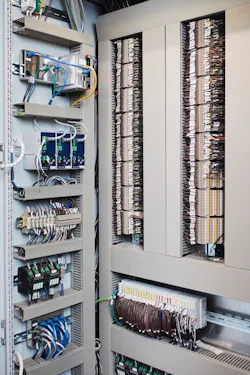
During a project with Canada’s Home Hardware, however, Centris began working with Beckhoff Canada, including regional sales manager Ted Sarazin. Based on that project’s success, Centris has continued to implement Beckhoff technologies, and Pépin Industries was no exception.
“Centris offers a blend of traditional systems integration and IT solutions, so it was a natural fit for them to work with Beckhoff,” Sarazin says. “From our first interactions, the flexibility of PC-based automation technology and the ability of EtherCAT to connect with many different communication protocols have proven to be significant benefits.”
Applying a fresh coat of automation technology
Pépin Industries’ new production facility features six bulk tanks for the most common paint ingredients and additional totes for a variety of others, including additives, resins and sands. The automated system designed by Centris transfers materials from the tanks and totes to the correct mixing station, and it replenishes tanks from incoming shipments. The system controls temperature and pressure while monitoring ingredient levels and other factors. As such, it ensures there is enough of each ingredient and that they remain viscous enough during transfer.
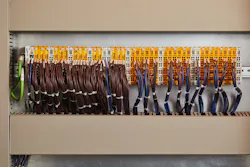
“Beckhoff Industrial PCs are very powerful and offer fast cycle times,” says Marc-André Duguay, industrial software developer at Centris. “It’s easy to access data, and the programming and troubleshooting are simple in TwinCAT software, especially with Structured Text.” As an end-to-end engineering and runtime platform, TwinCAT 3 automation software supports machine control logic, communication and safety, among other functionalities. Engineers can program in the object-oriented extensions of IEC 61131-3, predefined or standard function blocks, and the computer science standards in Microsoft Visual Studio, depending on which best suits their skillset or the project at hand.
The openness and secure connectivity of Beckhoff PC-based control enables communication with the Centris-developed SCADA via OPC UA. It also simplified integration of the plant’s local network via TCP/IP, which facilitates communication between the controller and the tablets on the plant floor. The continuing ERP upgrade will also benefit from the technologies’ automation and IT convergence. As such, it boosts collaboration between Centris’ automation engineers and industrial software experts, empowering the digital transformation at Pépin Industries.
Industrial networking that really brings the plant together
The EtherCAT industrial Ethernet system provides field-level communication. ELX series EtherCAT Terminals from Beckhoff deliver invaluable intrinsic safety at the paint plant. The ELX system allows for a wide range of intrinsically safe terminals to reside in the same segment with standard I/O. The ELX approach eliminated the costs and labor requirements for additional explosion-proof enclosures, barriers and the bus couplers needed to link to remote segments when compared to the traditional approach to intrinsic safety.
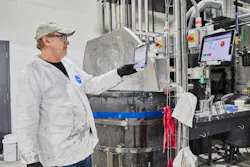
In addition, the open Ethernet fieldbus simplifies multi-vendor architectures. Beckhoff provides gateways and bus couplers to more than 30 prominent communication protocols for this purpose. The Beckhoff CU2016 16-port Ethernet switch, for example, easily incorporated scales for measuring raw materials over EtherNet/IP. TwinCAT can also enable communication to other protocols, such as the gas detection and ventilation system on BACnet that plugs into the C6030 with a standard RJ45 connector. The simple integration of building automation technology into a standard industrial automation system allows the customer to see all ventilation information in the SCADA, Duguay explains: “If chemical fumes reach certain levels, it’s very dangerous. The plant has alarms to protect operators, but this provides additional critical information.”
Automation and IT technologies mix to yield impressive results
The digital transformation at Pépin Industries increased throughput by more than 150%. “With the new system, we increased production from eight batches per day to 12 batches per day on some days and as many as 15 on others. Our average batch size increased from 180 gallons to 300 gallons,” Francis Pépin reports. “Our output is much greater due to the technology updates from Centris, and we have the potential to grow much more.”
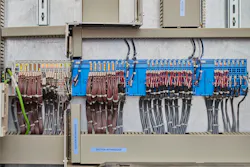
“Having better control of the production process allowed us to decrease our number of batches in rework from two to three per month to just one per quarter,” Daigle says. “Our workers spend less time looking for raw material in the warehouse as most ingredients for a batch are either pre-weighted or come from the automated system.”
For Centris, the use of PC-based automation and EtherCAT technologies continues to enhance the team’s capabilities and efficiency in a wide variety of projects. Commissioning times have accelerated since the company’s transition to Beckhoff, even in complex systems. “Having Beckhoff as our main control platform partner is reassuring, since they remain on the leading edge of automation and continue to enhance their technology offerings,” Kakos says. “Beyond the technology benefits, it’s always a pleasure to work with Ted and the local team.”
This extends through the design process to support and application engineering assistance. Duguay sees the reliable support from Yan Letourneau, application specialist at Beckhoff Canada, and others as exemplary: “We receive excellent technical advice from Yan, and on projects in the U.S., the support from Beckhoff USA is the same high quality.”
Just like a perfectly produced batch of paint, the collaboration between Centris and Beckhoff has combined all the right ingredients for an ideal mix.
By James Figy is marketing content leader at Beckhoff Automation.
About the Author
 Leaders Logo
Leaders relevant to this article: