Taking Industrial I/O and Control in New Directions
Raspberry Pi, the credit card-sized computer that can be used for a variety of computing applications, has been a favorite of the maker and IT developer crowds for years. Recently, I’ve been hearing more about it from industrial engineers. While attending an automation supplier’s conference this year, a control systems manager at a sizable U.S. manufacturing plant told me he uses Raspberry Pi single board computers for a number of basic control applications around the plant. He noted that, if it wasn’t for the levels of service and support he needed from the major automation supplier (whose conference we were attending), he could run nearly all of his plant’s control applications using Raspberry Pis.
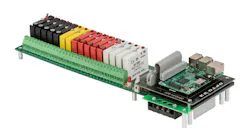
With that comment lodged in my memory, Opto 22’s recent release of a Digital I/O Carrier Board for the Raspberry Pi proved intriguing to say the least. According to Opto 22, their carrier board enables the Pi to sense or switch up to 16 individually selectable electrical loads ranging from 2.5 to 280 V ac/dc using solid-state power. The board provides the ability to connect, monitor, control and automate “billions of existing devices that were previously beyond the Pi’s built-in 3.3 V dc GPIO (general purpose input/output) sensing and control capabilities,” said Opto 22.
To use the Digital I/O Carrier Board with a Raspberry Pi, users attach a Pi to the carrier board by connecting the included interface cable to the Pi's 40-pin GPIO connector and snap the board onto a compatible 4, 8, or 16 I/O module mounting rack. The rack's power supply can be used to power the Pi. Raspberry Pi-supported programming languages are then used to read and write to up to 16 individually selectable digital input and/or output points.
In other news from Opto 22, the company announced that it has joined Dell’s IoT Solutions Partner Program. Opto 22’s Matt Newton said, “This relationship provides a product and solution ecosystem for connecting real-world signals and industrial things to the digital world of information technology, mobile and cloud computing.”
Opto 22 says its contribution to Dell’s IoT Solutions Partner Program is to “bring together an industrially ruggedized hardware platform, data visualization for mobile and web clients, robust industrial automation protocol support including Modbus/TCP and OPC UA, and advanced data flow processing with software development environments like Node-RED. Combining these capabilities with the ability to connect multiple data sources, including devices, databases and third-party application program interfaces, Opto 22 and Dell deliver a single, cohesive, cost-effective and powerful solution for nearly any IoT or edge computing application.”
About the Author
 David Greenfield


 Leaders Logo
Leaders relevant to this article: