For a control engineer, it can be pretty exciting to get your hands into a big startup project—launching a greenfield site or undertaking a major system install. But if you take a good look around your plant to find all the little tasks that could be automated, you’ll likely find that you can save your organization some major bucks.
Savannah River Remediation has its share of big projects to work on. But when Jim Coleman, principal engineer for the Savannah River Site, sees an operator doing boring, repetitive tasks or small quick tasks, he sees an opportunity for another mini-automation. And all those mini-automations add up.
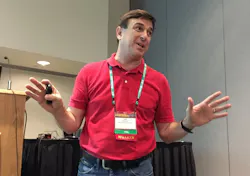
“Mini-automations can make you a lot of money,” Coleman said during a presentation at the latest Emerson Global Users Exchange in Austin. “It can increase production, but also it reduces operator errors.”
The Savannah River Site is a 310-square-mile site in Aiken, S.C., established by the U.S. Department of Energy to make nuclear materials. The primary goal there these days, though, is environmental cleanup—disposing of lots of highly radioactive waste in an environmentally friendly way.
The site has 51 tanks, each capable of holding 1.2 million gallons of waste. The site currently has about 36 million gallons of radioactive waste, all of which will be sent to another facility to be turned into concrete. At the Savannah River Site, a glass waste facility operates with a melter at the heart of the system. There, a mixture of radioactive soup and sand gets heated up, turned into glass, and poured into cans about 10 feet tall, weighing about 5,000 lbs each.
Coleman has found lots of opportunities to automate small tasks at the facility. He divides such possibilities into two main categories: small repetitive tasks that are boring and tedious, and consume more than 20 minutes of an operator’s time; and small, fast tasks, where an operator must drop everything to get it done quickly.
One example is on the bubbler, which measures tank levels by sensing the pressure required to blow air into the liquid. This works great until a tube gets clogged. So once or twice a day, the line has to be cleaned out with water and air. A flush sequence involves disabling alarms, isolating the lines, a water flush, then an air flush, and then reconnecting the lines and re-enabling the alarms.
For an operator, this process takes 26 manipulations, 30 minutes in all, one or two times a day. “That is boring,” Coleman said. “I see an operator with tedium, and I want to automate that.”
With automation, they “set it and forget it,” Coleman said. It runs periodically, requires no interaction from the operator, and is executed perfectly every time.
Another task that Coleman automated was the addition of chemicals to a tank, which previously required 20 operator manipulations plus 25 minutes of constant monitoring—50 times per month. Operators have since been freed from this boring routine.
Clog detection and flushing of the melter feed system is an example that falls within the other category of small, quick tasks. The goals here are simple—detect a clog and clean the bugger out—but the payback is significant. Each pump trip costs four hours of production time, whereas the automated detection and flushing takes only a couple minutes. That translates into $50,000 to $100,000 of profit each day. “If this thing saves two trips a day, that correlates to $2 million per year,” Coleman said. “We’ve been making that extra for the past several years.”
Coleman encourages other engineers to reproduce these sorts of mini-automations at their own facilities. “If you want to be profitable, and you want to write mini-automations that will be great for your facility, there are just two things that you need,” he said. “You need a great idea, and you need standard documents and code.”
The great idea can come from a number of areas:
• If an operator is looking at a drudge screen when you really want him to be doing something else.
• Repetitive, mind-numbing tasks.
• If an operator needs to respond quickly, but might not be able to because he can’t leave his other activities.
• Places where there’s a history of operator errors.
The standard documents and code help to make the endeavor cost-effective. “You have to make this profitable or it’s not going to happen,” Coleman said. “There’s lots of cost associated with code, documentation, training and automation errors.”
Coleman recommends a single automation document to serve the whole process—addressing the needs of operations, procedures, engineering and computing. Every automation document should follow the same format, which Coleman said should be split into three parts: the process description, written for operations, procedures and engineering (no nerd speak); the automation description, written for operations, procedures and engineering (again, no nerd speak); and the flowchart for each state, very detailed.
“Stay away from the keyboard until the documentation is complete,” Coleman advised. “That is so hard for engineers.”
It all sounds simple enough, but Coleman warned of some dangers. The document itself, for example. “It’s not easy to get an engineer to write an understandable document,” he commented. “Getting a good document is not easy, but it’s critical to success.”
Also, people tend to want to do things a “new way,” but don’t overlook the value of the tried and true, Coleman said. Focus on function and understandability.
Coleman recommends looking in particular at all the possible ways a project could fail. Seek out failure modes; consider Murphy’s Law and try to break the logic, cause a problem. “About 60 percent of our code deals with failures rather than normal execution,” he says.
An important aspect of the success with all the mini-automations at the Savannah River Site is how structured and repeatable the process is—every document is structured the same, every automation program is structured the same, and every structure is scalable, flexible and extensible. “Every one we write is the same, same, same, same, same,” Coleman emphasized. “We want our engineers to be creative, not futzing around with code.”
Once you get a few mini-automation projects in place, chances are your operators will come looking for more. “Operators will tell you what’s boring and what happens too fast for them,” Coleman said. “We have 28 of these mini-automations just waiting for us to get back to the plant. We can bang out the code really quickly now, and we’re ready to run in two weeks.”
Perhaps best of all, there are no hardware costs associated—nothing to buy or upgrade. “I’m just using ones and zeroes that are already available,” Coleman said. “We’re just not using this capacity.”
About the Author
Aaron Hand
Editor-in-Chief, ProFood World
 Leaders Logo
Leaders relevant to this article: