Digital Twin Asset Management Throughout the Network
Though the digital twin has a somewhat sprawling definition base, there is no doubt that the concept and its various manifestations are quickly taking hold in plant operation environments. A key definition leverages the digital twin as an important component in ongoing asset management—enabling a continuous view into physical assets through a virtual representation.
Building on a partnership formed about a year ago, Hilscher and SAP showed off extended capabilities in this area at this year’s Hannover Fair in April. Through 12-14 months of co-innovation, the two companies are using the digital twin concept to help integrate information technology (IT) and operations technology (OT) in plants—showing how production could be optimized through integrated installation and preventive maintenance, and device manufacturers could monitor and improve usage and service of their products in the field.
As things stand in most plants today, it’s difficult to keep track of the changes made on the network. “We just don’t know after a couple years what’s in our system,” said Armin Pühringer, business development manager, during a discussion at Hannover Fair. “It’s difficult to compare the as-planned structure with the as-built with the integrator with the as-equipped with maintenance.”
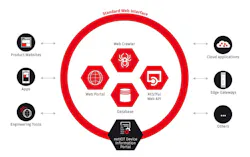
Hilscher and SAP aim to rectify that situation with the fruits of their partnership: Hilscher’s release of the netIOT SAP Connector to enable direct connectivity to SAP’s Asset Intelligence Network (AIN). Together, the two companies developed bidirectional integration of sensor/actuator data through Hilscher’s netIOT Edge Gateway to the SAP HANA Cloud Platform and AIN.
SAP launched the Asset Intelligence Network at Hannover 2016 with the idea of providing a cloud-based platform for manufacturers, service providers and equipment operators to exchange data with one another, regardless of equipment or network used. Hilscher provided a first live demonstration of new features for discrete manufacturing in SAP’s booth at Hannover 2017—integrating its netX technology and netIOT Edge Gateway into the AIN to show new functionalities.
What this means is that device manufacturers can access their own devices regardless of the programmable logic controller (PLC) or production network being used, enabling them to monitor and improve usage of their products in the field. It also enables them to develop new business models such as pay-per-use and function-based billing. Operators can optimize production technology through integrated and preventive installation and maintenance procedures.
“The topology scan is the key value of the netIOT Edge Gateway,” Pühringer said. Powered by netX fieldbus technology and Intel x86 architecture, the netIOT topology scan enables a live update between the planned and as-installed structure of plant assets. If, for example, an incorrect sensor is added to a production network, Hilscher’s device will detect the wrong topology, he explained.
A web-based depository holds device descriptions. “So if a maintenance guy adds an IO-Link sensor, you can detect it by scanning the network,” Pühringer said.
Access down to the field level from the SAP AIN also allows integration into business processes during installation, maintenance and service of the production system. “Asset management can use the existing infrastructure from SAP,” Pühringer explained.
It has become clear how important open communication and open architectures have become to the proliferation of Industrial Internet of Things (IIoT) strategies. “IIoT is a game changer,” Pühringer commented. “We have been living for 20-30 years with a closed architecture. But the key to success is cooperation.” He also added, “Open architectures are the future.”
Hilscher’s go-to-market strategy pulls other device manufacturers into the fold, such as Pepperl+Fuchs for discrete manufacturing, also adding Endress+Hauser and Samson in process industries. The strategy has Endress+Hauser’s flowmeters and Samson’s control valves communicating more openly with the network, with Pepperl+Fuchs and Hilscher providing connectivity and SAP connecting into asset management.
“Before, the control valve was on the same tube with the flowmeter, but never talking to each other,” Pühringer said. “Now, as they start to cooperate, they can think about common applications.”
The integrated solution from the sensor to the cloud allows the implementation of the reference architectures defined by the Platform Industry 4.0 and the Industrial Internet Consortium (IIC), Hilscher noted. The representation of the digital twin will be based on ongoing work executed within the LNI4.0 testbed “Implementation of RAMI 4.0 Administration Shell.”
About the Author
Aaron Hand
Editor-in-Chief, ProFood World
 Leaders Logo
Leaders relevant to this article: