It’s one thing for a supplier to talk about the great technology they offer, it’s another thing to demonstrate trust in one’s own product offerings by actually using them.
This form of “dogfooding” is essential in today’s digital world that has many manufacturers talking about the need to prepare for the Industrial Internet of Things (IIoT), but only a small percentage of manufacturers actually taking the leap. That’s because, at this point, with not that many proof of concept projects, it is a leap—of faith.
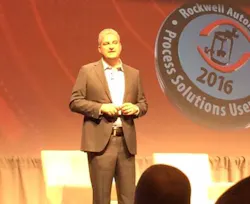
So, it was refreshing to hear Rockwell Automation tell its customers attending the Process Solutions User Group (PSUG) this week in Atlanta that they are leading by example.
“At Rockwell we have our own digitization projects going on inside of the company,” said John Genovesi, vice president and general manager of Rockwell Automation’s Information Solutions and Process Business. “The initiative, called ‘global process transformation,’ started four years ago.”
It began by value stream mapping processes, looking at work practices and understanding the plant floor culture. Then Rockwell looked at the opportunity to reduce inventory and the need for rework of WIP, after which the technology was applied.
In an effort to not only prove the “Connected Enterprise” concept that Rockwell promotes to customers, but to also increase its own operational efficiencies, the company rolled out FactoryTalk ProductionCentre manufacturing execution system (MES) across 24 of its manufacturing facilities, using the software to standardize processes.
And, here are just some of the results of their efforts: Inventory reduction from 120 days to 82 days; 30 percent less per year in capital expenditures; and a 50 percent reduction in lead times. In addition, quality improved with a 50 percent reduction in parts per million (PPM) defects, and productivity increased by about 5 percent per year.
Now, in phase two of Rockwell’s global process transformation, the company has created the Business Intelligence Center of Excellence in which they can bring in more information from the supply chain and new data streams around quality processes, using the cloud for large information management challenges to complement on-premise software. This includes combining production data with enterprise data to perform root cause analysis for making better business decisions, Genovesi said.
And, to help their own organization—and their customers—on the Connected Enterprise journey, the company announced this week FactoryTalk Cloud and FactoryTalk Analytics.
The cloud offering is a culmination of work that Rockwell Automation started three years ago with Microsoft and AT&T, designing a way to establish robust communication from the edge to the cloud. In the plant there is a “network crawler” that identifies all of the Rockwell equipment and collects data from the asset, which can be sent to the cloud. A second release will include a cloud gateway that allows users to gather Rockwell information from automation systems to securely transport it to the cloud. From there, plant and enterprise data can be combined allowing business intelligence (BI) tools to turn data into information.
Rockwell is evolving its analytics from descriptive and diagnostic (what happened and why) to predictive and prescriptive (taking data streams to predict where the process is going, or provide feedback to a person about an anomaly detected). Rockwell is currently working in a pilot partnership with a third party company to bring more predictive capabilities to machine downtime, said Scott Lapcewich, Rockwell’s vice president and general manager of customer support and maintenance.
To that end, the cloud offering will also support Rockwell’s Connected Services business that supports network and security, product and application lifecycle support, remote monitoring, asset management and reliability services, and asset safety—including people. Infrastructure-as-a-Service (IaaS) is also part of the offering with a future eye on “predictive maintenance as a service.”
The cloud, the analytics and the services are being delivered to customers to “make it easier for them to get to the data,” Lapcewich said, who also provided examples of companies Rockwell has already helped. Like, General Mills, which was having problems across six of its North American operations where there was a surplus of inventory, but the spare parts didn’t match what was in inventory, which didn’t help during a downtime event. Rockwell consolidated the data into an enterprise view and leveraged historical data on failures and real-time data collection from asset tracking systems to develop an inventory strategy that aligns spare parts across the six sites, matching higher risk assets on the plant floor.
The net result, Lapcewich said, was that General Mills “reduced inventory by 50 percent, reduced their downtime and now they have strategy for the future to migrate to a connected enterprise.”
The overarching message to manufacturers dragging their feet on digitization is that it is time— and results are achievable. If Rockwell Automation can do it, so can you.
About the Author
Stephanie Neil
Editor-in-Chief, OEM Magazine

Leaders relevant to this article: