2025 Salary & Career Survey: Automation Professionals Navigate a Cautious but Resilient Landscape
Key Highlights
- Despite widespread job satisfaction, nearly 75% of automation engineers say they'd pursue or respond to a new opportunity — a quiet retention risk hiding in plain sight.
- Engineering shortfalls are acute, with 58% of organizations struggling to fill open roles, particularly in systems engineering, software and robotics as many companies have frozen new hiring.
- Compensation remains the top driver of job satisfaction, yet nearly two-thirds of engineers who feel underpaid say they'd need an 11% to 25% raise just to reach what they consider fair pay.

For the first time in its history, Automation World conducted a salary and career survey of its audience. This had not been done in the past as our audience is extremely varied and includes titles ranging from manufacturing executives and directors to plant management and IT leadership to engineering management and production operations.
Looking broadly at our audience, we knew the variety of titles, pay scales and career trajectories would be too divergent to make sense in an all-encompassing survey. However, as Automation World is now part of Endeavor Business Media’s manufacturing and engineering group, we were able to conduct a survey that focused predominantly on the engineering and operations roles in our audience.
Before getting into the insights provided by the survey, let’s first look at who responded from among our audience.
From more than 100 respondents to this lengthy and detailed survey, automation and controls engineers made up the largest single group at 35%, followed by design and development engineers, engineering management and executive/operating management — each at roughly 14%. Process engineers accounted for about 5%, with the remainder spread across mechanical design and other functions.
This is a seasoned workforce. More than half of respondents have been in engineering for 20 years or more, and more than a quarter have logged 30 or more years in the field. Age data reinforces this picture: nearly half are 55 or older, with 26% in the 60-and-over bracket. The workforce skews heavily toward mid-to-late career professionals, a demographic reality with significant implications for the talent pipeline.
Tenure at current companies is more varied with about a third having worked for their present employer for less than five years, while nearly 50% have stayed 10 years or longer, suggesting healthy internal loyalty.
Educationally, this is a credentialed group. More than 60% hold a bachelor's degree or higher, and nearly a quarter hold a master's degree. Associate's degrees account for 15%, reflecting the hands-on, technical character of the controls and automation field where certifications and applied skills can carry as much weight as academic credentials.
Hiring, job stability and the scope creep problem
Most respondents (86%) report that they are in the same job they held last year. Of the 14% who changed jobs in the past year, the most common reason was leaving to pursue other opportunities (50%), followed by reassignment due to restructuring (33%). Less than 10% cited a return-to-office conflict as the reason for a change, suggesting that remote work tensions are not a dominant driver of churn in this field.
These results indicate that, while AI is clearly on engineers' radar, it is not yet the dominant anxiety in the profession, at least not compared to the more immediate pressures of talent shortages, project delivery and economic uncertainty.
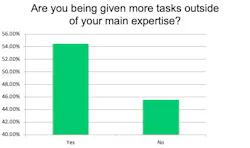
But staying put doesn't mean the job has stayed the same. A notable 54% of respondents say they are being given more tasks outside their main area of expertise. For automation engineers who were already straddling IT/OT boundaries, taking on additional responsibilities seems to be the norm rather than the exception.
The hiring environment as seen by our respondents reflects the broader uncertainty in manufacturing. Among the most common responses to a question about hiring and budgeting status, 37% said their company has put hiring for new positions on hold, while 34% reported an increase in general hiring. Workforce reductions or layoffs were reported by 14% of respondents, and budget cuts to engineering departments by 9%. Interestingly, amid all the current hype about AI use in industry, only 7% said their company is specifically hiring for AI expertise.
Looking ahead, 61% expect their company to maintain current engineering headcount, 31% anticipate growth, and 7% foresee staff reductions. Just 1% believe their company plans to replace staff via AI.
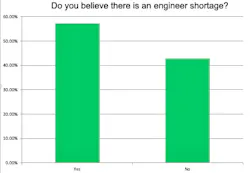
Despite the relative employment calm these responses indicate, finding qualified candidates remains difficult. Nearly 58% say their organization is struggling to fill open engineering positions. The most sought-after specialties where shortfalls are being felt include systems engineering (43%), software (34%), robotics (30%), power (28%), and both safety/security and mechanical design at 21% each. Machine learning and AI expertise is difficult to find for 17% of respondents.
These responses indicate that the pipeline isn't producing enough engineers with the right blend of skills, particularly at the intersection of traditional controls knowledge and modern software and systems integration.
54% of respondents say they are being given more tasks outside their main area of expertise. For automation engineers who were already straddling IT/OT boundaries, taking on additional responsibilities seems to be the norm rather than the exception.
When it comes to experience requirements for new hires, the bar is modest but practical — 47% seek candidates with about three years of experience, and 46% want five years. No respondents reported asking for 15 or more years, suggesting companies are looking for early-to-mid career professionals rather than seasoned veterans.
Respondents’ views on compensation
Base salaries for this group cluster in the $100,000–$149,999 range, with 23% earning $100,000–$124,999 and 18% at $125,000–$149,999. A little more than 25% earn $150,000 or more, with 10% in the $200,000–$249,999 band and a small number reporting $250,000 or above.
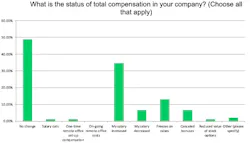
When it comes to bonuses, about 26% received $10,000 or more in bonus compensation, while 23% received no bonus at all. Bonuses are most commonly tied to company or division performance (56%), personal performance (37%) and profit sharing (23%).
Beyond salary and bonus, the benefits picture is fairly traditional: 401(k) matching leads at 70%, followed by health benefits at 60%, paid time off at 52%, company-paid communications (phone, internet connections) at 29%, and further education/training at 17%.
Year-over-year, 43% of respondents expect their 2025 total compensation to increase by 1% to 3% compared to 2024, with 16% projecting a 4% to 6% gain and 8% expecting more than 6%. About 29% expect no change, and 5% anticipate a decrease. Raise freezes were reported by 13% of respondents, and canceled bonuses by 7%.
Burnout is a word the industry should take seriously from a workforce that has been expected to do more with less across multiple technological transitions simultaneously.
Despite these incremental gains, a meaningful gap persists between what engineers are earning and what they believe they should be earning. Of those who feel undercompensated, 64% say they need an 11% to 25% increase to reach fair pay. Another 12% say they'd need a raise exceeding 26%, and 6% believe fair compensation would require more than 50% above their current pay. About 50% of respondents rated their pay package as equally or more competitive than what other employers are offering; 38% called their compensation somewhat or much less competitive.
Career satisfaction
Despite the grind of expanding workloads and compensation concerns, most automation engineers remain satisfied in their roles. About 82% describe themselves as satisfied, very satisfied or extremely satisfied. Only 18% expressed dissatisfaction.
Career optimism is also fairly strong: 63% believe that engineering's potential for salary advancement is as promising today as it was five years ago. And an impressive 90% say they would recommend engineering as a career to a young person.
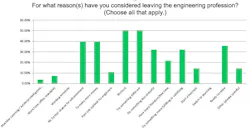
Still, a third of respondents admit they have, at some point, considered leaving the profession. The top reasons are burnout and wanting to try something different — each cited by 50% of that group — followed by no further chance for advancement and wanting to make more money (both at 39%), and readiness to retire (36%).
Burnout is a word the industry should take seriously from a workforce that has been expected to do more with less across multiple technological transitions simultaneously.
In line with the company longevity numbers and general satisfaction with their work that we’ve already seen, only 12% of respondents report that they are actively seeking a new position. However, 38% say they would follow up on an interesting opportunity, and 37% would respond if personally approached. In other words, roughly three-quarters of engineering talent is open to make a move if the right offer arrives — a significant vulnerability for companies not paying attention to retention.
Professional concerns and how they stay sharp
When asked about job-related concerns, staying current with new and emerging technologies topped the list at 32%, followed by concerns about the general health of the economy (27%), product quality issues (26%), dealing with reductions in staff (25%) and product reliability issues (25%). Concerns about the financial health of their own company were cited by 21%.
These responses indicate that the pipeline isn't producing enough engineers with the right blend of skills, particularly at the intersection of traditional controls knowledge and modern software and systems integration.
Again, given all the hype around AI over the past few years, concern about AI impacting their job was cited by only 8% of respondents, and concerns about using AI on the job by another 8%. Incorporating AI/ML into their work registered at 12%. These results indicate that, while AI is clearly on engineers' radar, it is not yet the dominant anxiety in the profession, at least not compared to the more immediate pressures of talent shortages, project delivery and economic uncertainty.
Unsurprisingly, compensation remains the top driver of job satisfaction in absolute terms, with a weighted average score of 4.12 out of 5 — significantly above company culture (3.77), learning and advancement possibilities (3.70), and the design challenges that drew many engineers to the field in the first place (3.53).
Continuing education is a priority for this group, and the channels they prefer reflect the realities of a busy workforce. Seminars lead at 63%, followed by webcasts at 57%, in-person trade shows and conferences at 54%, engineering and technology publication websites at 54%, engineering videos at 51%, and white papers and vendor-sponsored education each at 45%. Online college courses drew 24%, while traditional in-classroom courses attracted only 7%. This audience clearly prefers to receive its ongoing learning through professional channels rather than academia.
About the Author
 David Greenfield
 Leaders Logo
Leaders relevant to this article: