How Contactless Couplers Change the Approach to Industrial Power and Data Transmission
Key Highlights
- Contactless transmission across an air gap prevents the burned, dirty and misshapen contacts that cause unplanned production stoppages and high maintenance expenses.
- The contactless couplers use 60 GHz wireless communication for bit-oriented, full-duplex data transmission that's 1,000 times faster than 5G, supporting the use of real-time Ethernet protocols.
- Inductive power transmission and automatic coupling allow base and remote devices to face each other from any direction, even at offset or tangential angles, requiring less mechanical precision than traditional connectors.
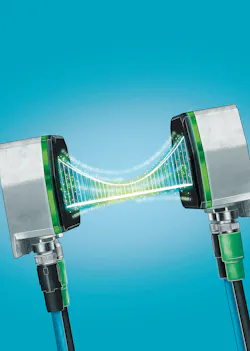
In industrial automation systems, connectors transmit most power and data. Because these connectors are frequently plugged and unplugged, their contacts become misshapen and worn, resulting in a limited service life. This leads to unforeseeable production stoppages and the need for regular maintenance intervals.
Contactless real-time communication systems, such as the NearFi couplers developed by Phoenix Contact, can solve many of these problems.
How contactless connectors address common causes of connector wear
The automotive industry provides a great example of the type of wear that connectors experience. Each day, hundreds of insertion cycles are performed between a robot arm and its interchangeable tools. Due to the high insertion cycles associated with these tool changes, the utilization period of connectors is significantly reduced because the contacts become burnt, dirty or misshapen with the constant interchange of tools.
The contactless devices don’t need to be positioned exactly. They can face each other with an offset or at a tangential angle, greatly reducing the degree of precision required for the mechanical movement of two independent system parts.
The resulting production stoppages cannot be foreseen or planned around. And the costs for regular maintenance intervals, employed as a preventive measure, can quickly amount to a seven-figure sum in this industry.
Connectors are also often used in automated guided vehicle systems, rotating and rotary tables, and applications involving slip rings. Until now, available connectors have either performed inadequately, been prone to errors or required intensive maintenance, making operation expensive.
At Phoenix Contact, we see contactless power and data transmission across an air gap as the perfect solution here. This approach enables wear-free and maintenance-free connections, while also allowing transmission through glass or other non-conductive media. The technology also opens up a range of possible applications, such as contactless inclusion of inaccessible and hard-to-reach areas like enclosed control cabinets, high-voltage areas or cleanrooms.
Bit-oriented full duplex communication
The development of contactless power and data transmission was driven by the challenges associated with digital production and the goal of cost-effective manufacturing in a batch size of one.
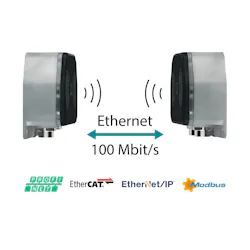
Most data transmission in industrial automation today is based on Ethernet (100 Mbps). And some protocols require communication with very low latency. Examples include Profinet IRT, Sercos and EtherCAT, which are often referred to as real-time protocols.
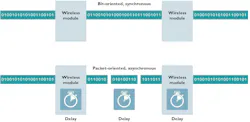
With a contactless Ethernet connection, achieving no appreciable latency is possible. Data exchange is based on wireless 60 GHz communication in the near field. This enables bit-oriented transmission, which is also used in fiber-optic communication.
The NearFi couplers offers a latency of less than 1 µs, making it around 1,000 times faster than 5G.
All other established wireless transmission technologies use a packet-oriented method to forward data, resulting in considerable latency. Packets first need to be received, repackaged and sent wirelessly. It’s a similar process at the receiver end, where the packets need to be received, unpackaged and output again. This process involves many asynchronous and latency-causing operations, which the new communication technology eliminates. Transmitting real-time Ethernet protocols requires full duplex forwarding, or simultaneous data exchange in both directions. This also presents a problem for many wireless technologies, such as WLAN or 5G.
Less than 1 µs latency
In Phoenix Contact’s NearFi couplers, two 60 GHz connections (an uplink and a downlink) are used in parallel on separate frequency bands to enable full duplex operation. For comparison, WLAN generates a latency of around 10 to 20 ms (10,000 to 20,000 µs) for Ethernet communication. 5G is aiming for 1 ms (1000 µs) in the future.
The new contactless Ethernet technology used in the NearFi couplers offers a latency of less than 1 µs, making it around 1,000 times faster than 5G. In addition, it allows contactless and almost latency-free Ethernet transmission up to 100 Mbps in real time and also works independently of a protocol. This means that the technology is also suitable for future developments.
Wireless communication in the near field takes place over a very small distance, so there is virtually no interference spectrum in the vicinity of the devices. Numerous systems can be used in parallel and coexist with existing wireless technologies, such as WLAN or Bluetooth. Industrial interference spectrums, such as those that occur with arc welding, likewise cannot influence the contactless technology.
The first use of this new technology is available in contactless couplers that can transmit 50W of power (24V, 2A) and real-time Ethernet data across an air gap of up to a few centimeters. Due to the IP65 housing featuring M12 connections for Ethernet and power, the couplers can also be used in demanding environments.
Constant power of 50W
Power transmission in contactless couplers is inductive. The base coupler generates a magnetic field via a coil, which is induced in the coil of the remote coupler. Active closed-loop control always selects the best possible parameters for power transmission.
Contactless couplers enable wear-free and maintenance-free connections, while also allowing transmission through glass or other non-conductive media.
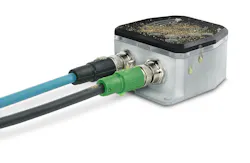
This means that the power is kept at a constant 50W over the entire operating range. End devices, such as I/O stations or switches, can therefore be supplied with power without contact. Coupling is automatic, eliminating the need for configuration or programming.
In contrast to standard connectors, base and remote couplers can be positioned to face each other from any direction, and even rotate in relation to each other. The user does not need to center the devices exactly; they can face each other with an offset or at a tangential angle. This greatly reduces the degree of precision required for the mechanical movement of two independent system parts. With standard connectors, however, the positioning of the male and female connectors must be extremely precise. Otherwise, the sensitive pins can quickly become damaged.
Rotating applications occasionally use slip rings or optical rotary transformers. Both systems involve a high amount of mechanical wear. In addition, they must be manufactured to a very precise standard, which drives up costs and failure rates. By using contactless couplers in these rotating applications, the flexible positioning of the base and remote device is enough to ensure reliable, wear-free transmission. The couplers are secured directly or with mounting brackets from three different sides with M5 or M6 screws to enable universal and flexible mounting.
More industrial networking insights from Automation World:
About the Author
Benjamin Fiene
Benjamin Fiene handles product marketing for communication interfaces at Phoenix Contact Electronics GmbH
Danny Walters
Danny Walters is product marketing specialist for wireless and surveillance products at Phoenix Contact USA
 Leaders Logo
Leaders relevant to this article: