Honeywell and Danfoss Unite VFD Technology with Process Control Systems
Key Highlights
- Honeywell and Danfoss are partnering to integrate variable frequency drive (VFD) technology with Honeywell's Experion Process Knowledge System platform to streamline motor control, reduce energy consumption and improve equipment reliability and maintenance scheduling.
- The companies are implementing a three-phase roadmap beginning with basic VFD connectivity, advancing to predictive maintenance capabilities that can reduce downtime by up to 45% and unplanned failures by 75%, and culminating in digital twin development for comprehensive equipment simulation.
- The partnership emphasizes energy efficiency, with research showing an additional 153-terawatt hours of untapped energy savings potential in European industrial facilities, while incorporating secure-by-design drive technology with hardware encryption and tamper-resistant features.

Industry’s push toward digitalization and increased levels of environmental responsibility has sparked a significant collaboration between Honeywell and Danfoss. The two companies are joining forces to transform how motor control technology interfaces with process automation platforms, creating what they describe as a more intelligent and resource-efficient approach to manufacturing operations.
According to Carlos Villa, modular system lead at Honeywell, end users consistently report integration challenges when connecting electrical systems, particularly variable frequency drives (VFDs), with process control infrastructure. These complications typically manifest as elevated capital and operating expenses, along with compromised process performance.
The partnership seeks to resolve these pain points by streamlining VFD integration at the control system level while extracting operational intelligence to enhance equipment reliability, reduce energy consumption and optimize maintenance scheduling.
Villa emphasized the complementary nature of the alliance to address industry’s issues in this technology area: Honeywell contributes process expertise while Danfoss provides its expertise in motor control technology. The integration of the companies’ technology and process insights will be housed within Honeywell's Experion Process Knowledge System (PKS) platform.
This level of technology integration is possible because modern drives have transcended their original energy-saving function, explained John Conboy, global sales and business development leader for Europe, Middle East and Africa (EMEA) at Danfoss Drives. “Today's drives function as sophisticated sensors, gathering data from electrical grids — including harmonics, voltage and current measurements — as well as from motors and mechanical loads,” he said. “This information flows directly into Honeywell's control systems.”
Phased approach to technology integration
Speaking at the 2025 Honeywell Users Group EMEA conference, Villa and Conboy outlined a three-stage implementation roadmap.
Centrifugal applications like pumps and fans, reducing speed by 20% with VFDs yields a 50% energy reduction. Yet only 25% of European motor applications currently use VFD technology.

The initial phase, now complete, established foundational connectivity between Danfoss VFDs and Honeywell’s Experion. This stage mapped essential functions, such as start, stop and jog commands into the Experion environment, along with basic drive monitoring capabilities. Villa noted this groundwork was necessary before advancing to more sophisticated functionality.
The second phase, currently in development, expands into asset management and predictive maintenance territory. Villa described the objective here as leveraging drive data to identify critical operational events and accelerate corrective responses. This phase also encompasses monitoring rotative asset health to enable predictive maintenance strategies.
Conboy noted that critical condition-based monitoring capabilities in this phase include motor vibration analysis, pump impeller damage detection, cavitation identification and early detection of motor winding degradation. Given that approximately 16% of motor failures stem from stator defects, current feedback measurement can identify these issues up to 30 days before failure occurs, he said.
These predictive capabilities can slash downtime by up to 45% and reduce unplanned equipment failures by as much as 75%, according to Conboy.
Traditional equipment testing often requires days or weeks, hardware-in-the-loop technology can compress setup time to approximately 15 minutes by replicating grid conditions and applications, such as pumps, fans or compressors, through mathematical modeling and drive-based control testing prior to field installation.
The third phase will center on digital twin development. Here, Villa said the plan is to combine Honeywell's simulation capabilities with Danfoss drive technology to provide comprehensive insight into control assets, motors, gearboxes and other mechanical plant equipment.
Conboy added that simulation and hardware-in-the-loop testing become possible at this stage to validate PLC code and operational sequences before equipment deployment. While traditional equipment testing often requires days or weeks, hardware-in-the-loop technology can compress setup time to approximately 15 minutes by replicating grid conditions and applications, such as pumps, fans or compressors, through mathematical modeling and drive-based control testing prior to field installation.
Advancing energy efficiency goals
Conboy identified sustainability as a cornerstone of the partnership, citing Danfoss's philosophy that unused energy represents the most environmentally friendly energy. For centrifugal applications like pumps and fans, reducing speed by 20% yields a 50% energy reduction, he noted. Yet only 25% of European motor applications currently utilize VFD technology.
In this Honeywell/Danfoss partnership, Honeywell contributes process expertise while Danfoss provides its expertise in motor control technology. The integration of the companies’ technology and process insights will be housed within Honeywell's Experion Process Knowledge System (PKS) platform.
Research conducted by Danfoss quantifies the opportunity here: While upgrades to IE2 and IE3 efficient motors have delivered 12 terawatt hours in European energy savings, and VFD deployment has saved 73 terawatt hours, an additional 153-terawatt hours remains accessible.
Conboy characterized this as being equivalent to Argentina's total annual energy consumption sitting unused in European industrial facilities. Conboy pointed out that Danfoss drives incorporate specialized cooling technologies that further boost energy efficiency and equipment reliability. For example, heat pipe and back-channel cooling systems shrink the drive's physical footprint while reducing cooling requirements by up to 90%, translating to decreased energy costs and extended equipment lifespan, he said.
Cybersecurity-focused design
With the goals of this partnership centered on high levels of networked technologies, Villa emphasized that the connectivity level between Danfoss drives and Honeywell's Experion platform makes robust security essential.
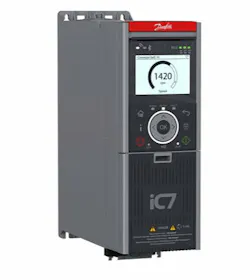
Explaining how the companies are addressing cybersecurity at the device level, Conboy pointed to the Danfoss iC7-Automation drive family as the industry's first secure-by-design drive solution. These units incorporate hardware crypto chips that safeguard firmware and ensure end-to-end encrypted communication.
Additional security features of the drives include selectable communication protocols, standard SIL3-rated safe torque off functionality and tamper-resistant hardware construction.
More motion control coverage from Automation World:
About the Author
 David Greenfield
 Leaders Logo
Leaders relevant to this article: