Large World Models & Software-Defined Automation: A Schneider Exec's Look at the Future
Key Highlights
- Data centers are super important because they allow us to run our AI models.
- This is a frontier development.
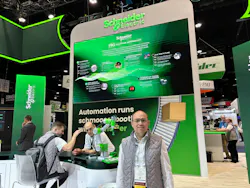
The booth looked like Oz, all shimmering green and towering, populated by uniformed experts from Schneider Electric exhibiting their new solutions and talking trends. Schneider is a staple here at the annual Automate show, a global leader in all things automation, and earlier this year in Chicago we sat down with their Andre Marino, senior vice president of industrial automation, to discuss physical AI, software-defined automation, and the evolution of large world models.
Andre is not a wizard, of course, but he’s a true thought-leader on the near future of automation. Take a look…
Automation World: Let’s address one of the hot topics in the world of industrial automation: software-defined automation. How are you working in this space?
Marino: I will start with the open word, which often neglected when people talk about software-defined automation. When we talk about open software it means how we decouple hardware and software in a way that gives more freedom to the end users.I think it's a fundamental word, otherwise we’d have the continuation of silos, right? If you keep siloed and stay in a closed word, you’re putting yourself in a bad position.
One of the fundamental industry problems right now is being locked into one vendor. AI is helping to resolve that—here’s my Rockwell code but I want it in Schneider, language, or in some open software, and you can just translate it, which is a really big help. We believe the future of automation will be way more open than it is today.
There’s a labor problem right now. But think if you have an open software approach, the appeal of that is huge to the labor market, who can use modern IT languages to program systems. You can attract new pools of talent—they're out there, looking forward to working with this new technology, particularly in the physical AI space.
Everything we are doing now is with the concept of decentralized controls, and embedding AI, as close as we can, to where the physical thing is happening, so we can bring intelligence to the unitary level, and then we can orchestrate at the plant level.
AW: How are data centers propelling these initiatives?
Marino: Data centers are super important because they allow us to run our AI models. They consume a lot of energy, of course. We need to solve the equation of power-hungry data centers and everything that's developing around them. We currently have applications actually running right in data centers. They are a catalyst because they are pushing the whole industry, saying, “Hey! We are coming with the AI technology.” That is harder to make happen in a manufacturing site.
AW: And how does the concept of large world models inform this approach?
Marino: You have that capacity to learn. Then you can orchestrate. Think about agents in the future, running autonomously, right? The ability of the connection here is super important.
But it’s not based on language. It’s a spatial problem. If you have a humanoid that cannot understand the space, and you think that a model that's based on language will solve that, you’re wrong. It's a different animal.
There's a concept called large world models. World…like the globe. Like the space we live in. It’s an attempt to digitize the physical aspects of the place we live in, the 3D, the spatial. Imagine if I push someone, I know the consequences when I'm doing this. Language cannot understand consequences.
In order to develop that type of technology, you cannot just use a language model. This large world model is the spatial version. A physical AI. It's where you get the spatial understanding, and you create a model in which you can simulate your spatial understanding.
The large language models serve a very nice purpose, but there's a confusion on how far we can get when you're talking about humanoids or self-driving cars, because then there's spatial problem. That's completely different.
These are really just developing. That's a frontier development, right?
About the Author
 Chris McNamara