Why Even the Most Automated Factories Still Need the Human Touch
Key Highlights
- Fully automated "lights-out" factories are gaining traction in high-volume manufacturing, but they thrive only in stable, repetitive processes, leaving complex, judgment-driven tasks still dependent on human oversight.
- The real risk of removing humans from the loop isn't inefficiency, it's rigidity as autonomous systems struggle to adapt when conditions change or unexpected challenges arise.
- A hybrid model that selectively automates routine work while retaining human accountability for consequential decisions offers the most resilient path forward for manufacturers.
Autonomous production is by no means a new idea. Going back as far as Homer’s “Iliad,” Hephaestus’ Mount Olympus workshop is described as one with automated bellows and autonomous golden handmaidens, all of which operate independently and react to the smith’s commands. Centuries later, early waterwheels and windmills automated real-world milling and irrigation tasks across the pre-industrial world.
The question of what machines can do for us — and what they may eventually do without us — has fascinated humans for centuries. It’s a sentiment that has driven some of the most impactful technological and social advancements of our history, from the Industrial Revolution to the birth of the personal computer. And it’s especially relevant to manufacturing where fully automated operations are increasingly discussed by industry leaders. In a time when artificial intelligence (AI) and automation are advancing rapidly, the tension between humans and machines feels more present than ever.
One particularly striking example of this tension can be found in Philip K. Dick’s 1955 novelette “Autofac,” in which he explores the idea of completely autonomous factories operating in a post-nuclear-war future. These factories use automated machinery to mine raw materials, produce goods and deliver them to surviving communities. But as society recovers, humans are unable to adjust factory output to suit their needs, turning an efficient and self-sustaining invention from a blessing into a burden.
Though this scenario in “Autofac” is fictional, in a world where we see autonomous technologies increasingly being deployed, some of the story’s lessons ring true. And as we get closer to fully automated operations in industries like manufacturing, healthcare, transportation and financial services, the underlying question remains the same: Where do humans fit into a world of increasingly capable machines?
Understanding the scope of “lights-out” manufacturing
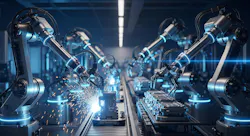
The modern real world equivalent to “Autofac” is “dark factories” or “lights-out” manufacturing facilities. These highly or fully automated production centers are powered by industrial robotics, AI models and machine learning (ML) solutions, manufacturing goods with minimal or no human presence. These operations are so self-sufficient that they can be run in complete darkness, hence the name.
Identify processes where autonomy adds value while maintaining adaptability. Automation of these repeatable and low-variability tasks will help improve overall efficiency and productivity without limiting responsiveness.
Dark factory concepts have piqued the interest of tech-forward manufacturers. They are most visible in specific high-volume, low-variability cells and lines — particularly in hubs such as China and Japan — as well as in more specialized and repeatable production processes. For example, The Wall Street Journal reports that some highly automated automotive plants in China produce dozens of electric vehicles (EVs) per hour, maintaining high productivity while lowering labor costs.
The technologies that enable dark factory concepts, such as industrial robotics, the industrial Internet of Things (IIoT), AI/ML and machine vision, continue to grow globally, and many leaders are exploring how far they can extend automation beyond individual cells.
Even with this momentum, the core debate remains: Should full automation be the goal or is it just a piece of the larger puzzle?
The limits of fully autonomous machines
There's no doubt that automation is an incredible lever for both scale and efficiency, especially in manufacturing. And it’s important to remember that automation thrives in conditions that are stable, repetitive and predictable.
Unfortunately, not every process has these characteristics, especially in U.S. manufacturing. In the U.S., greater product customization, shorter production runs and evolving regulatory requirements often favor human-in-the-loop models over fully automated approaches.
Even the most advanced systems still struggle with these kinds of dynamic tasks without human oversight.
Take the food and beverage industry, for example. The bottling process for a soft drink is highly repeatable and likely to have low variability, making it a prime candidate for smart machinery.
But what about food safety testing or handling an urgent recall? These situations require judgment, traceability and real-time problem-solving to link batch genealogy, isolate impacted lots, coordinate with regulators and communicate recalls. Such activities still benefit from human oversight.
Even the most advanced systems still struggle with these kinds of dynamic tasks without human oversight. And this is true when talking about automation beyond the factory floor, such as in customer service, finance, healthcare and creative work. In all these cases, automation can handle the routine but tends to falter when faced with nuance or ambiguity.
An argument for the human element
While “lights out” may be a niche concept to those outside of the manufacturing industries, it’s reflective of a much larger conversation happening across the business landscape. The temptation to remove humans from the loop is real. After all, who wouldn’t want a system that runs constantly and always hits its programmed targets?
The issue, however, lies in variability. Adopting full automation without a strategy risks sacrificing resilience for rigidity by removing the human capacity to reason, prioritize and improvise on the fly. Creating a blend of machine precision and human judgment helps to balance these priorities, simplifying work without limiting adaptability.
That’s why a hybrid manufacturing model — one that involves humans and automation — is likely to be the most successful approach to production in the near future. Whether in manufacturing or otherwise, a strategic approach to automation that balances streamlined processes with human oversight is going to create the most reliable foundation for future advancements.
Leaders who want to maximize their technological adoption while setting their teams up for continued success will:
- Automate selectively, not completely. Identify processes where autonomy adds value while maintaining adaptability. Automation of these repeatable and low-variability tasks will help improve overall efficiency and productivity without limiting responsiveness.
- Retain human accountability for consequential decisions. Machines can monitor, measure and even suggest data-driven solutions to important questions. However, the final judgment call should remain with informed humans.
- Invest in training and digital skills. Train your workforce to collaborate with machines, not be intimidated or overshadowed by them. This involves upskilling, cross-training and embedding digital tools into humans’ day-to-day work.
- Design for flexibility. Always plan for exceptions. When the unexpected occurs, things like feedback loops and pathways for human intervention will make for a more timely and effective response.
Where full autonomy still falls short
The problem with the fiction of “Autofac” and real-world lights-out manufacturing isn’t the machines’ autonomous capabilities. These have proven to be more than effective at the work they’re programmed to do. Instead, the problems arise from a lack of human agency. When conditions change and require machines to pivot, systems are unable to effectively adapt to new human needs.
There’s no indication that today’s “lights-out” systems autonomously remove humans from critical oversight, but the message remains: removing human judgment too early risks sacrificing resilience.
By finding the specific areas of production best suited for automation and keeping human workers appropriately trained to operate and maintain these solutions, manufacturers can sustain a better, more productive balance between efficiency and reliability.
More autonomous technology insights from Automation World:
About the Author
 Eddy Azad
Eddy Azad
Eddy Azad is CEO of Parsec Automation.