Why Industrial Augmented Reality Pilots Failed To Scale — And What Has Changed
Key Highlights
- Initial AR pilots succeeded in demonstrating value but struggled to scale due to high content preparation costs and hardware limitations.
- Transitioning from registration-based recognition to recognition models reduces setup time and improves scalability across diverse equipment fleets.
- Emphasizing real-time telemetry and open data interfaces enhances AR's relevance and reliability in industrial maintenance tasks.
- Handheld devices often outperform headsets in cost and lifecycle, but headsets are essential for tasks requiring both hands and gaze control.
- Building workflows around many assets rather than individual machines is key to overcoming economic and operational barriers in industrial AR deployment.
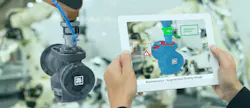
A few years ago I led an augmented reality exploration across a family of industrial process instruments. We turned equipment CAD into interactive 3D you could open up and walk around, ran it on wearables and on ordinary phones and tablets, and pushed live measurements out of the cloud onto the hardware itself. It went the way most of these went.
The demonstrations worked. Technicians liked them. You could see the training and troubleshooting value inside five minutes. Across the industry the pattern was remarkably consistent: take one high-value asset, build an experience around it, show it to a room of executives, collect the enthusiasm.
Then start on the second asset, and find out what the first one really cost.
The pilots did not fail. That is the part worth sitting with. The technology delivered what was claimed for it. What broke was the step from one machine to two hundred.
Post-mortems mostly blamed hardware — too heavy, field of view too narrow, battery too short. All of it accurate. None of it the reason.
The authoring cliff
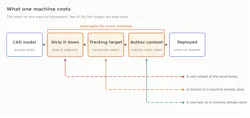
Here is what standing up an experience for a single piece of equipment took, in the pipeline that dominated the last decade.
It starts with CAD, and for industrial equipment that part is easy: the model is already there. The difficulty is the form it is in. Tens of thousands of parts, tolerances, internal routing that no real-time renderer on a handheld can carry. So you convert it and strip it down. Some of that is automatic. The rest is a person sitting in a tool for days, deciding which brackets and fasteners mean something to the task and which are clutter.
Next you prepare a tracking target so the application can identify the hardware in front of it and lock the graphics onto it. Vendor guidance was candid about the demands: scale had to match the real object, the geometry needed enough edges to be picked out reliably, and it had to look different enough from whatever else lived in the same database. Training ran in the cloud and took hours for a database of several objects. Keep a database small, the documentation said, or load times and device memory start to bite.
Then comes the content—which callout hangs on which component, what order the steps reveal in, what triggers each one. This is the visible part, the bit that resembles a product, and for that reason the bit routinely mistaken for the whole of the work.
Then somebody notices that the machine in the yard is a later revision than the model you built against, and a slice of the work goes round again.
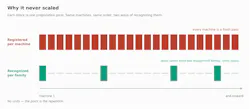
Now multiply. A fleet is not a set of identical machines. It is a handful of equipment families; inside each family, variants; inside each variant, twenty years of accumulated revisions. Almost none of the preparation carries across any of those boundaries, because what you prepared was one specific machine.
The first asset took us weeks. A fleet would have taken months. That is how I remember it rather than a figure anyone was recording at the time, and the shape is what matters: that arithmetic shut down more industrial AR programs than any headset ever did.
What makes it a trap is that it stays invisible exactly when the decision is being made. A pilot pays the setup cost once, for one machine, and comes back with something that works. The cost of machine number two is the first figure that tells you anything at all about a fleet, and hardly anyone measures it.
What changed
Two developments have started pulling out the per-asset registration step, which is the expensive one.
Recognition instead of registration. Vision models that identify equipment straight from a camera feed change the question. It stops being, "Has this particular asset been enrolled?" and becomes, "Can the model tell what it is looking at?" A technician aims a device at a valve manifold and the application knows what it is, with nobody having prepared that specific manifold beforehand.
Preparation does not disappear. The model still has to learn your equipment taxonomy, and teaching it with real photographs of your real hardware is honest work. What moves is the thing that work is proportional to: families of equipment, rather than machines one at a time. A different curve, and the curve was the entire problem.
Capture instead of modeling. Photogrammetry and the newer radiance-field methods let you capture a space by walking it with a camera and coming away with a usable spatial representation, no clean CAD required. On a brownfield site this counts for more than it sounds. The drawing describes what the plant was built as. The plant itself has been modified since, sometimes decades ago, frequently with nobody updating anything.
Both are current and both are green. Recognition accuracy on industrial hardware in poor light, at awkward angles, sitting beside something that looks nearly identical, is not solved. Reconstruction quality rides on capture discipline. Treat them as grounds for reopening the question, not as a capability you can buy finished.
The device question, honestly
Headsets get the attention. For most maintenance work the handheld wins, and the reasons have little to do with optics.
|
What decides it |
Head-mounted |
Handheld |
|
Hands free |
Yes |
No |
|
Gaze directs the system |
Yes |
No |
|
Cost per technician |
High |
Low, often already issued |
|
Hazardous-area approval |
Thin approved list |
Established approved products |
|
A full shift of wear |
Fatigue is real |
Goes in a pocket |
|
Worn over PPE |
Often awkward |
Not a factor |
|
Product longevity |
Models withdrawn mid-life |
Many suppliers, easy to replace |
|
IT support |
A new device class |
The existing mobile estate |
For most maintenance work the handheld wins on cost, certification and lifecycle. The headset wins where the job needs both hands and the technician's gaze.
For most maintenance work, the handheld wins on cost, certification and lifecycle. The headset wins where the job needs both hands and the technician's gaze.
Two of those rows deserve a word.
Hazardous-area certification is not a procurement footnote. Anything carried into a classified location needs certification for that location, and the approved list of head-mounted products is thin. A pilot run in a conference room will never turn that up. A pilot run where the work actually happens turns it up on the first morning.
Product continuity is the other. Google closed Glass Enterprise Edition sales in March 2023, support finishing six months later. Microsoft has since wound down HoloLens 2 production. Those two were the enterprise wearables available to us at the outset. Process equipment runs for decades — bolt a maintenance workflow to a single headset and you have quietly taken on that product's roadmap as your own.
None of which means headsets lose. Where a job truly needs both hands free and the technician's gaze pointing the system—wiring out a panel, guided assembly, work in a confined space—a headset does something no tablet can, and it earns the choice. That case is genuine. It is also narrow, and most maintenance work does not sit inside it.
The part that makes it worth doing
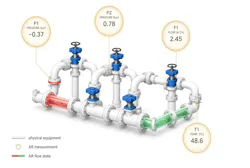
A fixed label hovering over a machine is a page from the manual, staged more elegantly. The change arrives when you render what the equipment is producing right now—pressure, temperature, flow state, valve position, alarm condition—on the component producing it.
That is an edge architecture problem far more than a graphics one. The application needs a live route to equipment telemetry, which in practice means a REST or MQTT interface into the same edge layer already feeding the operator HMI. Where that interface is already in place, AR joins the queue of things consuming it. Where it is absent, you are now building one, and the bill for that tends to land against the AR project—which is a large part of how AR earned its reputation for costing too much.
It also has to fail in the open. Lose the link and no technician should still be looking at a reading from yesterday. If the software cannot pin down which revision is in front of it, the right behavior is to stop offering component-specific steps and hand back the ordinary procedure. What you are looking at is a display layer. It cannot certify the number behind it, and it cannot certify the job in front of it.
What is worth building now
Four things, given that the enabling technology is moving and anything built this year will look dated quickly.
Start with the data path, not the visuals. A clean telemetry interface pays for itself whether or not the AR program survives, and everything else hangs off it.
Go handheld first. Lower cost, easier certification, already in people's pockets — and the workflow ports to a headset later if the hands-free case proves out.
Prefer recognition over per-asset registration, even at some cost in accuracy, because registration does not scale and you will find that out at asset thirty rather than asset two.
Build one workflow across many assets, not many workflows on one asset. That inverts how nearly every pilot was scoped, and it is the only scoping that tests the thing that actually killed them.
Worth a second look
The fatigue around industrial AR is fair. Money went in, demonstrations came out, and not much of it reached the routine work. Nobody should be embarrassed about being skeptical.
But what stalled it was a content cost that climbed with the size of the fleet, and that has nothing to do with what the picture is shown on. The workflows held up. The technicians wanted them. If the economics were the problem, the economics have moved.
About the Author
 Sathappan Alagusundaram
 Sathappan Alagusundaram
Sathappan Alagusundaram is a systems architect at SLB, with twenty years building control, IoT and human-machine interface systems for industrial process equipment. He led the augmented reality exploration described in this article, which involved headsets and handhelds, and live equipment telemetry rendered on the components producing it. He is based in Sugar Land, Texas, and can be reached at linkedin.com/in/sathappanalagusundaram.
 Leaders Logo
Leaders relevant to this article: