Physical AI Brings Machine Intelligence And Atomistic Materials Simulation Together
Key Highlights
- Physical AI connects machine-level operations with atomic-scale material behavior, enabling comprehensive insights for industrial applications.
- AI-driven atomistic simulations, like MLIP, allow researchers to explore a broader range of material candidates efficiently, guiding experimental efforts more effectively.
- Accelerated computational methods have reduced catalyst discovery times from years to months, demonstrating significant industrial impact.
- Integrating simulation results with laboratory automation and real-world testing helps refine material choices and optimize manufacturing processes.
- Focusing on specific performance requirements enables targeted material research, improving decision-making and resource allocation in industrial development.
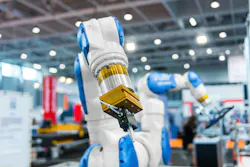
Imagine an autonomous mobile robot carrying components across a factory. Its software helps it navigate around workers, avoid obstacles and find an efficient route. How long it can keep moving between charges also depends on the battery inside it. Improving that battery requires understanding what happens at a scale no factory camera can see—it takes the engineering problem down to the movement of ions through a material.
Physical AI connects these two engineering challenges. At the machine level, AI helps equipment perceive its surroundings and act. At the atomic level, AI-driven simulation helps researchers investigate the materials that influence what that equipment can do. Bringing both into view reveals opportunities to improve industrial performance long before a machine reaches the factory floor.
In his writing on physical AI, Daisuke Okanohara distinguishes the macro scale of machines from the micro scale of atoms and molecules. AI-driven atomistic simulation gives researchers a way to investigate that micro scale before committing to synthesis and testing. For manufacturers, its value comes through in practical questions about which materials to investigate and which experiments to run.
Deciding which experiments are worth running
Materials researchers routinely face more possibilities than they can test. Changing a composition or the arrangement of atoms can alter a material's behavior, creating many candidates to investigate. Each laboratory experiment consumes time and resources, so deciding what to make next is a consequential engineering choice.
Computer simulation has long helped inform those decisions. Quantum mechanical methods such as density functional theory can describe atomic interactions in detail, but their computational demands limit the size of systems and duration of behavior researchers can afford to study. A team may have to narrow its search before it has explored many of the possibilities.
Machine learning interatomic potentials (MLIP) make a broader search practical. These models learn from quantum mechanical calculations to estimate energies and forces for arrangements of atoms. Researchers can use those estimates to simulate atomic motion and interactions much faster than repeatedly performing the underlying calculations.
For a battery electrolyte, that can mean investigating how readily lithium ions move through a candidate structure or formulation. The results can help researchers compare candidates and understand the mechanisms behind their behavior. They can direct laboratory work toward promising possibilities and investigate why others fall short.
The reasoning will be familiar to engineers who use virtual commissioning. Exploring a design in software helps them identify problems before committing to physical equipment. Atomistic simulation brings a similar advantage to materials development. Researchers still need to establish where a model's predictions are reliable, but they can approach an experiment with a more specific hypothesis about what will happen and why.
Making room for a wider search
Catalyst development shows what that change can mean at industrial scale. A catalyst's composition and atomic structure influence the reactions it can facilitate. Searching across those variables creates far more possibilities than a laboratory could reasonably synthesize and evaluate one by one.
In work announced in September 2026, ENEOS evaluated approximately 100 million candidate structures for oxygen evolution reaction catalysis, needed for hydrogen production from water electrolysis. AI-powered atomistic simulation and accelerated computing helped identify priority candidates for synthesis and experimental validation. The announcement reported that a discovery process traditionally taking years had been reduced to a few months.
The immediate achievement was a computational search that produced candidates for physical testing. Establishing their usefulness still requires experiments, including evaluating performance and durability under relevant conditions. Manufacturing feasibility and cost will also shape which candidates can progress toward industrial use.
For manufacturers, the value lies in how this changes the use of scarce experimental capacity. A team can explore a wider range of structures before choosing which to make. Laboratory time can then be spent investigating the most promising candidates and resolving uncertainties that simulation has exposed. Faster computation improves the information available at the point where a researcher commits to an experiment.
Experimental results can then guide the next round of research, with laboratory automation helping teams gather that evidence. At MIT, the CRESt platform combines AI-guided experimental planning with robotic materials synthesis and testing, feeding results back into its models to inform subsequent experiments. For teams using atomistic simulation, the same principle matters: measured results help establish which predictions hold up, where further investigation is needed and what to test next.
Start with a performance requirement
Manufacturers can put this approach to work by identifying a materials question tied to a specific requirement. If a coating fails in a process environment, what mechanism needs investigation? If battery performance limits a product, which material property might help address that constraint? These questions give materials specialists a basis for deciding whether atomistic simulation can inform the next engineering decision.
Teams should also agree on the evidence needed to advance a candidate. A model useful for screening may need support from additional quantum-mechanical calculations and targeted experiments before researchers can trust its predictions for a particular application. Operational engineers and materials specialists should define relevant conditions together, keeping manufacturing requirements in view throughout the search.
For the mobile robot, a longer-runtime requirement can lead to changes in navigation software, equipment design or battery materials. Simulation helps materials researchers assess their options before committing laboratory time. Bringing those researchers into the engineering discussion early gives them a clear performance target—and gives designers better evidence about which materials could help them reach it.
About the Author
 Joshua Young
Joshua Young
Joshua Young is a senior application scientist at Matlantis. He is a computational materials scientist whose research combines materials informatics and atomistic simulations to design new materials and understand their properties. His work spans materials for energy and nanoelectronic applications, including batteries, catalysis, two-dimensional materials and ferro- and piezoelectric devices.
 Leaders Logo
Leaders relevant to this article: