Big Show, Bigger Ideas: Thoughts from Automate 2026
Key Highlights
- Connectivity is critical in the modern industrial-automation strategy.
- Physical AI is going mainstream.
- Go small or go home!
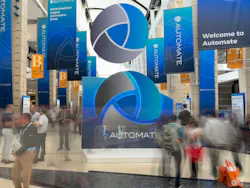
Wow, this show is big.
And the size of this week's Automate 2026 show in Chicago—with endless aisles of exhibitors and slickly produced presentations and 50,000 attendees and enough robotic arms whirling through the air in the exhibitor halls to make you feel like you’re at a cheerleader convention—is an indication of how big industrial automation really is.
“It wasn’t long ago automation felt like the future,” boomed the voiceover as the kickoff keynote presentation got underway. “Today it is proven. It is real. It is everywhere.”
And Chicago was the epicenter this week. Exploring the massive show floors and speaking with dozens of exhibitors ranging from global automation leaders to scrappy startups, a few themes emerged. Let's explore...
Connectivity is critical—While the disparate tools and techniques at play within industrial automation are vital to success, of course, the connectivity of those disparate elements is a deciding factor in the success or failure of modern automation strategies. Autonomous vehicles must properly connect to the robotic arms attached to them, which must properly connect to the warehouse network, which must be properly connected to the supply chain, which must connect fully with the human workforce, etc. Artificial intelligence is empowering this full connectivity. Industrial enterprises are having varying degrees of success achieving it.
Software-defined automation—This emerging approach is on the tip of many tongues. In short, software-defined automation decouples OT software from OT hardware to enhance flexibility, scalability and integrated control systems. Here at Automate it is celebrated by solution providers and sought out by manufacturers.
Humanoid robots—Why should robots resemble humans? That question is being pondered, with the benefits of humanoid robots and the limitations being weighed against one another. Resisting our attraction to robots that look like we look, mused Intrinsic CEO Wendy Tan White during the opening panel, we should rather consider the appropriate form for the appropriate industrial tasks. That old notion of “form follows function” holds true in this digital age, it seems. White asked of the full ballroom seated before her, “Why would the future follow the way human beings are formed?”
Cool question. It was followed by a directive. “The time to build is now,” boomed that voiceover during the kickoff keynote. “Welcome to Automate!”
And those robotic arms whirled in excitement.
The mainstreaming of physical AI—The notion of AI operating in the physical space is coloring many conversations here. In short, AI is directly directing robotic arms or autonomous mobile robots...quite a leap from the AI that exists merely in the digital space. This is a spinning/lifting/traveling version of AI that emerges from behind the computer screen and rolls up its proverbial sleeves.
Nimble, adaptable robots—Industrial robots have long been able to perform advanced tasks, but modern robotics hardware and software providers are supercharging functionality with robots that can truly, rapidly adapt to changing environments. Advancements with error-recovery are huge, noted one robotics rep, while nearby a robotic arm delicately assembled a multi-fold cardboard box.
Human / AI / robot alignment—Applications of artificial intelligence are diversifying in the ways that AI can partner with and empower human workers. Here is a solution-provider using AI to coach plant workers on optimal techniques. And here is another one offering AI-equipped pattern-recognition to develop deeper data sets.
“We’ve got to stop treating people like robots.” That quip came from a solution-provider who automates the welding process. What he means is that many industrial processes (such as fusing together two pieces of metal) are better suited to being performed by robots than by you or me. Robots can perform these tasks more accurately, and human workers don’t suffer the blown shoulders and eye-damage that a career as a welder often entails.
It was an interesting take on one aspect of the automation revolution that is on full display here at Automate, where exhibitors spotlight the unique capabilities of their products and the untapped potential for the humans who take advantage of them.
Go smaller—Manufacturers of digital components are in a miniaturization race, shrinking their products as small as possible to squeeze inside already crowded motors or robots or submarines. Smaller servo drives, for example, also generate less heat, which requires fewer cooling elements, which also saves space. Go small or go home!
More intelligent testing—AI is increasingly being used in testing and measuring applications, as noted by many on the exhibitor floor, providing more accurate results and freeing up resources for other tasks.
Sharper vision—Product inspection is getting faster, more detailed, and human-free, courtesy of emerging automated systems that scan, for example, complex assemblies with multiple welds in one single view, rather than requiring inspection teams to aggregate multiple scans. The results are clearer views of products, which enables more accurate flagging of faults.
“Industrial painting is a lousy job. People don’t want to do it,” added that welding-solution provider quoted above, highlighting another application of his product, and another task that makes perfect sense to hand off to our automated counterparts.
About the Author
 Chris McNamara
Chris McNamara
Automation Group Market Content Director
 Leaders Logo
Leaders relevant to this article: