How Robotic Laser Welding Delivered 400% Productivity Gains Over Manual TIG at West Coast Manufacturing
Key Highlights
- Increased production from 10-30 parts to 45-60 parts per hour using dual-station collaborative welding setup with operator and robot.
- Eliminated warping issues and post-weld straightening requirements that plagued thin-wall stainless steel components during TIG welding process.
- Reduced workforce needs while improving weld consistency and quality, solving the company’s issue with rising labor costs and scarcity challenges.
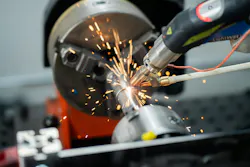
Manual GTAW (gas tungsten arc welding), also known as tungsten inert gas (TIG) welding, has long been the go-to process for precision work, but it's slow, labor-intensive and difficult to scale. Laser welding offers a faster alternative with minimal heat input and excellent aesthetic results. And when you automate it with robotics, the gains multiply exponentially.
West Coast Manufacturing (WCM), a CNC machine shop serving the commercial dishwasher industry in the U.S. and Canada, recently switched from manual GTAW to robotic fiber laser welding. As a result, WCM increased its productivity four-fold and significantly improved the entire process, from post-weld processing and product quality to a reduction in skilled labor requirements.
Challenges of manual GTAW
Manual GTAW/TIG welding is still used for a good reason. Despite being notoriously slow, it produces high-quality welds and offers excellent heat control in skilled hands. But here’s the catch: it demands expertise that's increasingly expensive and hard to find.
Here's what makes manual TIG a productivity bottleneck:
- Low travel speed: 7-10 inches per minute.
- Significant skilled labor dependency: relying on an increasingly scarce labor pool.
- Heat control paradox: TIG offers precise heat input, but only in highly skilled hands. Otherwise, it’s easy to overheat, distort, oxidize and discolor materials, especially exotics.
- Shielding gas sensitivity: Stainless steel, nickel alloys, titanium and other exotic materials require flawless gas coverage.
- Prep work: Unforgiving material cleanliness requirements.
- Post-weld processing: Grinding, finishing and electropolishing.
- Challenging to automate: TIG is more difficult to automate with robotics compared to GMAW (gas metal arc welding)/MIG (metal inert gas) or laser welding.
Manual TIG still has its place for low-volume, high-mix work where flexibility trumps speed. But when alternatives are an option, the economics of TIG rarely make sense. However, many of the same challenges apply to automated TIG welding. While using robotic TIG improves speed and quality, the TIG welding process remains the bottleneck.
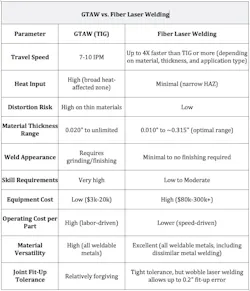
Why WCM chose automated laser welding over GTAW
After facing significant labor, quality and throughput bottlenecks, WCM automated its welding cells with robotics. However, they didn’t just automate their existing TIG process as most manufacturers would. Instead, they rethought the entire process and applied robotics with the more suitable welding process — laser welding.
Key achievements with this process included:
- 400% productivity boost.
- Introduced dual-station welding (operator with a robot).
- Went from 10-30 parts to 45-60 parts per hour.
- Improved consistency.
- Reduced rework and defects.
- Eliminated or reduced the need for post-weld processing.
- Lowered labor requirements and reliance on highly skilled welders.
“The initial reason for automation was the labor problem in California — rising costs and finding people willing to do redundant jobs,” said Patrick Hundley, president at WCM.
Do you genuinely need to automate the same process you do manually? Would you benefit from rethinking the entire process, including the auxiliary tooling and systems?
Like most manufacturers, WCM struggled with these labor challenges, which limited their production capacity. However, in 2020, welding became the biggest bottleneck in the company’s operations. That’s when WCM realized it needed to have a robotic welder.
“We had quality issues and we had production issues. And then when our work began to double and even triple, [we realized] it would have taken 15 welders to do the work,” Hundley noted. “When we learned about the robotic laser concept, we could see that it could knock that labor requirement in half.”
This wasn’t WCM’s first experience with laser welding or robotic welding. The company already had a robotic laser welder, but the supplier didn’t provide support to work through the implementation challenges.
Despite this, what drove WCM’s reassessment of laser welding was seeing how consistent and precise laser welding can be versus TIG welding.
“Smaller diameter parts with thinner wall materials had a lot of warping with TIG because of the heat,” said Bryan Montez, plant manager at WCM.
Not only did robotic laser welding prove to be significantly faster than manual or robotic TIG, but it also enabled WCM to eliminate post-welding straightening of warped parts. Plus, robotic laser welding allowed the company to maximize the speed capability of laser welding, as well as control heat input and achieve precision welds beyond what a human could do.
Collaborative welding setup
With support from THG Automation, WCM implemented robotic laser welding in a dual welding station to maximize productivity from the robot and their operators. Human-robot collaborative applications can significantly improve productivity for high-mix, low-volume jobs. Here, humans perform the hard-to-automate tasks, such as loading and unloading parts into fixtures, while robots weld them, ensuring high quality and eliminating human error where it matters the most.
WCM didn’t just automate their existing TIG process as most manufacturers would. Instead, they rethought the entire process and applied robotics with the more suitable welding process — laser welding.
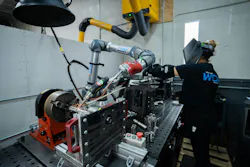
“We have two welding tables, which gives us a 4-ft x 8-ft footprint with a robot sitting in the middle,” Montez explained. “We are able to work on multiple fixtures on the table. Our operators can load one fixture, hit a button and get the next operation ready to go while it’s welding the previous one.”
Automating the right process
Before automating manual TIG welding with robotic laser welding, WCM had already automated its TIG welding with robotics. In the process, WCM realized that, while use of robotic TIG welding made sense for certain parts, thicknesses and materials, it was inefficient for others.
This kind of understanding about automation is important when determining if you are trying to automate the right processes and steps for your applications.
For example: Do you genuinely need to automate the same process you do manually? Would you benefit from rethinking the entire process, including the auxiliary tooling and systems?
This is why it’s worthwhile to think about the process from the bottom up prior to any automation installation. With welding processes, key factors to consider include:
- Fixturing practices.
- Welding process.
- Part geometry and material selection.
- The way you approach the part for welding.
- Weld sequence, spacing and weld size.
- Additional hardware, such as positioners.
- Safety.
- Quality control.
You’ll find that a more strategic approach based on this type of analysis lets you get far more out of automation than just having a robot take over manual processes. Don’t leave additional productivity and quality on the table by simply automating old manual processes. The difference between “what’s possible” and “what you get” can be staggering. Strategically consider your options and you can increase your throughput by 400% or more, just like WCM did.
More robotics coverage from Automation World:
About the Author
 Matt Hendey
Matt Hendey
Matt Hendey is CEO at THG Automation, a system integrator focused on welding automation.
 Leaders Logo
Leaders relevant to this article: