A Look Back at Automate 2026 & a Look to the Future of American Automation with the President of A3
Key Highlights
- Physical AI and humanoid robots were among the dominant themes at Automate 2026.
- Safety remains a critical focus, with ongoing efforts to develop global standards for humanoid robots working alongside humans.
- A3 advocates for a national robotics strategy to enhance U.S. competitiveness.

Jeff Burnstein, president of Association for Advancing Automation (A3), has spent decades helping shape the domestic robotics and automation industry. He also runs the annual Automate show that in late June welcomed 50,000 attendees and more than 1,200 exhibitors to Chicago.
We let Jeff catch his breath for a few days, then sat down to discuss the evolution of industrial automation on display at his show, emerging trends such as physical AI and humanoid robots, and why the United States desperately needs a national robotics strategy.
Take a look...
Automation World: You’ve got a unique, over-arching view of this event. What were the dominant themes at Automate 2026?
Burnstein: Physical AI and humanoid robots were certainly among the biggest topics. We also heard a great deal about collaborative robots, connectivity, software-driven automation and safety.
Safety was especially important. Since developing the first American National Robot Safety Standard in 1986, A3 has been heavily involved in safety initiatives.
Right now, there are no global safety standards for humanoid robots. A3 and other organizations are working on those standards, but we're not yet at the point where humanoids can safely work alongside people in most manufacturing environments. Today, many deployments remain in pilot programs, and where humanoids are in production settings they are often separated from human workers.
Automation World: How is public policy affecting automation and robotics initiatives in the United States?
Burnstein: A3 has been advocating for a national robotics strategy for the past two years, and we're seeing encouraging momentum. There have been legislative proposals introduced, renewed interest from the Congressional Robotics Caucus, and meaningful engagement from policymakers.
However, interest alone isn't enough. Legislation still has to pass, and concepts such as a National Robotics Commission need continued support.
I've been involved in this industry since the early 1980s. We watched Japan establish leadership in robotics, in part because the U.S. lacked a coordinated approach. More recently, China has developed a comprehensive national strategy and has become a dominant force in robotics. South Korea and the European Union also have coordinated strategies. The U.S. is one of the few major players that does not.
Automation World: What would a national robotics strategy accomplish?
Burnstein: Ultimately, it would help the United States become more globally competitive in what we believe is one of the most important technologies of this century.
Part of the strategy involves increasing robotics adoption. Greater automation would support reshoring efforts, strengthen domestic manufacturing and help address workforce shortages.
There are six principles that we outline. We need more adoption in the U.S. We have all these companies announcing that they're going to manufacture in the U.S., but we don't have enough people. And we also don't have enough automation. So those would all be good things.
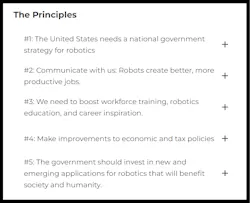
We see many companies committing to manufacture in the U.S., but to make that sustainable we need both people and automation. A comprehensive national strategy would help coordinate those efforts and establish a framework for long-term leadership.
Automation World: What excites you most about the future of industrial automation?
Burnstein: The rapid advancement of AI-enabled machines is incredibly exciting. As robots become smarter and more capable, they'll be able to perform a much wider range of tasks.
That has implications far beyond factories and warehouses. We could see automation helping address challenges in healthcare, elder care, environmental cleanup, housing and even food production. The potential benefits extend well beyond productivity gains.
When I think about the future, what excites me most is the possibility that robotics and automation can contribute not only to industrial progress but also to broader societal improvements.
Automation World: Automate has grown alongside the broader automation industry. How has the show evolved over the years?
Burnstein: The show dates back to the late 1970s when it was primarily a robotics event. Today, by every major metric—attendance, exhibitors and exhibit space—the show is more than ten times larger than it was then.
The exhibitor mix has also changed dramatically. The major robot manufacturers are still here, but now companies such as Siemens, NVIDIA and Schneider Electric are major participants.
The automation industry has become much more software-oriented and AI-driven, and the show reflects that evolution. An exhibitor told me this year's event felt like a step change, like the beginning of a new era for Automate. I think that's right. We're just getting started.
About the Author
 Chris McNamara
Chris McNamara
Automation Group Market Content Director
 Leaders Logo
Leaders relevant to this article: