The Three Bottlenecks Preventing C-3PO's Arrival: Reliability, Dexterity and Data
Key Highlights
- Modern robots prioritize body reliability and task-specific design over general intelligence.
- Vision-language-action models are enabling better reasoning, but physical dexterity remains a bottleneck.
- Reliability beats novelty.

When people picture robots, they often picture C-3PO: a humanoid that can walk, pick up objects and understand what human language.
And for years the assumption was that we needed smarter robot brains. In fact, the brain is now the fastest-moving part of the stack. Our most pressing challenges with robotics have moved into the body: dexterity, reliability and a data problem with no internet-scale shortcut.
The same reordering shows up in drones, autonomous vehicles and factory automation—anywhere AI has to act. Machines that look nothing like C-3PO already do valuable work at scale, precisely because they refuse to be general.
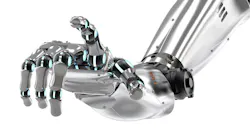
The brain is moving faster than the body
The reasoning layer has moved further than most people realize. Modern vision-language-action models (VLAs), which map what a robot sees and can act upon, borrow their backbones from the vision-language models that power frontier multimodal LLMs. Consider Google DeepMind's Gemini Robotics 1.5, split into two models: an embodied-reasoning model (spatial grounding, multi-step planning, native tool calls) and an action model that issues motor commands.
That split is the tell. A lab ships the part it trusts and holds back the part it doesn't. The reasoning isn't finished, but it's no longer what holds robots back. Even the researchers most bullish on cognition aren't spending their money on the reasoning gap. What stands in the way is getting a body to act on that intelligence with proper precision and consistency, and to be able to learn from the data that emanates from those actions.
Machines that look nothing like C-3PO already do valuable work at scale, precisely because they refuse to be general.
Dexterity hasn't caught up
Human hands have more than 20 degrees of freedom, and coordinating contact-rich manipulation across them is still unsolved at production reliability. Most real-world applications still run on simple parallel-jaw grippers. In-hand manipulation—repositioning an object within a grasp—remains an open challenge.
The same learned policies that pick objects reliably tend to drop toward zero on contact-rich tasks like standing a cup upright or stacking items. The bottleneck is not only the control policy, but the hardware: tendon-driven multi-finger hands break and are hard to calibrate.
Reliability is non-negotiable
Even where the hands are good enough, the bar that gates deployment is not capability. It is reliability. A policy that succeeds 80% of the time is a great demo video. A warehouse or an operating room needs to be measured in nines, across millions of cycles, including the long tail of weird edge cases. The gap between "works in the demo" and "works unattended on the night shift" is most of the actual engineering.
Surgery makes the point cleanly because it isolates the variable. A Johns Hopkins and Stanford team trained a model on about 20 hours of video and had a da Vinci surgical robot autonomously suture and manipulate a needle on tissue.
The intelligence exists. Yet every da Vinci in clinical use stays at Level 0 autonomy, every motion driven by a surgeon, because—on the operating table—failure is unacceptable. Reliability gates deployment in these critical cases, not intelligence.
Data has no shortcut
Unlike dexterity and reliability, data has no internet-scale shortcut. Language models had the internet; there's no equivalent corpus of robot actions. The workaround is the "data pyramid": a little real-robot teleoperation at the top, a large layer of simulated and synthetic data in the middle, and web-scale human video at the base. The scarcity is stark—Physical Intelligence's π0.5 draws 97.6% of its training data from sources other than the robot it is trying to control.
A second data problem arrives the moment a machine ships: operational data, not training data. Training data must be manufactured; operational data is a firehose that never stops. The internet trains the brain; reality trains the body.
The learning loop everyone counts on runs entirely on that exhaust, yet its infrastructure is far less mature than the models it feeds. The teams who treat telemetry as core infrastructure early in the process are the ones not required to rebuild it under load later.
Narrow robots already work
Constrain the task and every bottleneck above gets smaller. The pattern shows up wherever a team has shipped something narrow enough to be reliable.
Warehouses got there first. The lesson of 2025 was that reliability beats novelty. Fully autonomous picking across the entire SKU range is still unsolved at the level that replaces a human picker. But strip out the variability—grocery distribution, pallet handling, sortation—and the same systems scaled faster than almost anyone predicted.
Inspection took the same shortcut in a different dimension. Boston Dynamics has several thousand Spot units patrolling oil platforms, nuclear sites, and factories, each replacing hundreds of static sensors. In April 2026 it integrated Gemini Robotics-ER 1.6 into Spot's inspection software. But the discipline held—when conditions degraded, Spot stopped, documented the obstruction, and pinged a human rather than guessing.
Even the best-funded generalists prove the point. Skild AI raised about $1.4B to build one brain for any robot, yet its early revenue comes almost entirely from narrow deployments: security, inspection, warehouses and construction.
The vision is omni-bodied; the income is single-purpose.
Build for the robot you have
C-3PO is coming, just not first and not soon. The answer now is a capable mind riding a narrow, dependable body. The robots we're actually ready for are already flying over our neighborhoods, running our distribution centers and reading gauges in places that humans prefer to avoid.
The general-purpose robot will come. The real question is what you're building while you wait.
About the Author
Ajay Kulkarni
Ajay Kulkarni is co-founder and CEO of Tiger Data.
 Leaders Logo
Leaders relevant to this article: