Q&A: How New Global Robot Safety Standards Can Impact Manufacturers
Key Highlights
- New robot safety standards add guidance for cybersecurity, AI, and existing robot systems.
- Manufacturers should update risk assessments when deploying or modifying robot systems.
- The upcoming International Robot Safety Conference will help users understand and apply the latest robot safety requirements.
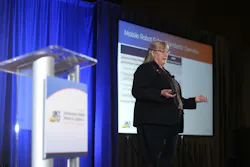
The Association for Advancing Automation is hosting a robot safety conference amid new global robot safety standards, which one leader said can serve as a crucial opportunity for manufacturers to stay informed about how their facilities might be impacted.
The 2026 International Robot Safety Conference will take place Nov. 3-5 in Detroit and will bring together engineers, safety professionals, manufacturers and system integrators to examine robot safety standards and their application in the workplace.
Sessions will address how the new standard, R.1506-2025, will impact established robot installations as well as collaborative applications, mobile robots and emerging technologies, according to A3.
Carole Franklin, the secretary of ISO/TC 299/WG 12 told Automation World about what the updated robot safety standards could mean for manufacturers, as well as what she's looking forward to at the upcoming conference.
Automation World: What do updated robot safety standards mean for manufacturers already using robots?
Carole Franklin: For industrial robot applications ("robot arms"), the revised ISO 10218 Parts 1 and 2, published in 2025 and adopted in the U.S. as ANSI/A3 R15.06-2025, don’t require manufacturers to retrofit existing installations that comply with the previous editions. The 2025 editions become relevant when a new industrial robot cell is designed, or when an existing robot cell is modified, relocated, or redeployed for a new operation, because those types of changes call for a new risk assessment.
Even if you don't plan changes to your industrial robot applications, the standards update is a good prompt to revisit existing risk assessments. Compared to the earlier editions (2011 for 10218, and 2012 for R15.06), the 2025 editions clarify functional safety requirements; folds collaborative application guidance (formerly ISO/TS 15066) into the main standard; and addresses cybersecurity as it affects safety. Users who understand these changes will be better positioned for their next project.
AW: What should they consider before adding new systems?
CF: First, start with the application, not the robot. Safety depends on the whole system: the robot, end effector, workpiece, layout, and how people will interact with it.
Next, a thorough risk assessment early in the project is less costly than redesigning later. Risk assessment should also be understood as an iterative process that is repeated throughout the design phase and through the lifecycle of the system.
And finally, users of industrial robots and mobile robots – often, manufacturers of their own products – should confirm that their integrators are designing new robot applications to meet the current standards. Robot users must also plan for how the system might be reconfigured over its life, and involve the operators and maintenance staff who will actually work alongside it.
For industrial mobile robots, the entire space that is accessible by the mobile robot must be treated with the same care that is given to the design of the industrial robot cell for non-mobile robot applications. ANSI/A3 R15.08, the safety standard for industrial mobile robots, adds facility-level considerations such as traffic, aisles, and shared spaces.
AW: Why is there a need for a Robot Safety Conference?
CF: The [IRSC] is a crucial opportunity for staying informed about the latest safety standards for robotics. It's important to consider how the requirements set out in the standards can be applied in a real facility. The [conference] focuses on teaching attendees what the ANSI and ISO robot safety standards require and how to apply them.
Those standards are primarily ANSI/A3 R15.06 for industrial robots, ANSI/A3 R15.08 for industrial mobile robots, and the safety standards of ISO TC 299, Robotics, the 10218 series for industrial robots and the ISO 13482 for service robots. A3 standards committees take an active role in developing all of these standards, so attendees hear directly from people who work on the standards. The exchange runs both ways: committee members learn where requirements are unclear in practice or where technology is outpacing the text. With the 2025 revisions to ISO 10218 and R15.06 now in effect, that dialogue matters more than usual.
AW: How is this topic changing as robotics matures? Is safety getting better, or trickier?
CF: Both, in different ways. The safety tools available today, including speed and separation monitoring, power and force limiting, and certified safety controllers, are far more capable than they were a decade ago, and robotic automation has a strong safety record. At the same time, robots are being deployed in less structured environments, in closer physical proximity to people, and in more varied tasks. That shifts the focus from guarding a fixed cell toward assessing dynamic applications. The challenge isn’t that robots are becoming less safe; it’s that the range of situations to assess is growing.
AW: How is autonomy changing things?
CF: Autonomy in an automated system means that the machine makes decisions based on what it senses in a dynamic environment. That raises questions about sensor reliability, how the system handles unexpected situations, and how its behavior can be validated.
The gold standard for machinery safety has been "functional safety" for well over a decade. This means that given component or subsystem has been certified to perform as expected over a certain number of cycles. At higher performance or integrity levels, the reliable performance can be expected to last through tens of thousands or even multiple millions of cycles. This reliability has been a crucial foundation-setting capability for human trust in the safety of machines.
Now with machine learning or artificial intelligence, one of the key factors in this new development is the machinery changing how it responds to stimuli over time, as it learns. This is very much a new paradigm compared to functional safety, in which the key trust factor is that people can rely on the system to respond exactly as expected over thousands or millions of cycles. If the system can change how it responds based on what is, essentially, a "black box" of its own learning, where does that leave the repeatability people have come to rely on from functional safety?
To bridge this gap, modern autonomy often requires traditional functional safety 'envelopes' to bound and monitor the unpredictable behaviors of AI. For example, the AI model might be trained in a lab, "frozen" (so its responses become deterministic), tested extensively, and then deployed. Or, a traditional, certified functional safety system (like a laser scanner or safety PLC) is "wrapped around" the AI, such that if the AI makes an unexpected decision, the traditional system can cut the power.
AW: What are you most excited about at the upcoming conference?
CF: I’m looking forward to hearing from end users and integrators who are applying these safety standards with practical use-case examples. It's also great to hear the kinds of questions our audience members ask. This helps our committees working to improve future editions of the safety standards.
I'm also excited to hear about new developments in standards that will become published in the next few years. For example, the new Technical Specification, ISO/IEC TS 22440 that is currently in development, will provide safety requirements for the use of AI in functional safety. I expect this to become a key normative reference standard once published, the way that ISO 12100, ISO 13849, and IEC 61508 are now.
About the Author
Sarah Mattalian
Staff Writer
Sarah Mattalian is a Chicago-based journalist writing for Smart Industry and Automation World, two brands of Endeavor Business Media, covering industry trends and manufacturing technology. In 2025, she graduated with a master's degree in journalism from Northwestern University's Medill School of Journalism, specializing in health, environment and science reporting. She does freelance work as well, covering public health and the environment in Chicagoland and in the Midwest. Her work has appeared in Inside Climate News, Inside Washington Publishers, NBC4 in Washington, D.C., The Durango Herald and North Jersey Daily News. She has a translation certificate in Spanish.
 Leaders Logo
Leaders relevant to this article: