Cobots And AMRs: Streamlining Flexibility And Accuracy In Industrial Workplaces
Key Highlights
- Cobots on AMRs add mobility, flexibility, and precision to manufacturing tasks.
- Integrated systems can improve machine tending, material handling, and palletizing.
- The technology helps manufacturers boost productivity and address labor challenges.
Automation is being embraced at higher rates than ever in industrial workplaces. Advanced technologies and solutions are being widely adopted with a strategic goal of operational excellence to meet high consumer and market demand.
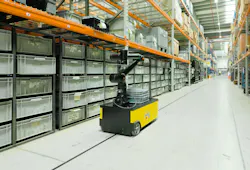
Among these automated concepts being integrated in manufacturing are collaborative robots (cobots) mounted on autonomous mobile robots (AMRs). These small but mighty cobots are some of the most compact solutions on the market, with the controller integrated into the base. This results in a reduced need for an external controller, improving precision and productivity as a cobot’s flexible, precise arm movements handle high payloads with maximum repeatability. These compact cobot designs that run on direct current (DC) power from the AMRs can make a great fit for mobile solutions.
Extended reach and reduced footprint
Some advanced cobots come equipped with seven degrees of freedom. This gives the cobot arm an extended range of motion that improves reach and enhances the capabilities of traditional AMRs when loading and offloading materials. Because the 7-axis arm is more flexible, cobots can provide more accuracy from the added orientation. The cobot is then able to access and navigate harder-to-reach areas.
Some cobots are able to run on the AMR battery pack on 48-volt DC, making it very compact and neatly packaged to pair with a mobile solution like AMRs and AGVs. This solves many space constraints that companies often encounter with AMRs and cobots by eliminating the need for a control cabinet, thereby reducing the overall footprint of the automated solution.
Having an onboard controller built into a cobot arm is a major differentiator for operations and will have a large impact on the type of work cobots on AMRs will be doing in the future. Because of the DC power, LiDAR, sensors and built-in controller, these cobot-integrated AMRs can maneuver more freely around a facility while providing greater control, accuracy and faster response times.
Where cobot-AMR systems are already at work
7-axis cobots mounted on AMRs can extend use cases in manufacturing, offering operational improvements that weren’t previously possible with stationary systems. For example, these systems move between stations on the factory floor to streamline pick-and-place, packaging or palletizing operations with repeatable accuracy, and notably, more flexibility than a standard cobot.
In general, machine tending is a well-suited application that cobots on AMRs can improve production. When moving metal parts or raw materials, the AMR allows the arm to be utilized around a facility to load parts on a production line, or even in CNC machines. In CNC tending, once a cobot on an AMR is in position, the flexible arm can utilize grippers or other attachments to accurately place materials in a confined machine or remove finished material.
Cobots on AMRs can come in many forms thanks to modular designs that let arms switch quickly between customizable ends, such as three-pronged, vacuum, magnetic and quick-change grippers. Additionally, vision systems can be integrated to provide depth perception to a cobot application that is inspecting objects, and soft grippers are able to pick up more delicate or irregularly shaped items. When implemented on AMRs, these cobot gripping technologies can move around the warehouse to automate specific tasks with the right tool for the job.
Solving labor challenges
As labor shortages continue in manufacturing, cobots mounted on AMRs can address staffing challenges companies are facing. Many workers say that working alongside robotics helps them become more productive and maintain workplace satisfaction as they work on more creative or meaningful tasks instead of the repetitive jobs that cobots can now handle. This ultimately improves worker safety by eliminating the repetitive lifting of heavy objects and tending machines that can cause injuries. Cobots on AMRs can also work autonomously with no supervision when programmed to do so, which can improve a facility’s overall productivity with increased output.
Worker and robot collaboration will continue to be a critical point and consideration moving forward as automation technologies are adopted at higher rates. Companies can prepare their workforce for robotics adoption by prioritizing incremental change management, providing resources and training workers on how to properly engage with robotics in the workplace.
Additionally, the ability to monitor automated systems can improve data management and operational efficiency. Cobots are no different, as operations managers can set up and monitor these applications through integrated software. Once cobot-integrated AMRs are programmed and able to be monitored through connected dashboards, functions can be customized, which is critical for allowing cobots to provide each facility with its own personalized experience, fit to its operational needs.
Whether handling low-volume or high-mix production, integrating automated cobot technology provides a unique set of advantages to help companies address labor challenges, improve productivity and reduce errors while mobile cobots are at work. Over time, combining these two robotic technologies will allow facilities to continue advancing their automation and technical abilities for higher output, precision and maximum benefit.
About the Author
Eric Updike
Kassow Robots
Eric Updike is the senior business development manager at Kassow Robots, part of Bosch Rexroth.
 Leaders Logo
Leaders relevant to this article: