Custom NewTek Sensors Designed for Harsh Environments
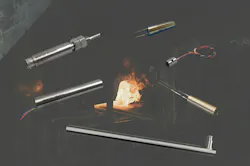
NewTek Sensors announced that its custom linear position sensing units are engineered to operate reliably in hostile environments where temperature can reach up to 200°C, or 392°F.
This is possible because NewTek’s AC-operated LVDTs (linear variable differential transformers) contain no internal microelectronics at the sensing element, a design that reduces thermal drift, eliminates the need for extensive shielding and cooling, provides survivability under sustained high temperatures and allows simplified mechanical installation.
The NTC LVDT signal conditioners power and process signals from these AC-LVDTs that operate directly in the hot zone. The external signal conditioner demodulates the low-amplitude AC output and converts it into DC voltage, current or digital output for meters, PLCs and other control systems.
By keeping sensitive electronics away from the heat, the system ensures long-term reliability and performance.
According to NewTek, the high-temperature AC-LVDTs are designed for:
- Aerospace and defense with environmental control system valves, flap and actuator monitoring and high-temperature test stands.
- Power generation with turbine actuator control and steam valve automation.
- Oil and gas with valve position monitoring and actuator feedback in refineries and processing plants.
- Industrial processing and manufacturing with plastic injection molding machines, die casting equipment and metal forging presses.
- Testing and measurement systems with environmental simulation chambers and high-temperature material testing.
With customizable designs in housing, stroke length and high-temperature materials, NewTek can design a high-temperature sensor tailored to exact specifications. Units also can be developed to operate in extreme environments, reaching temperatures of up to 1000°C or 1832°F.
More sensor insights from Automation World: