Small PLC Retrofit Delivers Big Reliability Gains For Wastewater Aeration
Key Highlights
- Small control system upgrades can significantly improve the reliability of aging industrial equipment, preventing costly failures.
- Wireless communication and sensor feedback are essential for monitoring rotating machinery in environments where wiring is impractical.
- Choosing user-friendly, well-supported automation hardware reduces project complexity and enhances troubleshooting efficiency.
Systems integrators (SIs) exist in a variety of sizes, tailored to serve their clientele. Early in my career, I learned the ropes working at a larger SI on refinery and pipeline automation projects. That position allowed me to hone my skills in programmable logic controller (PLC) and supervisory control and data acquisition (SCADA) programming. However, the time came when I wanted to start up my own operation, and I felt there were plenty of smaller customers in my area to support this endeavor, so about 15 years ago I took the leap.
My integration business is a family operation—basically a one-man show—but this has been an advantage for landing work with my typical smaller clients, and keeping them as repeat customers. Running a small shop of my own has also helped me develop my overall experience and capabilities. Most of the day is spent out in the field, and every hour really needs to count. Any time spent on specifying and ordering parts is time not doing the actual controls work, so anything that quickens the process of finding documentation, or drawings, or answers to technical support questions directly affects how billable I can be.
This mix of fieldwork and self-sufficiency is exactly what a recent project called for. A piece of equipment that had been in service since 1996 was causing trouble and was overdue for a better way to handle problems before they became failures, and to improve reliability for the years to come.

The dangers of equipment with no feedback
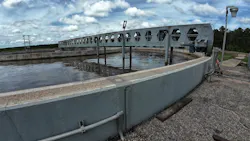
A long-term client operates a wastewater treatment facility that has two aeration basins. Each basin has a rotating bridge (Figure 1), essentially an arm that sweeps around a center column like the hand of a clock. Diffuser wands hang from the arm into the water, blowing air to keep the basin oxygenated as the bridge travels. The purpose of oxygenating the water in the basin is to support aerobic bacteria that break down organic matter.
The trouble starts at the bottom of the basin. Over time, sediment builds up down there. When the build-up increases enough, the rotating arms drag or hang up as they sweep through it. The original design from 1996 really had no specific protection for this, other than using basic motor overload protection when the system became too jammed up. There was no current monitoring, position feedback of any kind or historical data about the duration of a given rotation. In other words, there was almost nothing to help identify a problem that was developing before it became a failure.
As stalls became more frequent, the consequences became more expensive. On occasions where the overload protection didn’t trip in time, the bridge would twist off under its own momentum, requiring a crane to come out and reset it. In one case the bridge hung up but didn't draw enough current to trip the overload at all. The client asked for better protection and tasked me with devising a solution.

Bridging the gap in position monitoring
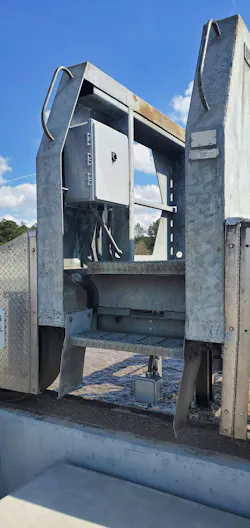
The solution wasn’t as obvious as simply adding sensors to the bridge and wiring them back to a PLC at the plant. Since the bridge rotates continuously on the center column, mounting some sensors to it and running cables wasn’t an option. The only electrical connection to the bridge is made by a set of brushes carrying power out to the arm motor. So, instead of bringing the sensor data to the controller by wires, I determined that the better approach was to bring the controller out to the bridge (Figure 2).
The power circuit through the brushes was modified to provide constant power out to the bridge, versus just energizing the circuit when the motor needed to run. Also, a power transformer was added to step down the voltage needed by the instrumentation and controls. The new controller and sensor were then mounted onto the bridge. With the control system riding along on the rotating structure, communications back to the plant SCADA system needed to be handled wirelessly.
To detect the rotation of the bridge, an inductive proximity switch (Figure 3) serves as the sensor to detect metal targets (Figure 4) that were strategically epoxied around the structure, dividing the circumference of the basin into eight sections. As the bridge-mounted prox switch travels over each target, the controller can determine that the bridge is in motion, and based on timing, the logic can calculate the speed at which it’s rotating, and the direction of rotation. This provides one level of confirmation that the operation is proceeding normally.
Although the bridge motor was still operated by a soft start (to reduce electrical and mechanical stresses during startup), a current transducer was added to monitor the motor. This enhancement provides a 4-20mA analog signal to the PLC, which was programmed to catch the high-draw conditions that a basic overload responds to slowly, along with the stalls it occasionally misses entirely. An emergency stop located off the bridge is available so operators can quickly stop the operation if there is a problem. On any fault, the system shuts the bridge down and sends an alarm to the SCADA system, which notifies operators so they can respond to the situation.
Smarter bridge automation
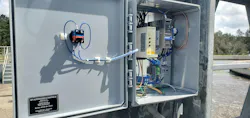
Once the sensing upgrades were determined, it was time to choose the best PLC platform for the project. The facility's main control system is already based on an AutomationDirect Productivity2000, and I regularly rely on this supplier, so choosing the same supplier for the new bridge controls was a natural choice. In this case, a larger-size modular or rack-based PLC would be overkill. However, the much smaller CLICK PLUS PLC with built-in Wi-Fi (Figure 5) is extremely capable and is available with the right I/O and networking capabilities. This PLC handles both the control logic and the wireless link in one compact package. The plant's SCADA system is Inductive Automation’s Ignition, which communicates directly with the PLC.
The logic itself is fairly straightforward. During startup, the system runs through an initial timing sequence to accommodate the delay due to a ramped startup. Once the bridge is running at nominal speed, the proximity targets provide a form of heartbeat that pulses as the bridge rotates. Under normal conditions the bridge moves from one target to the next in about 20 seconds. If 30 seconds pass without seeing a target, the system stops the bridge and raises an alarm. The current transformer provides a high current warning, so the operators can see a drag starting to develop before it turns into a twisted bridge and a crane rental. Or, if the current goes too high (but perhaps not an overload), then the system can shut itself down and alarm.
For a project like this, having free software that comes with the equipment is a huge benefit. When questions came up, the documentation and online forums on the supplier’s website were a reliable resource. At times when tech support was needed, the response usually came back within a day. That combination is a big part of why I prefer choosing this PLC supplier whenever the project allows it.
Many end users have aging equipment ,which can benefit from smaller controls retrofits such as this. While some of these projects might be like-for-like functionality replacements, the reality is that with just a bit more design effort, and access to a wide variety of industrial automation sensors and products, it is often possible to add extremely valuable performance upgrades that extend the equipment lifetime and maximize uptime.
Back in service and producing data
The bridge has returned to making its slow laps around the basin. However, it is now protected and monitored in a way that the original design never was. When a stall occurs, it’s caught by the timing logic or the current monitoring, and the system shuts itself down before anything more problematic occurs. The operators now see the alarm at the SCADA instead of discovering the problem on a walkthrough.
For a one-person shop, the success of a project like this comes down to using equipment that doesn’t fight you. The easier a product is to work with, the more likely I am to use it, and the more time I’m able to spend solving the client’s actual problem. Nearly 30 years after it was first commissioned, this aeration bridge finally has controls that can tell somebody when it's in trouble.
About the Author
 Micky Franks
 Micky Franks
Micky Franks is the founder of MF Automation & Controls, a Southwest Louisiana-based company providing PLC programming, SCADA/HMI development, control panel design, troubleshooting and commissioning services. Micky is a licensed electrical contractor whose technical background includes electrical engineering studies, extensive on-the-job experience, vendor training, and decades of self-directed learning, with more than 30 years of electrical experience, including 25 years primarily in industrial automation.
 Leaders Logo
Leaders relevant to this article: