Autonomy Demands Safety… How We Are Redefining Machine Safety In Our Autonomous World
Key Highlights
- Next-generation emergency-stop systems can help prevent unintended restarts while allowing operators to remotely stop equipment in situations where traditional e-stops are inaccessible.
- 3D sensing technology gives autonomous robots broader awareness of people and obstacles, helping reduce safety zones while improving robot productivity in dynamic environments.
- AI can enhance robot safety and virtual safeguards, although its probabilistic nature requires a more conservative approach than traditional deterministic safety systems.
- Industrial data, digital twins and predictive analytics can move safety from reactive to proactive, helping identify hazards and evaluate potential scenarios before incidents occur.
- IT/OT convergence creates new cybersecurity risks for safety systems, making integrated security, certified technologies and incremental implementation essential to modernizing industrial safety.
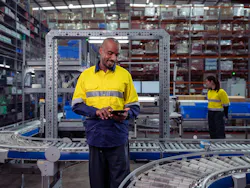
As manufacturers embrace AI to advance autonomous operations, there’s a growing need for industrial safety to shift from an isolated and static set of controls to a dynamic paradigm that enhances machine and human collaboration.
Despite advances in automation and expanded use of robots for key industrial tasks, safety systems and protocols have remained relatively unchanged throughout the years.
What started out as protections to safeguard humans working in close proximity to industrial equipment eventually morphed into procedures and technologies designed to separate the two entities using fencing and other physical measures. Traditional safety guidelines follow a strict interpretation of what constitutes a safe response. For example, industrial assets are typically shuttered when a potential safety threat is identified—a practice that offers protections for workers, but can significantly impact plant productivity and performance.
“There’s a sea change happening right now,” notes Ted Combs, global industry principal for consumer products at AVEVA. “In the past, safety efforts in operations were static, well understood and established, with a clear delineation—for example, don’t walk through that gate into that danger zone,” Combs explains.
Today, against the backdrop of increased robotics use and the push toward autonomous operations, the stationary view of safety doesn’t hold up. “It’s forcing new interactions between humans and machines while driving changes for how to address safety,” Combs says.
The collaborative safety era
IDEC, a provider of machine safety solutions, advocates for a new era of collaborative safety, where humans and machines leverage shared data to deliver more responsive and adaptable protections.
Through use of technologies like sensors, Global Positioning Systems (GPS), wireless communications, image recognition, wearable devices, and AI, industrial players can monitor systems and human and machine interactions to create an environment where both domains can work together safely and effectively, free from the constant threat of downtime.
“By sharing information and working together, you establish a more productive style of safety that isn’t black and white anymore,” explains Masao Dohi, manager of the International Standardization & Collaborative Safety Department at IDEC Japan.
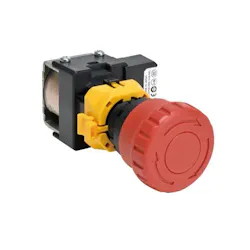
IDEC’s new Assisted E-STOP system is a prime example of a safety system recalibrated for the dynamic demands of a modern industrial environment, Dohi contends. Assisted E-Stop works alongside the traditional emergency stop switch functionality to enable remote activation of e-stops while also preventing subsequent worker accidents caused by unexpected, unintended restarts. For example, during remote machine stops and restarts, there is always the danger of a worker operating from a blind spot—a scenario Assisted E-STOP corrects by requiring the machine to be manually reset for subsequent operation.
Traditional e-stop offerings also require direct interaction with the switch for activation, yet that isn’t always possible if the button is out of reach or robots and other autonomous vehicles are underway and can’t be approached.
The ability to maintain the stopped state of equipment ensures there are no unintended safety breaches, Dohi says. IDEC’s Assisted E-STOP, informed by advanced safety logic from wireless systems, sensors, AI cameras, safety laser scanners and audio input, is designed to function as a part of a larger collaborative safety system, Dohi advises, not as a singular product. “The advent of human robots and physical AI presents challenges,” Dohi says. “An emergency stop assist system that takes the form of a wearable device and is based on the collaborative safety concept does a lot to enhance worker safety.”
New sensing technologies empower robot safety
As robots and other automated systems move out of controlled spaces into mainstream
areas of operations—think warehouses and plant floors—there is a need for greater intelligence and holistic sensing capabilities to drive more reliable and secure operations.
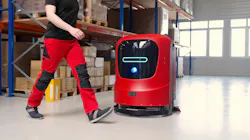
Sonair is tackling that problem with what it claims is the first safety-rated 3D ultrasonic sensor for autonomous robots. Unlike legacy sensors that rely on views in 2D slices, Sonair’s ADAR (acoustic detection and ranging) sensors bring 3D awareness to robots and industrial assets to deliver improved obstacle detection, which advances human safety.
ADAR’s key differentiators are its use of ultrasound and MEMS technology to pack powerful sensing capabilities into a small footprint that is also scalable for cost-effective production, according to Knut Sandven, Sonair’s CEO.
The proprietary software handles real-time signal processing and beamforming, which ensures fast, accurate obstacle detection. Most current robots, which rely primarily on 2D LiDAR sensing technologies, are limited to a view in a single horizontal plane, which means they can miss things like overhead obstacles, low-lying hazards, or even a person that isn’t standing upright. ADAR’s 3D orientation allows robots to detect obstacles and humans at any height, providing optimal safety coverage for the complexity of more direct human-to-robot interactions. Currently in testing with robotics companies and machine builders, Sonair’s ADAR sensors are now available in a fully safety-certified version. Companies are tapping the sensors to enables autonomous mobile robots (AMRs) to navigate more safely in dynamic, cluttered environments with hanging cables and low shelving and in manufacturing and packaging applications where ADAR is creating a virtual safety zone around robot cells.
“We’re seeing huge interest in companies that want to move existing fences and light curtains used to protect people from machinery,” Sandven says. “You can mount an ADAR sensor to a robot arm, define a safety zone, and if something comes in and is detected by the sensor, it will send a signal to the machine to slow down or stop. We can reduce safety zones and allow people to come closer to robots, which will increase working speed and robot output.”
As AI spawns more flexible applications that call for dynamic interactions between humans and robots, it also has a role to play in improving the controls that govern robot safety. For example, AI algorithms can enhance vision-based systems for enhanced detection of operator presence akin to how the technology is used in self-driving cars, according to David Brandt, vice president of research and development and CTO of Teradyne Robotics, which includes Universal Robots.
While there is potential for AI to transform robot safety, this area is developing much more conservatively than other use of AI, in part because safety is a deterministic process while AI is probabilistic, Brandt explains. In the interim, Universal Robots and Teradyne are teaming up with AI startups and established companies to advance AI to establish new levels of virtual safeguards. “We are looking at making AI responsible for safety with virtual fences so the robot is incapable of moving outside of the area,” he explains.
Data holds the key to proactive and predictive maintenance
The traditional approach to industrial machine safety has been reactive, reliant on people and manual logging to catalog anomalies in machine behavior.
With more sophisticated computer-aided visualization, increased access to data digitalized across the entire industrial footprint, including at the edge, and the influx of AI, organizations can better understand the root cause of problems to aid in proactive decision making on safety-related matters. “You can use AI to detect things from a safety standpoint—for example, a slippery surface related to a specific process—that might never be discovered with just humans looking at it,” notes AVEVA’s Combs. “With AI [and digital twins], you can also think through all scenarios when implementing a robot so that it’s aligned properly with your safety requirements.”
The key to predictive analytics for safety applications is trust, a scenario that demands real-time access to high-quality data with context. AVEVA’s heritage in historians and time series data gives it an edge, Combs claims, compared to solutions built around LLMs and outside data. “Safety is a matter of life and death so you need to stick to the physics of what is actually happening to determine outcomes,” he explains. “As soon as you introduce outside data sets, you lose that rigor.”
AVEVA’s CONNECT data platform and visualization services, buoyed by its recent acquisition of Crosser, which makes a unified DataOps platform for industrial environments, expands its ability to contextualize streaming and event-driven data in real time. The integrated platform eliminates industrial silos and makes it easier to share and use data across systems. “AI is data hungry, but you need tools to orchestrate the data and secure and manage it,” he explains. “We are making it easier for companies to manage and leverage the disparate sources of data that inform industrial safety systems.”
Cybersecurity opens a new front for safety risks
On-going IT/OT convergence, including tighter coupling of safety systems within the enterprise, raises new cybersecurity risks. Safety systems that were once walled off from core enterprise networks are now part of the broader framework making them potential targets for nation-state attackers and other cybersecurity threats. Claude Mythos, Anthropic’s frontier AI model designed for complex cybersecurity and biology research, has opened the door for autonomous hacking capabilities while shortening the vulnerability to exploitation cycle. That has introduced AI as a critical tool to guard against the new crop of AI-driven cyberattacks.
“The best way to counter AI-based attacks that target or impact Safety Instrumented Systems (SIS) is to use AI to make things more secure,” notes Chris Grove, director of cybersecurity strategy for Nozomi Networks. The Nozomi Networks platform, powered by AI, is purpose-built for complex industrial environments and critical infrastructure, which ensures it can initiate a more intelligent and resilient safety response, Grove claims.
“Knowing the context that you can’t shut off a fire system because you saw a possible safety concern like you would a worker’s laptop infected with ransomware is important,” he explains. “The reactions need to be totally different.”
ROI and implementation strategies
Before implementing any new industrial safety technology and protocol, organizations must have a solid asset inventory of what’s in play and what’s at stake. Using certified components, retrofitting existing robots and machinery with new safety and sensing equipment, and targeting small and specific spaces for incremental improvements can deliver benefits without impacting production or creating unnecessary downtime. Most importantly, addressing safety as part of overall industrial automation advances, not as a separate silo, is key to optimizing results and maximizing technological innovations.
“Keep things as a manageable scenario, not on separate tracks,” Combs says. “That ensures decisions are ultimately made with the best safety ramifications in mind.”
About the Author
 Beth Stackpole, contributing writer
Beth Stackpole, contributing writer
Contributing Editor, Automation World
 Leaders Logo
Leaders relevant to this article: