GE, Boeing Help Veterans Get Advanced Manufacturing Jobs
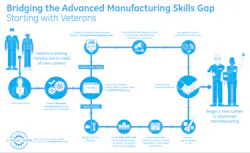
The initiative, called “Get Skills to Work,” aims to match 100,000 veterans to manufacturing jobs by 2015. According to a report in the Washington Post, the coalition hopes to raise awareness about manufacturing opportunities for veterans who don’t know exactly what they want to do upon returning from service, said Kris Urbauer, program manager for GE veteran initiatives.
On the blog, “Joining Forces,” U.S. Deputy Assistant Secretary of Defense John Campbell, “Through a blend of business, digital, academic, and not-for-profit partners, “Get Skills to Work” aims to close the advanced manufacturing gap, bolster the talent pipeline, and enhance American competitiveness.”
Get Skills to Work will be managed by the Manufacturing Institute and supported through financial and in-kind commitments from GE, Alcoa Inc., Boeing and Lockheed Martin. These initial investments will help 15,000 veterans translate military experience to corresponding advanced manufacturing opportunities and gain the technical skills needed to qualify for careers. The coalition is seeking additional partners to meet its goal of reaching 100,000 veterans by 2015.
The initiative includes three main components: an accelerated skills training program; translation of military experience to civilian manufacturing job opportunities through an online “badging system”; and partnership with the Institute for Veterans and Military Families to create an employer toolkit for expanded hiring, developing and mentoring of veterans.
Starting in January 2013, classes of veterans will be enrolled in a technical training program at Cincinnati State Technical and Community College, and additional training sites will operate in 10 other states. The Washington Post also reported that the program could help fill the 600,000 currently vacant jobs in the manufacturing sector, according to the National Association of Manufacturers President Jay Timmons.
“The problem is manufacturers don’t know how to reach out to these folks, and military personnel don’t know how to translate their skills to manufacturers,” Timmons said.
One such Marine Corps veteran recently sent his resume to Mike Haynie, executive director of the Syracuse University Institute for Veterans and Military Families, who is participating in the initiative. The young job seeker had extensive experience with tanks. His resume read: “I can drive a tank, fix a rank, and shoot a tank,” Haynie said. But in reality, “that young man has highly advanced skills in electric systems and hydraulic systems.”
To find an appropriate civilian job for his skills, he “needs to articulate that in a way that demonstrates his value,” Haynie added.
Next month marks the one year anniversary of the President Barak Obama’s unveiling of the Veterans Jobs Bank, hosted at the NationalResourceDirectory.gov. “In one short year, more than 5,000 employers posted more than 1 million veteran friendly jobs,” Campbell said. “But statistics only tell part of the story…. Companies who are willing to invest in veterans as employees experience what I call the ‘Vet Effect.’ It’s the fundamental change in a company’s DNA when veterans bring their leadership experience, team approach, and loyalty to the mission to work. I’ve seen firsthand the meaningful change it brings within an organization.”
About the Author
Renee Bassett
Managing Editor
Leaders relevant to this article: