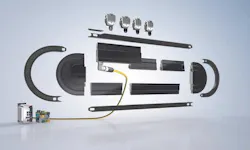
Jeff Johnson Since the technology’s launch in 2012, the intelligent transport system has fundamentally changed mechanical engineering and machine design with revolutionary mechatronics XTS emphasizes simplicity throughout – from its mechanical components, minimal cabling, integration into standard automation technology, and emphasis on software-defined motion control. That’s where Beckhoff’s XTS enters the game. More than a conveyor, more than a servo system, XTS is a reimagining of what it means to move products through a machine. And XTS doesn’t just complement the Beckhoff product portfolio—it amplifies it, becoming a cornerstone for a new generation of adaptive automation. It does this by incorporating dynamic servomotor and drive technology, PC-based control, and EtherCAT networking to the fullest effect. From mechanical to software-defined motion control This shift in thinking unlocks a simple but profound idea: format changes handled in software, not hardware. Whether switching between bottle sizes in a beverage line, different blister pack formats in pharmaceuticals, or varying cell types in battery production, the same hardware adapts on the fly with no mechanical retooling. That kind of agility is no longer a nice-to-have—it’s become the difference between keeping pace with market demands and falling behind to the competition. The power of XTS is amplified by its seamless integration into the entire Beckhoff technology ecosystem built on PC-based control, EtherCAT, and TwinCAT automation software. Compact machines offer big time capabilities Assembly demands gentle yet precise handling of intricate components. XTS provides smooth, vibration-free motion and the ability to synchronize movers with robotic arms or vision systems—perfect for smartphones, battery cells, or medical devices. Food and beverage operations must manage rapid changeovers and rigorous hygiene requirements. XTS Hygienic , with its IP69K-rated stainless steel design, is purpose-built for washdown environments while retaining the system’s core flexibility and performance. Intralogistics operations with material handling requirements that exceed the capabilities of traditional conveyors and sortation systems can lean on XTS to handle microfulfillment and other complex applications. Packaging companies constantly innovate in different package formats—stand-up pouches, blister packs, multipack cases, portioned trays—and XTS enables rapid adaptation without extensive machine downtime for mechanical changeovers. These examples highlight a consistent theme: XTS doesn’t just solve today’s problems; it equips manufacturers to adapt and address tomorrow’s challenges with confidence. EtherCAT provides the optimal fieldbus for synchronizing robotics with mechatronics, like the XTS With XTS, Gefasoft was able to optimize the quality inspection of cylindrical metal parts. Series of buckets on the M2000 holds pizzas as XTS takes them around a 180-degree corner ©Brenton (© Cavanna) This convergence of intelligent transport and robotic functionality blurs the line between machine modules. Instead of discrete stations linked by conveyors, the machine itself becomes a distributed, adaptive system where every XTS mover acts independently. It’s a shift as dramatic as the move from solid state relays to PLCs—and one that opens entirely new possibilities in mechanical and electrical engineering for machine builders, system integrators, and end users. XTS leverages the power of the Beckhoff ecosystem EtherCAT ensures real-time communication not just between movers, but across the entire automation architecture—robots, vision systems, drives, sensors, and cloud-based platforms. TwinCAT provides a universal engineering environment for everything in automation: mechatronics, machine control, robotics, safety, HMI, simulation, and more. So machine builders can model the behavior of XTS in any application concept, optimize it virtually, and reuse software modules across projects. Industrial PCs scale from compact controllers to high-performance many-core platforms, ensuring that even complex systems with hundreds of movers, robots, and integrated machine vision run seamlessly on one IPC. This unified ecosystem reduces engineering effort, improves performance, speeds commissioning, and future-proofs machine designs. For OEMs and end users alike, that translates into faster innovation cycles and lower total cost of ownership. Permanent paradigm shift in machine design In a world where change revolves constantly, the ability to adapt quickly is the ultimate competitive edge. With XTS, that edge is built into every motion sequence on your machine. Jeff Johnson is the Mechatronics Product Manager at Beckhoff Automation