Food and Bev Manufacturers Feast on IIoT for Productivity Gains
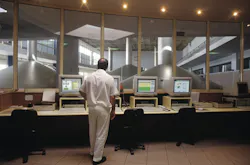
SugarCreek’s business—selling raw and cooked pork products and an array of packaged foods—may be slightly old fashioned, but its manufacturing processes are surely not. The food manufacturer, which caters to retail and food service customers, is heavily investing in the Industrial Internet of Things (IIoT), mobility and analytics solutions, among other cutting-edge technologies, as part of its drive to achieve operational excellence along with a top-quality product.
Sensors throughout the plant monitor everything—from the temperature of pork bellies in the smoke house so airflow is optimized to the positioning of precooked bacon in slicers to improve yield. Temperature tags on trucks ensure proper refrigeration for products during transport, and worker helmets will leverage RFID sensors to enable better communication and to boost safety within SugarCreek’s plants.
“The food business is a skinny margin business and the most fundamental thing we need to do well is have a good cost structure while maintaining our quality,” says Ed Rodden, SugarCreek’s CIO. “IIoT on the plant floor helps with quality and efficiency, but it’s not just on the plant floor—it’s everywhere. Sharing the data companywide gives us the ability to analyze and improve processes.”

Like SugarCreek, more food and beverage manufacturers are taking the next step in connecting plant floor equipment, leveraging Internet standards, the availability of low-cost sensors, and emerging cloud-based data analytics platforms to achieve real-time visibility throughout their value chain and enable better decision-making. According to a recent survey of Automation World readers in the food and beverage industry, nearly half (49 percent) have either implemented IIoT initiatives or are planning to do so. After years of struggling to pull data from legacy systems that don’t talk to each other and aren’t synced up to the rest of the business, the opportunity for IIoT is all about gaining that next level of visibility, according to Reid Paquin, industry analyst for food and beverage at GE Digital.
“IIoT really just allows you to get more connected to what’s going on on the plant floor and throughout all your processes and machines,” says Paquin, citing the ability to eliminate guesswork and understand, for example, exactly why a filler isn’t operating at peak efficiency or track why waste is occurring with a particular piece of packaging equipment. “You have to connect all of these areas before doing that and manage the data.”
While plant floor equipment has been connected for years, much of the information has remained siloed, trapped in individual systems and not readily accessible to plant floor workers or upper management to help determine where inefficiencies are in the process or aid in decision-making. IIoT changes that scenario through standardization and convergence, specifically between operations technology (OT) and information technology (IT), according to Don Pearson, chief strategy officer with Inductive Automation.
“It’s different from the old days when there were operations on the plant floor and information technology in the back office doing business applications and never the two shall meet,” Pearson explains. “Decoupling device protocols with the applications creates a complete infrastructure and architecture change. That’s what we’re dealing with.”
As the architecture changes enable connected systems, food and beverage manufacturers can do things they couldn’t before and, most importantly, eliminate cumbersome and error-prone manual processes. “Historically, people have gone around with clipboards, reading stuff off of meters, and entering data into spreadsheets,” explains John Dart, senior industry consultant for Rockwell Automation. “[IIoT] technology makes real-time data available, but also contextualizes it with data in other systems, giving manufacturers the ability to improve operations and continue to lower costs.”
IIoT at work
With access to a real-time treasure trove of data, food and beverage manufacturers can achieve efficiencies on the plant floor and throughout their entire operations. Consider an industrial refrigeration company, which is leveraging IIoT to stay on top of equipment health, using sensors to detect unusual vibrations that might indicate a potential failure. This allows them to practice predictive maintenance and eliminates any risk of downtime. In another example, a manufacturer of baked goods has a vision for IIoT to automatically adjust oven temperature to match the characteristics of specific grains from different suppliers to ensure quality remains consistent.
IIoT also has applicability far beyond the shop floor—from the moment produce is picked on the farm all the way through distribution channels, collecting data on everything from temperature to ripeness to how long product remains in transport can help manufacturers optimize processes across their entire lifecycle. “From when you pick it to putting it in the box, there is applicability in every step of the process,” says Matt Newton, director of technical marketing at Opto 22. “You can go all the way back to tracking profitability of certain crops based on historical weather reports.”

Though food and beverage manufacturers have been leveraging sensors to collect data for years, they’ve historically been limited to what they could achieve given the high cost associated with deployment. “The cost of sensors has gone down so much, now huge volumes of manufacturers can afford to have sensors everywhere, on transportation trucks or refrigerators in the plant,” says Aravind Yarlagadda, vice president of portfolio strategy and marketing for the software business at Schneider Electric. “With the right sensors, you can monitor how efficient a packaging line is or determine what equipment will fail six years from now.”
Couple ubiquitous use of sensors with new predictive modeling and analytics capabilities, and food and beverage manufacturers can benefit from a variety of use cases around predictive maintenance, improved operational processes that boost quality and yield and, eventually, anytime, anywhere analytics delivered through a mobile empowered workforce, Yarlagadda says (see “ Mobility Drives Situational Awareness for All,” below).
That’s exactly what SugarCreek is striving for with its myriad IIoT initiatives, many of which were designed in partnership with Cisco. Beyond connecting all of the various pieces of equipment and sensors, the next critical leap is to put the proper data analytics infrastructure in place to handle the volume of data and transform it into insights that can have real impact on the business. “Getting the raw data in the right form is still a huge issue, and the volume is just going to keep growing,” Rodden says. “The tools haven’t yet caught up with that and, ultimately, that’s where our focus is turning.”
Tyson Foods is also committed to turning IIoT data into actionable intelligence that can drive better decision-making. One such example is a major sustainability project to reduce water usage in its plants. By leveraging Inductive Automation’s message-oriented middleware to bridge data collected from the plant floor with its enterprise SAP system, the company can determine exactly how much water it’s using and also gain insight into why one plant uses more water than another plant manufacturing the exact same offering, explains Avery Nelson, project manager for Tyson. “Today, there’s a lot of estimating on the true cost of our products,” he explains. “This will allow us to make decisions based on true numbers. It’s all about better decision-making.”
Sidebar:
Mobility Drives Situational Awareness for All
IIoT is providing food and beverage manufacturers with real-time visibility into what’s happening throughout their operations while support for mobility is serving up that critical intelligence to a much wider audience.
In a traditional scenario, workers roam the plant floor, checking key status indicators and monitoring other valuable data points by way of human-machine interface (HMI) panels found on each piece of machinery. By making that same information available on a mobile device, plant floor workers as well as upper management can gain visibility into real-time metrics from wherever they happen to be located and without needing to be tethered to a specific HMI console or desktop.
“Mobility is important because you don’t have to physically visit a plant to understand how a particular piece of equipment is doing,” notes Aravind Yarlagadda, vice president of portfolio strategy and marketing for the software business at Schneider Electric.
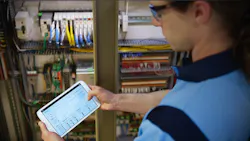
Making plant floor data available on commonly used devices like smartphones adds a level of ease and encourages more involvement, ultimately leading to better decision-making. “It’s really about giving everyone situational awareness—not just higher level management,” adds Matt Newton, director of technical marketing for Opto 22.
Despite the upside of mobile support in plant floor applications, food and beverage manufacturers have been slower to adopt the technology. In an Automation World survey, nearly half (49 percent) of respondents were not yet using mobile devices to track production parameters and only 36 percent said the technology was in use by a few select operators or managers.
Concerns around security, cost and the lack of support for mobile devices by mainstream manufacturing and automation platforms have been the primary barriers to adoption. That’s starting to change as automation vendors add support for technologies like HTML5 to accommodate a growing mobile workforce.
“Today, there’s so much walking around the plant floor or driving around in a car,” says Don Pearson, chief strategy officer at Inductive Automation. “Having information when you want it, where you want it can impact organizational productivity.”
About the Author
 Beth Stackpole, contributing writer
Beth Stackpole, contributing writer
Contributing Editor, Automation World
 Leaders Logo
Leaders relevant to this article: