Physical AI: New Possibilities for Mid-Market Manufacturers
Key Highlights
- Physical AI helps manufacturers adapt to change by enabling machines to perceive, analyze and respond to real-time conditions.
- Mid-market manufacturers can use physical AI to improve resilience through applications such as AI-powered inspection, adaptive warehouse robotics and computer vision systems layered onto existing infrastructure.
- Successful adoption often starts with targeted pilots that address specific operational challenges.
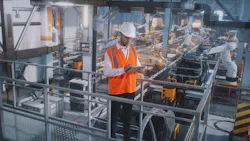
For many mid-market manufacturers, automation has long meant investing in fixed systems designed to deliver repeatable output at scale. That model can drive efficiency, but it also assumes relatively stable conditions: predictable production runs, consistent labor availability and environments that do not change too quickly. In practice, many mid-market operations do not have that luxury.
Product mixes change. Workforce availability fluctuates by shift or site. Equipment footprints evolve over time. And when even a small disruption hits the line, mid-market manufacturers often have less excess capacity, fewer specialized resources, and less margin for delay than their larger peers. Each of these circumstances is where physical AI is beginning to matter.
Physical AI enables machines to perceive their surroundings, interpret what is happening and act autonomously in dynamic, real-world environments. In manufacturing settings, that could mean AI-powered inspection systems that identify anomalies in real time, robotic systems that adjust to changing material flows, or computer vision tools that improve safety and visibility without requiring a full facility redesign. For mid-market manufacturers, the value is not simply automation for automation’s sake. It is adaptability.
Adapting in real time
Variability is often a daily reality in manufacturing, and the mid-market may feel certain aspects more acutely, such as production schedules that change quickly and plants that manage a wide mix of products with little standardization. Older equipment may coexist with newer systems and the addition of labor constraints make it tough to absorb disruption when conditions shift unexpectedly.
Physical AI offers a way to make those environments more responsive. One mid-market warehouse operator, for example, began deploying AI-enabled robotic systems to support fulfillment in an operation where order volumes and SKU combinations shift constantly. Rather than following a fixed routine, the system adjusts how it identifies, sorts and moves materials based on real-time conditions. That helps the operator maintain throughput even as demand patterns change.
The same dynamic can apply on the factory floor. Mid-market manufacturers often need practical ways to improve safety and productivity without pausing operations for a large-scale transformation. One automotive supplier, for instance, layered AI-powered vision onto existing factory cameras to gain better visibility into safety risks. The company identified repeated near misses between forklifts and pedestrians, then used that insight to reroute traffic, create more defined walkways, and prioritize intersections and doors for stop signs. In this case, the opportunity was not to replace the environment, but to make the existing one smarter and safer.
Pilots, proof and progress
A practical mindset matters. While interest in physical AI is growing, many mid-market manufacturers are still balancing ambition with operational reality. Adoption can be slowed by technical limitations, uncertain returns, and the challenge of integrating new tools into existing environments. Legacy systems, inconsistent data, and workforce trust can all affect how quickly a solution gains traction.
For mid-market companies in particular, the business case often needs to be clear early. Large, multiyear bets may be harder to justify without proven value. That is why focused entry points can be so important. Deloitte worked with a beverage producer facing losses tied to site security and asset monitoring. By installing a robotics solution to augment existing camera systems, the company was able to patrol facilities, record activity, and flag anomalies in real time. Starting with a specific operational problem helped create momentum for broader adoption.
This kind of phased approach may be especially relevant for mid-market manufacturers. Rather than pursuing enterprise-wide transformation from day one, they can begin with targeted use cases where physical AI complements existing assets, delivers visible operational benefit and builds confidence across the organization. That could include quality inspection, warehouse movement, safety monitoring or site security—areas where the value can often be measured in fewer disruptions, better visibility and reduced risk.
Even then, talent and funding remain important considerations. Many mid-market manufacturers do not have deep benches of in-house AI or robotics talent, which can make fully custom development difficult. Cost structure matters too. Subscription-based or as-a-service models may offer a more flexible alternative to large upfront capital purchases, giving manufacturers a way to test, scale, or adjust course with less risk.
Physical AI can be a powerful extension of existing automation. For mid-market manufacturers, the opportunity is not to build the factory of the future overnight. It is to apply adaptive intelligence in targeted ways that help current operations become safer, more resilient and better able to respond when conditions change.
About the Author
 Wolfe Tone
 Leaders Logo
Leaders relevant to this article: