Why Latency Still Haunts Industrial Automation and What Engineers Are Doing About It
Key Highlights
- Even a 1 millisecond delay can disrupt OT systems, making latency and jitter critical factors in precision robotic synchronization.
- Edge computing keeps real-time decisions close to the machine, but security controls must stay at network boundaries to avoid adding lag.
- Network slicing can isolate robotic control data from non-critical traffic, but RF signal quality and proper spectrum planning ultimately determine whether 5G delivers on its latency guarantees.

Simply defined, latency is the time delay between the transmission of data from one point to another. Latency determines how fast any single piece of information reaches its destination.
Not so simple are how latency affects industrial automation technologies. Because the impact of long latency times is mostly negative in automation applications, maintaining the lowest possible latency lags is a serious concern. Zero latency may never be achievable, but near-zero is within reach.
Latency thresholds and their impact on robotic assembly lines
Robots must reliably synchronize with each other if they are to perform precision manufacturing tasks such as assembly, welding, materials handling, safety and other critical tasks. To achieve this precise synchronization, industrial robots require real-time decision-making capabilities, hence, a critical factor is minimizing latency.
A first step in addressing this is to consider the maximum threshold of latency a particular application can tolerate before production problems occur, as well as the minimum threshold possible. This requires measuring and monitoring latency in real time.
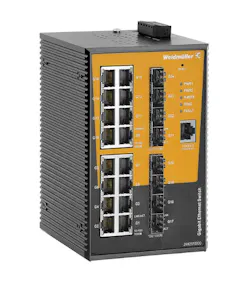
In manufacturing environments, latency requirements vary depending on the application. Basma Ahmed, product manager for industrial Ethernet at Weidmuller said that, in contrast to information technology (IT) systems where delays of 1 to 5 milliseconds are typically acceptable, many operational technology (OT) processes require extremely fast and consistent communication. In OT systems, even a 1 millisecond delay can have real production consequences.
She added that jitter, or variations in delay, can be more disruptive than latency because inconsistent timing introduces unpredictability that systems cannot compensate for.
Daniel Mai, Siemens’ director of industrial wireless communication concurred with Ahmed as he noted that meeting low latency levels alone is not sufficient in many industrial automation applications. What matters most, he said, is predictable, deterministic communication. Because automation applications, synchronized processes and safety-related coordination rely on consistent timing, deterministic behavior and low jitter (the variation in delay) should be initial considerations.
Traffic profiles are a viable alternative to network slicing to ensure QoS because they allow the handling of diverse traffic classes like mission-critical control-related communication along with non-critical data flows with different performance and security parameters within the same network.
Ahmed explained that real-time monitoring of latency and jitter can be done via the use of packet time stamping, where industrial switches or end devices add precise timestamps to packets at ingress and egress points. These timestamps measure end-to-end delay and jitter and identify where delays begin.
Managed switches also provide diagnostics, traffic monitoring and network management capabilities, she added.
Edge computing and processing distribution
Edge computing plays a major role in robotics deployment by keeping real-time data processing and decision-making near production machinery. Advantages of this form of distributed processing include reduced latency, better control, greater efficiency and faster responses to sensor data.
Additionally, distributed processing enables the addition of numerous devices without taxing the network.
Mai pointed out that edge computing reduces latency by processing data close to the machines and processes instead of relying on remote cloud roundtrips. Edge nodes placed close to the production line or cell and near OT network aggregation points keeps network paths short and enables fast monitoring and analytics, as well as AI-based application responses.
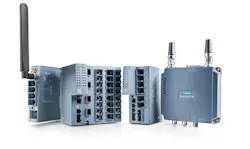
In efforts to minimize latency in time-critical processes, Ahmed observed that manufacturers typically position edge computing nodes close to production equipment and connect them to industrial Ethernet switches. This is where security becomes a consideration, especially where factory networks connect to external systems, remote access platforms or the cloud.
To address this, OT traffic should be isolated from less critical networks to enhance security and preserve deterministic performance.
Industrial companies should be aware that, common security mechanisms such as firewalls and deep packet inspection can introduce additional latency and jitter if placed directly in time-critical communication paths. To avoid this issue, manufacturers should position security controls at network boundaries rather than within real-time control segments.
By combining edge computing with well-designed, segmented industrial networking infrastructure and appropriately placed security controls, manufacturers can ensure both low-latency decision-making as well as secure and reliable connectivity across their production environments.
Latency vs. reliability
Amid all the latency considerations manufacturers need to ponder, they must also consider the potential impacts on reliability. Here, manufacturers need to consider the failover mechanisms available to them.
“In industrial applications, availability and performance must be engineerable together,” said Mai. “High reliability is not achievable by a single feature, but by an end-to-end design approach, to apply redundancy where necessary and avoid any single point-of-failure to clearly prioritize and separate traffic flows and ensure robust monitoring and diagnostics.”
Because private 5G network connections to the wired factory network occur through a gateway or a router that connects to an industrial Ethernet switch that links controllers, PLCs and SCADA systems, manufacturers should aim to minimize protocol conversions, maintain precise network timing through the PTP and use industrial-grade hardware.
In facilities with private industrial 5G setups, this typically means operating a controllable radio environment with appropriate QoS (quality of service) concepts for different traffic classes, securing the transitions into OT networks and using architectures that keep critical functions local. This helps maintain stable latency and robust operation — even under disturbances or peak loads —without making the overall network unnecessarily complex.
“Manufacturers must balance high reliability with low latency when designing industrial networks,” said Ahmed. “To maintain communication during failures without introducing significant delays, they often implement redundant network topologies such as ring architectures or high-availability redundancy mechanisms supported by industrial Ethernet switches.”
However, it is important to note, that while redundancy helps reduce downtime, it does not eliminate latency and may not fully address the needs of millisecond-level, time-critical systems, where even brief switchover times can have an impact. To preserve deterministic performance, manufacturers often rely on Layer 2/Layer 3 managed switches, which provide fast forwarding, traffic prioritization and support for time-sensitive networking and PTP (Precision Time Protocol)/IEEE 1588 for accurate synchronization. These technologies ensure predictable communication and minimal jitter across the network.
While redundancy helps reduce downtime, it does not eliminate latency and may not fully address the needs of millisecond-level, time-critical systems, where even brief switchover times can have an impact.
By prioritizing TSN- and PTP-driven synchronization and deterministic networking alongside carefully placed security controls, manufacturers can achieve both precise timing performance and highly available and secure operations.
Switch and router selection for 5G architectures
Integrating a 5G network into existing infrastructure with the goal of maintaining ultra-low latency requires serious thought for switch and router selection. An initial consideration here should focus on having an efficient strategy for managing transmission points between wired and 5G wireless points in the manufacturing system.
One of the biggest challenges here is maintaining deterministic performance between wireless and wired networks. Ahmed explained that, although 5G ultra-reliable low-latency communication (URLLC) helps enable low-latency (about 1 ms) and highly reliable wireless communication, manufacturers still need to preserve this performance end-to-end. Therefore, they should focus on selecting industrial-grade switches and routers that can handle high-performance data traffic while ensuring stable connectivity.
Additionally, because the private 5G network connection to the wired factory network occurs through a gateway or a router that connects to an industrial Ethernet switch that links controllers, PLCs and SCADA systems, manufacturers should aim to minimize protocol conversions, maintain precise network timing through the PTP and use industrial-grade hardware.
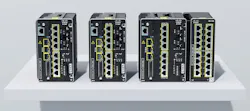
Mai agreed that a robust industrial 5G architecture is an end-to-end design: from radio access, core functions and industrial routers at the edge to integration into the OT network. Industrial devices commonly connect through a 5G router into the private 5G network and from there into the plant’s industrial Ethernet.
Interestingly, Samuel Pasquier, head of product management for Cisco's Industrial IoT Connectivity Portfolio, noted that he has not yet seen a lot of 5G deployment in automation. Most of Cisco’s customers, he said, use wireless technologies on the ISM (industrial, scientific, medical) spectrum, not 5G.
“We have a few customers here and there, but I don't think 5G is in the mainstream position yet,” said Pasquier.
In instances where a manufacturer chooses to use 5G, Pasquier said an integrator will typically use a router or a particular type of 5G bridge rather than install a switch on the equipment. He said this is done because just one connection up to the network is necessary and the addition of a switch is not necessary to expand the number of ports on the end device.
Keeping critical data separate and deterministic
Network slicing is a 5G technology that allows operators to create multiple virtual networks on a single system. Each slice supports specific requirements, such as latency, jitter, speed and security. The initial advantage of network slicing is it allows different services to operate independently on the same network.
As an example, to keep robotic-control data separate from other operations such as maintenance and inventory control, manufacturers need to have an effective network-slicing strategy. As a result, they must be cognizant of the configuration and maintenance challenges virtual network slices present, which include maintaining slice isolation and ensuring the slices do not introduce additional latency.
Pasquier said implementing network splicing is a straightforward task and not a major challenge. The biggest challenge surrounding latency requirements pertains to the quality of the spectrum and the quality of the RF signal. Using 5G on the network requires manufacturers to do proper RF planning. This involves surveying and analyzing spectrum usage to maximize what operators can do on the network.
Mai added that traffic profiles are a viable alternative to network slicing to ensure QoS because they allow for the handling of diverse traffic classes, like mission-critical control-related communication along with non-critical data flows with different performance and security parameters within the same network. With traffic profiles, separation of the different applications is handled via virtual extensible local area network (VXLAN) tunnels to ensure the different profiles do not disturb each other.
More industrial networking insights from Automation World:
About the Author
 Mat Dirjish, contributing writer
Mat Dirjish, contributing writer
Mat Dirjish has years of tech reporting experience at B2B technology publications such as Electronic Products Magazine, EE Product News, Electronic Design, Sensors Online & Sensors Expo, and Sensors Daily. He's been a regular contributor to Automation World since 2023.
 Leaders Logo
Leaders relevant to this article: