How AlgaeBarn Used Industrial Automation to Eliminate Manual Cap Labeling
Key Highlights
- The system automates cap orientation, labeling, inspection and sorting, replacing manual 'sticker parties' and reducing labor costs.
- Custom design and open-source hardware kept costs below $1,000, providing full process control and flexibility.
- A key challenge was achieving precise label placement, solved by redesigning the drive with a geared NEMA 24 stepper motor for repeatable positioning.
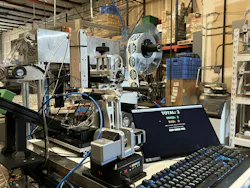
At AlgaeBarn, a Colorado-based producer of live aquaculture products such as copepods and phytoplankton, we manage nine product lines. Each product requires its own cap label, which once meant applying thousands of stickers by hand.
Before automation, employees from across the company periodically gathered for one- to two-hour "sticker parties," peeling labels and placing them on caps one by one. The sessions became a social tradition, but they also pulled operators, technicians and engineers away from their primary responsibilities. When labeled-cap inventory ran low unexpectedly, production employees had to pause other work to prepare more.
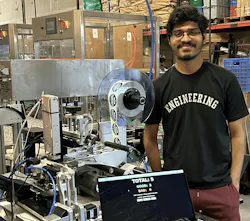
As AlgaeBarn's Robotics & Automation Engineer, I identified this repetitive process as an opportunity for practical automation. The objective was not simply to apply labels faster. I wanted an autonomous cell that could orient each cap, apply the label, inspect the result and sort the finished part without continuous operator supervision.
Why build instead of buy?
Commercial labeling machines were available, but they presented two concerns: cost and control. Many systems assume that once an operator completes the setup, label placement will remain correct. On a production floor, that assumption does not always hold. After 100 or 200 cycles, the label roll or backing paper can shift slightly. A small change in the feed path can affect the next label's position.
We also wanted access to the machine logic so the process could evolve with our production needs. Most of the mechanical system was designed in-house using SOLIDWORKS, and the direct hardware cost was kept below $1,000. More importantly, building the system internally allowed us to inspect every cap rather than trusting only the initial mechanical setup.
From loose caps to inspected parts
The cycle begins when an operator empties loose caps into a dispensing elevator. A sensor monitors the feed track and turns on the elevator conveyor whenever more caps are needed. The track provides passive orientation: correctly oriented caps continue toward the labeling station, while inverted caps fall back into the collection bin. This mechanical approach avoided the complexity of a separate active-orientation mechanism.
A tray receives one cap at a time. A KEYENCE laser sensor confirms the cap's presence and signals the controller. The controller actuates a pneumatic cylinder to move the cap into position, while reed switches verify that the cylinder has reached its required location before the sequence continues.
A geared stepper motor advances the label roll around a peel edge. As the backing paper changes direction, the label separates from the liner. A vacuum-assisted pneumatic applicator captures the released label and presses it onto the cap. Another reed switch confirms completion of the application stroke.
The controller then sends an MQTT message to a Raspberry Pi equipped with a camera module. A custom OpenCV routine captures an image and evaluates the label's position. Because the cap and label dimensions are constant, the software measures the spacing between their detected edges and verifies that placement remains within the selected tolerance. The inspection result returns to the controller, and a robotic arm with a suction-cup end effector places the cap in either the accepted-parts bin or the reject bin.
A small motion error with a large impact
The hardest engineering challenge was stopping the label roll at exactly the correct location. An early motor drive responded to the controller's stop command, but residual energy and mechanical inertia allowed the shaft to coast. The additional travel could approach an inch, which was more than enough to misalign the next label.
To eliminate the overrun, I redesigned the drive around a geared NEMA 24 stepper motor. The controller could then command a repeatable number of steps for each label and stop at a defined position. That change significantly improved consistency and reinforced one of the project's most important lessons: On a production floor, a millimeter is never just a millimeter. Small deviations become meaningful quality problems when repeated hundreds of times.
Accuracy before maximum speed
The completed system processes approximately 450 caps per hour. That rate meets our production needs, but throughput was not the only measure of success. An operator can load the caps, start the machine and return to other work. If the feeder runs out of caps or the controller detects another abnormal condition, the system stops and sends an alert instead of continuing to produce uncertain results.
In an initial 100-cap trial, 98 caps met the selected placement tolerance. The other two were rejected for small positional differences. Because product quality was the priority, the inspection thresholds were intentionally conservative rather than allowing borderline parts to pass.
The project took approximately four months to complete while I was supporting other automation initiatives. It eliminated the recurring need for employees to gather and label caps manually, although some operators joked that they missed the opportunity to sit together and talk. Based on reduced manual labor and fewer production interruptions, the system is projected to generate approximately $40,000 to $50,000 in annual labor and productivity savings.
The broader lesson is straightforward: Begin with a genuine operational need. Estimate the time, budget and expected value before committing to automation, and then design within those constraints. Small manufacturers do not always need the fastest or most expensive equipment. They need reliable systems that solve the right problem, provide feedback when something goes wrong and deliver repeatable quality.
About the Author
 Akash Chinthamanipeta
 Akash Chinthamanipeta
Akash Chinthamanipeta is a robotics and automation engineer at AlgaeBarn in Commerce City, Colorado. He holds a master's degree in mechanical engineering from the University of Colorado Boulder, with a focus on robotics and control systems.
 Leaders Logo
Leaders relevant to this article: