Beyond AI Pilots: How Systemic AI Drives Scalable Industrial Automation Across Manufacturing Plants
Key Highlights
- Systemic AI links decision-making across all manufacturing levels, enabling real-time, end-to-end operational flow.
- Focusing on core differentiators like domain expertise and proprietary data is essential when building AI solutions; partnerships are crucial for integration.
- Redesigning decision rights and operating rhythms ensures AI becomes a seamless part of daily manufacturing activities.
- Combining physical AI with agentic AI creates secure closed loops that improve factory responsiveness and safety.
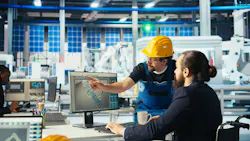
Many manufacturers share the same frustration: AI works great in pilots but struggles to scale. Gains remain local and difficult to replicate from one site to another. This is because they have approached AI as a new set of tools to be integrated.
AI needs a different approach. As Accenture has found, leading companies have moved to “systemic AI.” It means intelligence that operates as the production system itself, not alongside it, linking decision-making to physical execution across machines, lines, plants and supply networks.
Unlike earlier Industry 4.0 programs, which digitized and automated assets in isolation, systemic AI connects key performance indicators, decision rights and escalation paths. This lets the system act repeatedly and safely across sites without rebuilding from scratch each time.
Systemic AI creates durable advantages
Most AI projects happen in operations and maintenance, for example, to reduce quality error rates. But what if those errors didn’t happen in the first place, because the production line or entire plant had been designed and commissioned virtually and then optimized before construction began?
Such upstream wins are one of systemic AI’s greatest advantages. AI applied to early phases of asset and product development lifecycles locks in cost and performance before capital is committed. Mistakes are caught before teams rework physical assets, and the time it takes to bring products to market shrinks.
Manufacturers deploying AI systemically report significant efficiency gains. A US aerospace manufacturer found that enabling AI in the notoriously challenging handoff from engineering BOM to manufacturing BOM eliminated traceability errors that had previously propagated unchecked into production.
More broadly, companies report 30–40% reductions in unplanned downtime, 25–30% gains in maintenance capacity and over 30% faster new product introduction.
Getting from piloted AI to systemic AI
These five areas support systemic AI:
1. Integrate systems and data so decisions flow end to end
Most manufacturing systems still optimize locally. Planning runs on forecasts, production reacts on the floor, quality flags issues after the fact and logistics compensates afterwards. Manufacturers should link these functions and systems, so decisions reinforce each other in real time.
This means tackling the hardest problem in manufacturing IT: connecting enterprise systems (planning, finance, procurement) with operational systems (machines, sensors, quality) and engineering systems (product specifications, change management, BOM).
A practical approach is to create a shared semantic layer. With common definitions across processes, AI can reason across systems and act consistently. A global automation manufacturer implemented a hardware-agnostic platform layer that communicates with legacy equipment from across vendors simultaneously. The platform does not replace the underlying systems; it enables agentic AI to traverse the full stack, from shop floor sensors to procurement records in ERP.
2. Know what is worth building yourself
Foundation models and industrial AI platforms have made building everything from scratch indefensible. Manufacturers should focus on what differentiates them: domain expertise, process knowledge, proprietary data and integration architecture.
Some assumed that generative AI and vibe coding had made it possible to build complex systems like MES and ERP without specialist help. The experiment failed. As one executive put it: “Maybe there are some companies that will try to do it. Good luck. It's much more complex than people anticipate.”
As a result, the need for partners and providers has intensified. But no single provider delivers the full stack. Manufacturers should look for domain depth and an IT/OT integration track record. Nothing from any vendor works out of the box without deep integration expertise on top of it.
3. Redesign decision rights and operating rhythms
AI deployments often stall because organizations fail to anticipate how workers experience AI and adapt how decisions are made. Before AI goes live, manufacturers must define what decisions can be automated, what decisions require human validation and what conditions trigger escalation.
Operating rhythms determine whether AI is actually used. Leading manufacturers are embedding AI into the daily cadence of work. For example, shift handovers reference AI-generated insights, and planning reviews are built around live model outputs. That way, AI becomes part of the work rather than an option.
4. Create secure closed loops with physical AI and agentic AI
Physical AI excels at execution, while agentic AI excels at coordination. Together, they enable a closed-loop system where the factory anticipates, adapts and continuously improves. To achieve this, AI outputs must directly influence machines and workflows. Digital twins and simulations act as safety layers before real-world execution.
As agentic logic expands into operational environments, cybersecurity risks increase. Manufacturers must separate IT and OT networks, apply strict verification of all connections, monitor for anomalies in real time and maintain incident response plans that account for physical safety. AI systems should also have clear limits on authority over critical production decisions.
5. Keep humans in the lead
Autonomy without accountability is senseless risk. The manufacturers making the most progress with AI clearly define where human judgment is required.
To scale safely, companies must formalize four modes of control:
- Autonomous execution within guardrails (system acts when risk is low and defined constraints are satisfied)
- Human validation required (supervisor approves proposed action before execution)
- Escalation required (thresholds trigger escalation to a named role)
- Stop and rollback for anomalies (anomalies trigger automatic return to manual control)
About the Author
 Sam Paul
 Sam Paul
Sam Paul is the senior managing director leading Accenture's US Industrials Industry Group, which includes aerospace & defense, automotive, transportation & logistics, and all industrials. He serves as a member on the National Association of Manufacturers’ Board of Directors.
 Leaders Logo
Leaders relevant to this article: