Volkswagen Looks to the Cloud for Productivity Gains
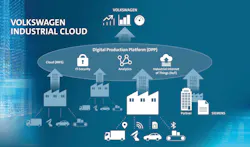
In March 2019, Volkswagen and Siemens announced the creation of Volkswagen’s Industrial Cloud, developed jointly with Amazon Web Services (AWS) using Siemens’ MindSphere IoT platform. According to the Volkswagen Group, the company sees this project as “laying the foundation for the seamless digitalization of its production and logistics” that would include the integration of Volkswagen’s global supply chain with more than 30,000 locations of its more than 1,500 suppliers and partner companies.”

Working as Volkswagen’s integration partner for the Industrial Cloud, Siemens plays “a key role in ensuring that machinery and equipment from different manufacturers at Volkswagen’s plants are connected efficiently in the cloud,” said Volkswagen. “In addition, Siemens will make its own applications available in the Industrial Cloud.”
As a first step in Volkswagen’s expansion of its Industrial Cloud, the company said that ABB, ASCon, BearingPoint, Celonis, Dürr, Grob-Werke, MHP, NavVis, SynaOS, Teradata, and Wago are joining the initiative.
Volkswagen plans to open access to its Industrial Cloud to other partners as well. According to Volkswagen, “new partner companies will be able to connect with Volkswagen plants and contribute their own software applications for optimizing production processes to the Industrial Cloud. Each plant will be able to obtain applications for its machinery, tools, and equipment directly from the Industrial Cloud to optimize production.”
The Industrial Cloud will eventually include “all of Volkswagen’s factories throughout the world and its global supply chain and will facilitate data interchange between systems and plants,” said Volkswagen. The company expects “significant efficiency and productivity gains at its plants” as a result of this Industrial Cloud program.
App development
Some of the applications already created for VW’s Industrial Cloud include:
- An algorithm using artificial intelligence to calculate requirements for driverless transport systems for plant logistics, developed by SynaOS;
- Software for optimizing plant efficiency using overall equipment effectiveness (OEE), developed by Dürr; and
- An application for generating a digital twin in the cloud to simulate the capacity deployment and maintenance intervals of machines without intervening in the physical production process, developed by ASCon Systems.
Once cleared for use in the Industrial Cloud, these apps can be downloaded and applied by Volkswagen plants, much like consumers download apps from an app store.
The company noted that its Industrial Cloud program will provide its partners the ability to “scale and further develop their applications in one of the world’s largest automobile production networks, enabling them to optimize their own processes and products” in the process.

Partner management
Explaining how partner participation in its Industrial Cloud is managed, Volkswagen said, the process begins by sharing “the necessary information needed by its partners to get the most efficient solutions. At the same time, data security and confidentiality are our top priorities. The key is selectivity. Volkswagen alone decides who has access to which data and information and to what extent.”
Specifics Volkswagen provides to its partners include technical readiness criteria for development, integration, API (application programming interface) documentation, and security to ensure the compatibility of the applications in the Industrial Cloud.
Partner applications uploaded to the Industrial Cloud are “extensively tested in selected plants during the partner onboarding process,” Volkswagen said. “Only after a successful test phase are the applications rolled out [to other plants] via the Industrial Cloud.”
Join us for “The Most Engaging Virtual Event for the Entire Industry” at PACK EXPO Connects, November 9-13. Live demos of equipment and products, live chat with product experts, expedited product search, and more. Attendee registration opens September 15. Be notified when the site goes live by clicking here.
About the Author
 David Greenfield
 Leaders Logo
Leaders relevant to this article: