Industrial Surge Protection: Essential Technologies and Installation Standards for Automated Equipment Safety
Key Highlights
- While 80% of surges originate internally from normal operations like motor starts and VFD inverter operation, external causes like lightning and utility switching also demand industrial-grade surge protective devices across all system components.
- UL 1449, IEC/EN 61643, IEEE C62 and NFPA 70 (NEC) establish requirements for surge protection devices, which are categorized into five types by Underwriters Laboratory for different installation scenarios from main distribution panels to point-of-use applications.
- Whether retrofitting existing systems or designing new facilities, organizations can choose from busbar-mounted, DIN rail, enclosed external, terminal block and conduit-compatible options, including specialized Ethernet protectors for digital networking and data communications.
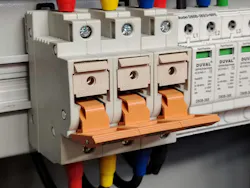
In many settings, people consider electrical surge suppression protective devices as being optional. However, proper electrical surge suppression technologies and techniques are critical to protecting equipment and systems in industrial environments.
The reason: Power surges can originate in a variety of ways, and while sensitive digital control and power elements are particularly susceptible to surges, even motors can be affected.
That’s why those responsible for industrial equipment need a complete understanding of the regulations associated with surge protection, along with the products available to create surge-resistant systems.
Understanding surge sources
While electrical surges can originate from several areas, sources such as Mersen, indicate that the majority (perhaps 80% or more) are attributable to internal causes, even during normal operation or recovery actions.
Some common examples include:
- External causes: Normal utility and generator grid switching, nearby electrical system faults (such as a downed transmission line) and lightning strikes.
- Internal causes: Starts/stops of large motors, and variable frequency drive (VFD) inverter operation.
- Restoration causes: Surges caused when a utility restores power after an outage, or a site engages/disengages backup power.
Depending on the source, the voltage and current characteristics of a surge can vary widely.
Surge suppression requirements and technologies
A surge protective device (SPD) is designed to detect and divert harmful overvoltage conditions, shunting the surge to ground before it can reach sensitive downstream electronics. Metal oxide varistors (MOV) and gas discharge tubes are two fast-reacting technologies commonly used for handling and clamping excess voltages.
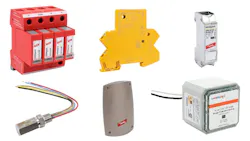
Today there are a wide variety of industrial-grade SPD products and design techniques applicable for main power distribution, control panels, electrical circuits and even for low-voltage signaling circuits.
Unfortunately, SPD technologies tend to be sacrificial, i.e., they need to be replaced after protecting equipment from a surge. For this reason, there are increasing requirements and product options to provide indication that protection is active and to alert personnel if inspection and maintenance is needed.
Some OEM equipment includes built-in SPD provisions, but power distribution systems supplying loads of all types may require surge protection to comply with applicable standards and regulations.
A few of the key standards addressing surge suppression for commercial and industrial applications include:
- UL 1449 Standard for Safety Surge Protective Devices.
- IEC/EN 61643 series, which addresses SPDs for a variety of applications.
- IEEE C62 series covers many surge protection topics.
- NFPA 70 of the National Electrical Code (NEC), which now has many sections related to surge protection.
SPDs are defined by several characteristics such as:
- Single surge current rating.
- Nominal discharge current.
- Short circuit current rating.
- Response time.
- Nominal operating voltage.
- Maximum continuous operating voltage.
- Voltage protection level. This is also called let-through voltage or clamping voltage. It is the maximum voltage that a surge protector allows to pass through to connected devices before it starts to limit or suppress further voltage. A lower let-through voltage indicates better protection for the devices against power surges.

SPDs are commonly available as parallel-connected devices, which simplifies installation, but some versions may be connected in series. Depending on the installation, SPDs may require overcurrent protection or compliance with the tap rule. This means that designs may need to incorporate a separate overcurrent circuit protection device (OCPD) or upsize conductors to properly install an SPD. Some SPDs include an integrated OCPD to simplify installations.
To clarify the types of SPDs, there are several categories defined by Underwriters Laboratory (UL):
- Type 1: Permanently connected, hard-wired SPDs intended for installation between the secondary of the service transformer and the line side of the service equipment overcurrent device, as well as the load side.
- Type 2: Permanently connected, hard-wired SPDs intended for installation on the load side of the service equipment overcurrent device.
- Type 3: Point of utilization SPDs (commonly cord-connected surge strips, direct plug-in devices or receptacle-type products) installed at least 10 meters from the service panel, usually at the point of use.
- Type 4 component assemblies: Assembly of discrete components intended to be integrated into end-use products or larger SPD assemblies.
- Type 5: Discrete components, such as MOVs, which may be mounted on a circuit board. These are often used in the design and construction of other SPD types.
Surge suppression may be mandated for new installations. However, many end users understand that it is prudent to retrofit SPDs into existing systems.
For these reasons, a variety of SPD form factors have been developed to support any type of installation need. Examples include:
- Configurations designed and optimized for direct installation to the busbars of compatible electrical distribution panelboards.
- Open types for panel or DIN rail mounting with one or more circuits. Some types have plug-in protection modules for fast hot-swap replacements. These are typically best for protecting the main circuits of new equipment.
- Enclosed types for external mounting near the connection point. These are useful for space-limited new installations and for retrofits.
- Terminal block types for high-density DIN rail mount. These are especially useful for control power, data/communications and input/output signal applications.
- Conduit-compatible types, made of stainless steel for installation near a field device. These are useful for lighting protection of instruments and devices located outdoors at process facilities, even in potentially explosive environments.
Looking beyond traditional power and signal circuits, newer installations rely more on digital networking, and there is an increasing need to protect low-voltage Ethernet connections for data and telecom applications.
Specific standards such as UL 497B “Protectors for Data Communications and Fire-Alarm Circuits” address these applications and specialized product form factors with CAT6 RJ45 sockets are making it easy to protect Ethernet and Power over Ethernet cabling and equipment within a control panel or as the cables transition from inside to outside a building.
More industrial power-related insights from Automation World:
About the Author
 David Saenz
David Saenz
David Saenz is a product engineer at AutomationDirect. He joined AutomationDirect in 2024, and holds a BSEE degree from the Georgia Institute of Technology. Before joining the company, David Saenz spent 10 years supporting a medical device manufacturing facility as a controls and electrical engineer. He previously worked as an I&C engineer supporting civilian nuclear power generation engineering projects.
 Leaders Logo
Leaders relevant to this article: