What Your Maintenance Data Can And Can't Tell You About Wrench Time
Key Highlights
- Downtime and work-order data don't fully reveal how technicians spend their time.
- Wrench time is influenced by planning, scheduling, parts availability, and other delays.
- Manufacturers can improve visibility with better time-stamping, delay tracking, and periodic sampling studies.

When a machine stops, the plant's systems start keeping time. The MES logs the stop until the machine runs again, and a work order opens in the computerized maintenance management system (CMMS). The technicians who respond book hours against it. Those records time the machine and the job. None of them, on its own, shows how much of a technician's shift went to the repair.
That gap is the maintenance side of a question Luigi De Bernardini, CEO of the integrator Autoware, raised in his September CSIA column. An MES/MOM system, in his view, has to know "what counts as normal operation and what counts as loss." Analytics built before a plant settles that logic for machine states and losses tend to rest on shaky ground, he adds.
Where the benchmark figures come from
Wrench time is the portion of a technician's available hours that goes to productive work on the job. The rest, in Doc Palmer's definition, is lost to delays, among them waiting for parts, tools, instructions, clearance or assignment, plus travel and coordination with other crafts. Job paperwork, including entering time and feedback into the CMMS, counts as direct work in the category scheme of his Maintenance Planning and Scheduling Handbook. So the term covers more than time with a tool in hand.
Across most maintenance crews, wrench time runs about 35%, Palmer writes in a Plant Services column on crew size, summing up statistical work sampling without naming a study. In the same column, he sets upwards of 55% as what proper planning and scheduling can achieve, a target rather than anything measured.
Table 1 sets the other figures in circulation beside those two. Only two rows point to a study a reader can examine, and each covers a single site. One is a power plant's mechanical crew, in a study reproduced in Palmer's Handbook. The other is a titanium dioxide plant.
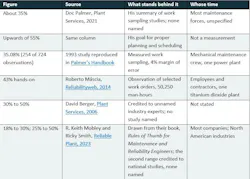
What moves wrench time matters more than any one figure. Planning done ahead of assignment shortens the waits inside a job, and scheduling shrinks the dead time between one job and the next, Palmer explains. Both show up in wrench time. Yet as a number to track, wrench time can be terrible, he warns. It says nothing about how efficiently the work was done, or whether the job was worth doing in the first place. A plant that measures it anyway learns more from its own figure, measured the same way twice, than from any row in the table.
What plant records show and miss
Start with the downtime event, which the standards define around the machine. In IEC 60050-192, the dependability part of the IEC's international vocabulary, downtime is the interval an item spends in a down state. An item is in that state when it can't perform as required because of an internal fault or preventive maintenance. Under ISO 22400-2:2014, the KPI standard for manufacturing operations management, time to repair is the time a work unit is unavailable because of a failure.
Neither definition separates the repair from the waiting around it. Researchers at the National Institute of Standards and Technology (NIST) caution that the whole interval from machine down to machine up might not be spent on the repair. Their KPI list places time to dispatch, from machine down until the technician arrives, inside that window. The IEC vocabulary names the rest: repair time excludes technical, administrative and logistic delays. A logistic delay is the wait for resources a maintenance action needs to proceed or continue.
The work order can hold time-stamps that would separate some of those delays from the repair. Besides machine down and work order start, the same researchers list one for the technician's arrival at the machine, plus part ordered, part received, problem solved and machine up. Not every manufacturer they studied recorded those elements. Technicians often record work informally or not at all, NIST researchers observe, and the staff who enter work orders are often short of time.
Close dates add a distortion of their own. At one laboratory and office facility, about 93% of the HVAC work orders in a NIST case study were closed on a Friday. The authors judged it highly unlikely that those dates matched when the work was finished in the field. Without a direct estimate of labor hours, they concluded, treating the close date as the finish would inflate downtime or labor-hour figures by a wide margin.
Booked hours are the third record, and the IEC vocabulary is blunt about them. Maintenance man-hours are "a measure of resource use, either estimated or actual, and not the real time duration of the maintenance action." Suppose a work order carries eight booked hours. How many of them went to work on the equipment itself? That was David Berger's question in a Plant Services column, and he added that such detail is hard to record in a CMMS and not easily verified.
The Society for Maintenance & Reliability Professionals (SMRP) puts booked hours to a different use. One of its metrics compares actual hours with the planning estimate, a gauge of planning and supervisory skill rather than of hands-on time. Wrench time has a place of its own in the same set, as a trend that can show whether unnecessary delays are being eliminated.
One plant tested its records before trusting them. At a titanium dioxide plant in Brazil, the project team first analyzed what maintenance employees had recorded in work orders and judged it not properly logged. It ruled out time cards too, since they would add a document to the process and carry the same recording problem, and observed the work directly instead. Hands-on time came to 43% of what the team measured across employees and contractors. The project's account in Reliabilityweb is one plant's experience, not a benchmark. Its order of work is the useful part: check what the records can show, then measure the crew.
What to change next week
Four changes let the records a plant already keeps show more of where the crew's time goes.
Time-stamp the technician's arrival and the parts. Record when the technician reaches the machine and when parts are ordered and received, beside machine down and machine up. The stop then breaks out time to dispatch and the wait for parts. What remains still mixes the repair with other waits, such as for a clearance or tools.
Check close dates before trusting any duration. If most completions land on the same weekday, NIST's researchers say those dates likely reflect a management routine rather than time spent on the work. A start-to-finish interval that is consistently zero or negative means at least one of its time-stamps is wrong.
Read schedule compliance with the reasons attached. Count it Palmer's way, as the share of originally scheduled work orders the crew completed, so work done off the schedule earns no credit toward the score. Its second job is to show why the plant couldn't execute all the work it planned. That means recording a delay reason against each job that slipped, with a short list of reasons and room for a note. Keep that note: restricted-entry systems can increase errors under some circumstances, NIST researchers caution. Then run a Pareto of the reasons, as Palmer recommends in a later column, and go after the biggest practical opportunities. His examples include jobs that take longer than expected, planned parts that turn out wrong, new reactive work, and operators who can't give access to the equipment.
Calibrate with a sampling study now and then. Work sampling means recording what technicians are doing at sampled moments and counting the share that falls on direct work, as in the power plant study above. Tell crews what the study is for. Measuring wrench time can improve productivity if the aim is to remove the obstacles and frustrations that hold up the work, Ron Moore argues in Uptime magazine. It should never become a test of whether technicians are working, he adds.
De Bernardini's question about production data, what counts as loss, applies just as well to a technician's shift. Time-stamps and recorded reasons start the counting, and an occasional sample checks it.
About the Author
Luke Hamer
Sockeye Technologies
Luke Hamer is the vice president of Business Development at Sockeye Technologies.
 Leaders Logo
Leaders relevant to this article: