Multiply Labs Develops Robotics for Therapy Production with Nvidia Technology
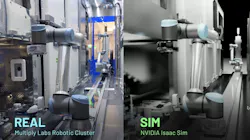
Robotic biomanufacturing company Multiply Labs said it has made a significant advance toward its goal of scaling production of cell and gene therapies by using Nvidia’s open Isaac and GR00T robotics simulation and perception technologies.
This marks a change for an industry that has historically relied on manual processes.
The robotics-first biomanufacturing systems being developed by Multiply Labs are intended to bring greater consistency, traceability and operational efficiency to advanced therapy production so that personalized therapy treatments can be more broadly accessible.
Multiply Labs’ systems use four robotic arms operating in parallel to maximize output in existing facilities, targeting up to 100x more patient doses per square foot of cleanroom space compared to traditional manual processes.
The company’s integration of Nvidia robotics and AI infrastructure covers three core areas:
- Digital biomanufacturing twins: Multiply Labs is building high-fidelity robotic digital twins with Nvidia Isaac Sim to simulate new hardware, test automation strategies and perform software-in-the-loop validation before deploying to physical systems.
- Training and generalizing manipulation skills with foundation models: The company is exploring how Nvidia Isaac GR00T open robot foundation models can learn manipulation behaviors relevant to biomanufacturing.
- Perception pipelines to convert expert demonstrations into training data: This involves building perception workflows with Nvidia FoundationPose and Nvidia FoundationStereo to learn biomanufacturing steps.
More robotics insights from Automation World: