Meeting E-commerce Expectations with Automation
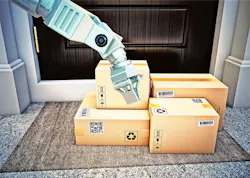
In today’s e-commerce environment, it’s what Walmart wants. Or, more specifically, “If you don’t do what Walmart says, they go somewhere else.” That was the statement from a representative of a large consumer packaged goods (CPG) company who participated in the Vision 2025 sessions at PACK EXPO Las Vegas last September. This meeting brought together machine builders, CPGs, and contract packagers to tackle issues ranging from asset reliability to request for proposals to dealing with multifunctional equipment with fast and efficient changeovers—a byproduct of “what Walmart wants.”
While Walmart and other online retailers are influencing manufacturing decisions, they are merely a symbol of a much bigger issue related to the omnichannel market—broadly defined as an integrated approach to e-commerce that serves a multichannel sales model. This new sales scenario means that products must be made in smaller formats and sizes. As a result, manufacturers must adapt processes to accommodate the batch of one, which requires flexibility on the manufacturing and packaging lines as well as in the warehouse and across the supply chain.
Automation World recently reported on this Amazon effect, in which consumers expect fast, frictionless transactions with visibility and accessibility at every step in the buying process. In this demand-driven market, the goal is to economically produce one customized product. This requires reconfigurable, modular machinery that can mix and match product flows. One solution for this comes in the form of flexible track systems, such as B&R Industrial Automation’s AcoposTrak and Rockwell Automation’s iTrak independent cart technology.
But technology suppliers are taking the concept of flexible manufacturing a step further by doing more integration, coupling traditionally independent applications—like robots, vision, and labeling—with machine control. They are also applying emerging technologies, like digital printing, and investigating ways to tie it all together through enterprise applications.
Integrating the automation portfolio
Robots are an important element in the e-commerce ready factory. At Procter & Gamble (P&G), there are three pilot projects underway at manufacturing sites focused on digitization, from suppliers to customers—a specific response to omnichannel retail. As part of that effort, the company is deploying automated guided vehicles (AGVs), automated mobile robots (AMRs), and collaborative robots (cobots).
“As we move to e-commerce, we have changed the way we look at manufacturing,” says Jay Joyner, P&G’s engineering manager, product supply global engineering and supply innovation. “We need to do more customization—like putting four different products in one package—and therefore we are trying to increase the amount of automation to create agility and flexibility from when the order is placed to when it is shipped.”
Cobots, specifically, are a natural extension of B&R’s AcoposTrak technology because they have the flexibility to change end-of-arm tooling (EOAT) without changing the layout of the processing station, says John Kowal, marketing director at B&R Industrial Automation. In November, B&R—which is a unit of ABB’s Robotics and Discrete Automation business—announced the integration of ABB robots into B&R’s automation portfolio, resulting in the integration of robotics and automation into one controller and one engineering system. This means there is no need for an extra control cabinet for the robot, and that programming robotics and machine control is combined in one development application.
This is the latest development in B&R’s integrated control strategy which added machine vision into the mix in 2018. A smart camera—including intelligent image processing algorithms and integrated with the control system—running over the same network can synchronize machine functions with microsecond precision.
“We are running robotics, safety, the track system itself, and even condition and energy monitoring on the same processor, same program, and same network,” Kowal says. “It means you don’t have as many hardware connections and we can synchronize a robot to a shuttle axis with CNC kind of precision. These are fundamental changes, only possible with integrated software development and with Moore’s Law processing power and communication over a unified, high-speed network.”
An example of how this can work was demonstrated at PACK EXPO Las Vegas in September 2019, where JLS Automation showcased its new patent-pending Peregrine robotic cartoning system. Using B&R’s AcoposTrak—which JLS renamed to JLS Trak—the vision-guided system can handle a variety of packaging formats—all at once.
“Peregrine has three elements that are game-changing,” said JLS president Craig Souser in a video interview. “It remains a high-speed cartoner, but it is a flexible machine that can do changeovers on the fly. Conceptually, we can run two different SKUs at the same time…and it is a small footprint compared to conventional cartoning systems.”
This type of flexibility carries through to other application areas on the production line, like labeling. A beer bottle may have a front label and a neck label or different shaped containers that requires different size labels, all of which AcoposTrak can manage.
For example, an adaptive machine from Makro Labelling makes it possible to run different labels, container shapes, and sizes simultaneously on the same rotary labeler. One application could be making rainbow packs without repacking. Makro synchronizes two tracks, one below to serve as the bottle plates and one above to secure the bottles' necks. The bottle plates pair two shuttles to provide an infinitely adjustable bottle rotation with no changeover parts or stoppages, thus allowing any combination of label configurations inline. It is limited only by the number and type of aggregates available.
The importance of labels, digitally speaking
An e-commerce package can pass through 20 to 30 different touchpoints in the supply chain before reaching its destination. Tracking the individual packages to ensure the product is delivered all in one piece is an important part of the e-commerce story.
When a product comes off the manufacturing line it requires information of its origin and expiration dates. From there, layers of information are added. “Each movement requires yet another labeling action,” says David Crist, president of Brother Mobile Solutions. “So there is a need for technology in a lot of different places whether it’s on the manufacturing floor or in the warehouse.”
And with smaller lot sizes and mixed products, there’s a need for more detailed identification. “Amazon has set the standard for small, customized quantities delivered instantaneously and done flawlessly, and that has become the consumer expectation that everyone is scrambling to organize their infrastructure around,” Crist says. “It may seem that printing is a dull part in the infrastructure piece, but it plays a role. Anything that moves in and around the infrastructure has to have a label on it with a barcode or RFID tag, or you can’t keep track of where it is going to satisfy these hyper-requirements.”
Crist says Brother is stepping up to meet e-commerce demands with new products that are geared for the smaller, distributed warehouses being built closer to the customer.
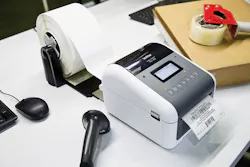
Last May, Brother Mobile Solutions announced the launch of its TD 4 Desktop Thermal Printer Series designed with ‘supply-chain-ready’ functionality for printing barcode labels, tags, or receipts for virtually any application in the warehouse, transportation, and logistics supply chain, including the manufacturing plant. The product series was engineered to help the business or warehouse meet new standards of speed driven by omnichannel commerce. The initial launch included TD 4-inch printer models using direct thermal printing technology, which was followed by thermal transfer printing models—these are used on the factory floor for tagging sourced components when they arrive at the plant and move to shelves, bin boxes, and tool cribs. During production, barcode label systems identify and track items as they move through a facility or assembly line. And in the warehouse, they are used to mark racks, shelves, bins, and to identify finished goods for fast, accurate routing and traceability as they are packaged or shipped for delivery across the supply chain.
In addition, the printers integrate with warehouse management systems and enterprise apps running on mobile devices.
The end user experience starts in the enterprise
Ultimately, e-commerce begins and ends with the consumer—from the ordering to the unboxing—the experience must be effortless and enjoyable. From the customers’ perspective, buying a product online must feel personalized. But on the backend of manufacturing, the process of customizing offerings must be highly organized.
“How a customer perceives the personalized offering and how manufacturing builds it are two different things,” says Carter Lloyds, senior vice president and chief marketing officer at QAD, a provider of enterprise resource planning (ERP) software for the manufacturing industry. “Like a Mini Cooper, there might be a million different configurations, but it is all really assemble-to-order and not engineered-to-order, even though it may feel that way to the customer.”
Built into the QAD software suite is a product configurator that can be used as part of an online storefront enabling the configuration of an item down to a batch size one.
“The product configurator understands what capabilities are being created and the process changes needed to manufacture it, whether it’s different routings or if it just needs to have information attributes sent to a given machine to do some specific calculations,” says Bill Keese, QAD’s senior vice president of research and development. “Through that configurator you basically can have as much flexibility as you can design into the product itself and that, of course, drives out into the manufacturing process.”
Moreover, if projections need to be made around demand for individual configurations—which requires more demand-based supply chain planning—the QAD platform includes built-in machine learning, enabling timely adjustments to seasonal demand patterns, for example, at lower inventory levels.
The flexibility within the supply chain and manufacturing must also flow over into packaging, which is where digital printing comes in. Remember the “Share a Coke” campaign from Coca-Cola with people’s names on the bottle label? This kind of personalization relied on digital presses and raised the bar for a new kind of user experience, one that builds a trusted relationship between brands and consumers.
“That became a major disruption in the flexible packaging industry,” Keese says.
Indeed, it’s fair to say that everything associated with e-commerce has been a major disruption to manufacturing, in general.
According to Joyner from P&G, the company’s manufacturing lines are not set up to meet the needs of e-commerce and therefore they are still in the early stages of figuring out how to customize a single bottle of Tide with your name on it and the scent of your choice. “We need machine builders and vendors to bring us ideas of what we can do different. We’ve been testing different types of technology, but we need a lot of help.”
About the Author
Stephanie Neil
Editor-in-Chief, OEM Magazine
Leaders relevant to this article: