You Automated Your Factory Floor, But What About Your Yard? Automation Prepares to Step Outside
Key Highlights
- Consider what outdoor autonomy actually requires.
- Agriculture gave us something the industrial automation industry largely doesn't have.
- Build something that can see, navigate and operate reliably in a world that was not designed for it.
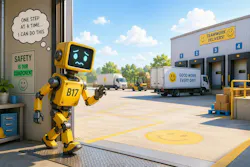
Walk through a modern distribution center and you will see one of the genuine achievements of the automation era. Autonomous mobile robots glide across polished concrete floors in choreographed patterns. Goods move from shelf to packing station without a human hand touching them. The lighting is consistent, the floors are flat, the environment is controlled, and the system works because someone spent years designing the physical space to accommodate the robot rather than the other way around.
It is impressive, and it is real, and it has delivered meaningful productivity gains for the operations that have deployed it.
Now walk outside.
The yard behind that distribution center, where trucks back in at irregular intervals, where forklifts cross paths with pedestrians, where the surface changes from asphalt to gravel to dirt, where weather introduces variables no planner fully accounts for, where nothing is labeled and nothing is fixed and the whole environment rearranges itself continuously…that is where automation stops. The robots go back inside. The humans take over. And in that gap between the controlled indoor environment and the chaotic outdoor one, enormous amounts of labor are performed in ways that are dangerous, physically punishing, and extraordinarily difficult to staff.
That gap is where the next decade of industrial automation value gets created. And companies that have spent years learning how to operate autonomous systems in genuinely unstructured outdoor environments—not in simulation, not in controlled demos, but in actual fields across multiple continents—are in a position that no amount of capital can quickly replicate.
Agriculture gave us something the industrial automation industry largely doesn't have: years of hard-won operational experience in outdoor conditions that are more variable, more unpredictable, and more unforgiving than any factory floor. The problems we had to solve to operate reliably in a vineyard row or a nursery yard are not simpler versions of the indoor robotics problem; they are different problems entirely, and solving them required building capabilities that translate directly to the industrial outdoor environments that are next.
Consider what outdoor autonomy actually requires. Indoor robots exploit structure: fixed shelves, consistent lighting, barcoded locations, floors designed to be machine-navigable. When you take that structure away, the foundational assumptions collapse. Localization, knowing precisely where you are in the world, becomes genuinely hard when you're operating under crop canopy where GPS is unreliable and the visual environment changes daily with plant growth and weather. Obstacle avoidance becomes a different problem when the obstacles include workers who don't wear sensors, vehicles moving at unpredictable speeds, and terrain features that weren't there last week. Path planning becomes an exercise in real-time adaptation rather than pre-computed optimization.
These are exactly the problems that industrial outdoor environments present. A port yard. A utility corridor. A construction site. A logistics campus where the indoor automation ends at the loading dock door and everything beyond it is managed by human labor and diesel equipment.
The specific form factors and use cases differ from agriculture. The underlying challenge is identical—build something that can see, navigate and operate reliably in a world that was not designed for it, near people who are not going to modify their behavior to accommodate it.
What agriculture also taught about the human dimension of outdoor automation is something that the industrial world tends to underestimate. The workers in these environments, the yard operators, the equipment drivers, the people doing the physical outdoor work that industrial facilities depend on, are not passive recipients of technology. They are the ones who determine whether it works or not. A system that takes work away from people that they take pride in, that represents their skill and their value to the operation, will face resistance that no engineering solution can overcome. A system that takes the genuinely miserable work, the repetitive, physically punishing, exposure-risk work that nobody chose when they have other options, creates advocates out of the workforce it touches.
We learned this through years of fieldwork, not through user research reports. We learned it by hiring people who spoke the same language as the workers running our equipment; by being present in operations when things went wrong and listening to exactly what happened; by building our product-iteration cycles around complaints rather than compliments. The workers closest to our systems have consistently become their most effective advocates. Not because we asked them to, but because the alternative was worse and they knew it better than anyone.
The industrial outdoor-labor market is not a niche. It is one of the largest concentrations of physical labor in the developed economy, and it is facing many of the same structural pressures that drove agriculture to automation: genuine workforce scarcity, rising labor costs, safety-liability exposure, and the widening gap between what these jobs physically require and what the available workforce is willing to sustain in the long-term.
Those pressures don't resolve on their own...they accelerate.
The question for industrial operators is not whether outdoor automation is coming. It is whether they engage with it now, on their own terms, with the ability to shape how it integrates into their operations, or whether they wait until the pressure is acute and the options are fewer.
The technology that has been proven at scale in one of the hardest possible outdoor environments is ready to be applied to the next one. The yard outside the factory has been waiting long enough.
About the Author
 Leaders Logo
Leaders relevant to this article: