Physical AI Safety: How Industrial Robots Should Respond When Authorization Is Withdrawn
Key Highlights
- Physical actions are not atomic: stopping midway can create risks or operational consequences of its own.
- PackML, ISA-88, fail positions and safety functions may already define exits, but their coverage should be verified.
- Withdrawn authority differs from a fault or hazard, and a safe action can still be unauthorized.
- Test systems by withdrawing authorization at random points and comparing the resulting behavior with the approved exit plan.
- Document how quickly withdrawal reaches the actuator, who approved the exit, and what authority existed throughout the action.
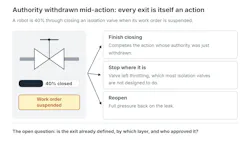
A mobile robot is 40% of the way through closing an isolation valve on a leaking line when its work order is suspended. It was dispatched properly. Its motion is safe, the request was authenticated and the robot can do the job. Now the authority behind the action is gone, and the robot has three choices: finish closing, stop where it is or reopen. Each is a physical event with its own consequences. Which layer owns the decision about what happens next?
Discussion of physical AI tends to focus on the start and end of an action: Is it safe? Who asked? Did it work? Less attention goes to what happens when the authority behind an action ends partway through, at a point where stopping is itself consequential.
No rollback in the physical world
Transactional software has a clean answer when permission fails at the moment of use: abort and roll back, as if nothing happened. Physical actions are not atomic. A half-closed valve throttles flow, which most isolation valves are not designed to do. Reopening puts full pressure back on the leak. Finishing may be exactly what the new instruction forbids if the control room has chosen to isolate closer to the leak and needs this line kept in service. The same holds well beyond valves: a robot halfway through placing a heavy part, a dispensing cycle half complete, a weld partly laid.
So “stop” is not one answer. The right exit depends on why authority was withdrawn. A revised isolation plan, a suspended permit and a change of operating mode may each call for a different one.
What already answers it
Much of this is familiar ground. PackML and ISA-88 define holding, stopping and aborting states that operators or supervisory systems can command, so a running machine or batch phase already has defined exits. Actuated valves have designed fail positions. The stop categories in IEC 60204-1 distinguish an immediate power-off stop from controlled stops. Interlocks and run permissives, scanned every controller cycle, can halt an action under way. And functional safety (IEC 61508, IEC 61511) should act if the half-finished state creates a hazard its safety functions were designed for.
Where these mechanisms cover the case, the question is answered. That coverage is worth documenting rather than assuming.
Where they may fall short
Safety functions and fail positions were built for faults, hazards and lost power. Withdrawn authority is different. It is often not a hazard: closing a valve against a supervisor’s new instruction can be perfectly safe and still wrong. A fail position is chosen once, at design time, for one kind of event. It cannot know why authority ended this time.
Physical AI adds two complications. First, a robot working a manual valve sits outside the DCS and outside any PackML or ISA-88 state model, so beyond its own safety stop it may have no defined exit at all. A human operator in the same spot gets a radio call and follows procedure; whether the robot’s dispatch path does the same is the question. Second, an AI planner taking direction from enterprise systems is a new command source. Its authority may be checked once, upstream, when the request arrives and a withdrawal takes time to reach the actuator. Management of change should catch that; whether it asks what the exit is, and who approved it, is worth checking.
What would settle it
This is testable. There would be no distinct gap if, across representative deployments, withdrawing authority mid-action reliably produced an exit that was defined and approved in advance, through control logic or procedure, and near-miss records showed no actions completed, or left in an undefined state, after authority lapsed. Tests or incidents showing the opposite would indicate a gap.
A simple pilot can tell which: on a test rig or during commissioning, withdraw authorization at random points during actuation, record whether the effect stopped, held, reversed or completed, and compare that with what was supposed to happen.
Four questions to ask about your own systems
- When authority is withdrawn, how long does that take to reach the actuator?
- For each action in progress, is the exit (complete, stop, hold or reverse) defined, and does it depend on why authority ended?
- Who approved that exit, and when?
- Afterward, can you show what authority existed at each moment of the action?
If those answers already exist, physical AI inherits a sound foundation. If not, the exit may need to be settled when an action is authorized, not improvised after. Either way, a machine that can do something has not, by that fact, been allowed to, and that is as true of how it stops as of how it starts.
About the Author
 Abhinandan Gill-Lakhowal
Abhinandan Gill-Lakhowal chairs the IEEE Robotics and Automation Society’s Execution-Boundary Authorization Study Group. He is principal advisor at Gillian Holdings Inc., an independent AI and data governance advisory practice in Calgary, has more than 11 years of delivery experience in regulated enterprises, and he has published a peer-reviewed paper on deterministic runtime enforcement in IEEE Access. He writes here in a personal capacity.



 Leaders Logo
Leaders relevant to this article: