Why Industrial AI Success Can Require Deployment Across Cloud, Edge and Field Environments
Key Highlights
- Manufacturers are focusing "why deploy AI here?" to strategically match use cases to cloud, edge or field environments based on specific business needs.
- Siloed data and cybersecurity concerns remain the biggest obstacles to scalable AI, making purpose-built industrial data fabrics essential for aggregating and contextualizing information across IT and OT systems.
- By using six coordinated AI agents working together, predictive maintenance systems can provide for automatic equipment identification and health monitoring to root cause diagnosis and manufacturing plan adjustments.

As AI adoption matures and the technology demonstrates scalable value, a shift is happening in how manufacturers deploy it. For example, industrial leaders are becoming more strategic about starting by first asking “why?” when identifying potential AI projects.
This line of strategic thinking indicates industrial leaders are more closely considering the best environment — cloud, edge or field — to maximize AI success for their specific use case.
Cloud deployments unite information from similar equipment to create larger context and holistic models. The cloud is especially useful for large language models (LLMs) as they require scalable compute power.
Edge deployments keep proprietary data secure and offer low latency to support tight control cycles. Edge computing is especially valuable for regulated industries where data must remain on premises.
Field deployments are best for intermittent connectivity and high-bandwidth scenarios, such as an AI-powered solution running on a truck in a mine.
There is no single deployment option that can be considered the right fit for all AI applications. The key is that AI projects designed to solve specific problems with measurable business value are better positioned to succeed and scale.
AI’s common thread: data
While the cloud, edge and field have their differences, all three have one thing in common: data. Purpose-built industrial AI based on first principles and simulation models can be effective without continuous data access, but model sustainment requires it. This is one of the biggest obstacles to scalable AI success.
Industrial data fabrics lessen cybersecurity risks that have been exacerbated by hundreds of point-to-point data connections built up over years. Instead, centrally managed data flows through a single, encrypted communication port.
Siloed data, lack of proper ontology and context, data quality issues and cybersecurity concerns can make it challenging to reap AI’s full benefits. That’s why industrial organizations are eager to adopt data management tools that not only mitigate these challenges but provide data access at the location where AI agents are deployed.
A lack of reliable data access can delay time-to-value and prevent organizations from reaping the full benefits of their AI strategies.
Bringing data to AI
For industrial AI adoption to continue its rapid growth trajectory, leaders need data infrastructures that support flexible AI deployment across different processing environments.
Modern industrial data fabrics are meeting this need, acting as a single source of truth that can aggregate and contextualize all types of data from both IT and OT environments. In addition to mitigating common data silo and ontology challenges, modern industrial data fabrics lessen cybersecurity risks that have been exacerbated by hundreds of point-to-point data connections built up over years. Instead, centrally managed data flows through a single, encrypted communication port.
Purpose-built industrial AI based on first principles and simulation models can be effective without continuous data access, but model sustainment requires it. This is one of the biggest obstacles to scalable AI success.
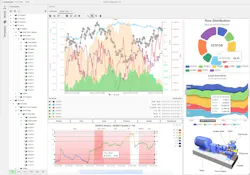
Modern, purpose-built industrial data fabrics can also support lightweight, flexible and scalable deployment by using edge devices and Linux containers for processing — even in remote industrial sites with unreliable network connectivity. With computing power closer to the data source, an industrial data fabric can significantly lower overall total cost of ownership by reducing bandwidth and cloud storage costs, while distributing workloads efficiently between resource-constrained edge environments and cloud locations. This unlocks critical data exchange between cloud, edge and field deployments.
Predictive maintenance reimagined
To understand how a modern industrial data fabric can operate in a real-world setting, consider the example of a predictive maintenance solution using six coordinated AI agents, with each agent having access to the right data.
The first agent automatically identifies equipment configuration and deploys health monitoring agents where needed. A second agent then monitors these deployed agents and sustains them as plant behavior evolves, ensuring they remain accurate and do not generate false alarms.
When abnormalities emerge, a third agent assesses severity and predicts time to failure, and a fourth agent then diagnoses root cause and automatically orders replacement parts. A fifth scheduling agent determines optimal repair timing. Finally, a sixth agent proposes changes to the manufacturing plan itself in context of the other agents’ work.
This coordinated multi-agent approach transforms maintenance from reactive firefighting into proactive, financially optimized operations management.
About the Author
 Dr. Heiko Claussen
 Dr. Heiko Claussen
Dr. Heiko Claussen is chief technologist at Emerson's Aspen Technology business, leading its AI organization encompassing the Asset Performance Management (APM) product suite, the AI shared services research organization supporting all product areas, and the AI R&D organization focused on developing novel cross-functional AI products such as Aspen Virtual Advisor. Moreover, Heiko is defining and executing AspenTech’s AI strategy, driving innovation across industries including energy, chemical, subsurface engineering, and electric power grid. Prior to Aspen Technology, Heiko was head of autonomous machines and principal key expert of AI at Siemens and led initiatives to enable autonomous machine applications for factory automation. During his 15-year tenure at Siemens, where he was ‘Inventor of the Year’ twice, Heiko worked in many areas related to AI and digitization, including remote monitoring, machine learning, robotics, pattern recognition and statistical signal processing. Heiko is a recipient of numerous technical awards and recognitions and is the author of over 100 registered inventions with 67 granted/published patents. Heiko holds a Ph.D. degree in electrical engineering from the University of Southampton, UK; a master’s degree in electrical engineering from the University of Ulster, UK; and a Dipl.-Ing degree in electrical engineering from the University of Applied Sciences Kempten, Germany.
 David Streit
David Streit
David Streit is a seasoned leader in industrial automation and digital transformation, currently serving as Vice President of Technology for the Enterprise Operations Platform (EOP) at Emerson's Aspen Technology business. At the forefront of Emerson’s Project Beyond, he is driving the development of a flexible, software-defined OT-ready digital platform that unites scalable control, industrial AI, and zero trust cybersecurity to enable autonomous operations and next-generation optimization across industries. With more than 15 years of experience spanning engineering, sales leadership, and executive roles, David has consistently advanced the adoption of cutting-edge automation technologies. David brings a unique perspective that bridges business strategy, technical depth, and operational excellence to support the convergence of IT and OT. As a frequent speaker and thought leader in the industrial automation space, his work centers on helping organizations modernize their automation architectures to unlock unified data intelligence, accelerate digitalization, and build resilient, future-ready operations.