Slashing 'Wrench Time': How Agentic And Physical AI Are Accelerating Repairs
Key Highlights
- Agentic AI can automate maintenance scheduling, parts coordination and work planning.
- Physical AI can support or perform maintenance tasks in the physical environment.
- Unified IT/OT data, intelligent edge systems and strong governance are key to safe autonomy.

For the past decade, the industrial sector has viewed predictive maintenance as the ultimate machine learning paradigm. We have wired our shop floors with sensors to foresee equipment failure and built sprawling dashboards to alert maintenance personnel the moment an anomaly is detected. The promise was simple: predict the failure, and you eliminate the downtime.
But there is a fatal flaw in this predictive paradigm. Knowing a failure is imminent does not automatically fix it.
Today, when an AI model flags a degrading asset in milliseconds, the alert hits a dashboard and the process slams into a wall of human administration. A typical alert initiates a slow, manual cascade of cross-departmental actions. A reliability engineer must verify the data, coordinate with the stores for spare parts, negotiate a downtime window with operations, and dispatch a physical maintenance crew. This human dependency creates a massive administrative bottleneck that slows everything down and erodes the value of the initial AI prediction.
The era of passive predictive dashboards is over, however. The true shift in industrial competitiveness occurs when AI matures beyond mere prediction and prescription. To achieve true optimization, industries must architect systems that answer a far more critical question: “How do we fix this with zero human administrative overhead and maximum throughput efficiency?”
The answer lies in activating two advanced realms of Industrial AI. By deploying agentic AI, to autonomously orchestrate the logistical response, and physical AI, to execute the physical repair, organizations can transform maintenance from a reactive bottleneck into an autonomous, self-optimizing engine. Here is how plant leaders can architect this transition.
The realm of agentic AI: autonomous orchestration and optimization
Agentic AI represents the critical next step in industrial intelligence, enabling the leap from generative output to autonomous action. In the context of industrial operations, an agent is a system operating within identified boundaries and guardrails, empowered to reason, plan, and execute multi-step processes across the operational environment with minimal to no human supervision.
When applied to maintenance, the agentic AI layer does more than merely identify an issue; it autonomously schedules and optimizes the entire logistical reality of the factory.
To understand the financial impact of this capability, consider a high-volume precision manufacturing line. A predictive AI model detects micro-vibrations in a critical CNC spindle, forecasting a catastrophic failure within 48 hours.
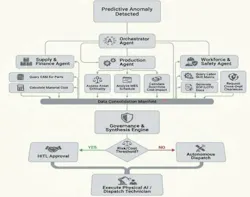
Traditionally, this sets off a frantic, manual coordination effort. But, with agentic AI, a multi-agent system takes over instantly, executing a three-phase remediation lifecycle that includes dynamic logistical reasoning, optimized scheduling (this is where the biggest ROI is achieved), and the generation of work protocols.
The mandate for deterministic bounding
For CXOs, the deployment of these autonomous systems introduces a valid concern regarding risk. To bring agentic AI into action safely, plant leaders must prioritize "Deterministic Bounding". In a safety-critical industrial environment, agents cannot rely on probabilistic guessing or hallucinations. They must be strictly guarded by rigid governance, secure interfaces, and highly specific APIs that enforce an auditable, secure trail of autonomous decisions.
Here is the typical agentic AI workflow:
The realm of physical AI: embodied execution
If agentic AI functions as the cognitive brain orchestrating the logistics, physical AI serves as the eyes and hands executing the work in the operational world. physical AI enables the deployment of agentic intelligence directly into hardware, allowing machines to perceive, navigate, and act dynamically within physical, three-dimensional space. This critical capability elevates the maintenance operation from a mere digital notification into a tangible, physical resolution.
Once the agentic layer has secured the part and locked in the schedule, the execution is handed off to the physical systems—enabling autonomous delivery. In scenarios where human intervention is still required for the final repair, physical AI optimizes the workflow. But in highly advanced manufacturing environments, physical AI will extend directly to robotic effectors.
Architecting to make the system autonomous
Transformation of a manufacturing shopfloor to this level of autonomy requires a comprehensive systemic change spanning industrial data management, the design of intelligent agents, and the enablement of physical systems.
To accomplish this goal of autonomous optimization, however, organizations must be conscious of three major mandates. Firstly, for agentic AI to be effective, IT and OT data must be unified and seamlessly available for the system to perceive and act. Secondly, the Edge must be intelligent as latency caused by cloud computing will be a severe constraint for any autonomous system.
Finally, a robust governance model is necessary. Even as systems become highly autonomous, humans remain an essential part of the operation. Stringent guardrails and rigid governance are the keys to avoiding AI hallucinations, enforcing safety non-negotiables, and controlling enterprise costs.
The strategic imperative
Autonomous maintenance is no longer science fiction; it is rapidly becoming a reality. It represents the current frontier of industrial competitiveness, enabling manufacturers to eliminate unplanned downtime, reduce capital expenditure through optimized inventory planning, and free up human capital to be deployed toward strategic engineering and root-cause elimination.
For CXOs, the mandate is abundantly clear: the era of passive dashboards is over. The organizations that will thrive in the next decade are those that strip away generalized AI hype and focus explicitly on building robust data foundations. By architecting their operations for decisive action, these leaders will harness the full power of an Industrial AI domain that natively integrates both physical AI and agentic AI.
About the Author
Venkatesh Bendigeri
Cognizant
Venkatesh Bendigeri is the asisstance vice president and delivery head of IoT and Engineering at Cognizant.
 Leaders Logo
Leaders relevant to this article: