Machine-Vision Industry Expected to Reach $8.3 billion in 2030 Despite Tariff Impacts, Report Finds
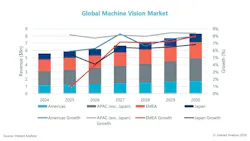
The machine-vision industry is continuing to grow despite anticipated tariff impacts and the market is forecast to achieve an average annual growth rate from 2025-2030 of 7.2% and reach $8.3 billion in 2030, according to a report from market intelligence specialist Interact Analysis.
The report had three key findings:
- The machine-vision industry outperformed expectations, growing 5.2% in 2025.
- Market predicted to reach $8.3 billion in 2030, increasing at an annual average of 7.2%.
- 3D cameras and vision software, along with autonomous driving and bin-picking applications, drive market growth.
According to the report, the machine-vision industry exceeded expectations to grow by 5.2% in 2025. Despite anticipated tariff impacts, the market is forecast to increase from $5.9 billion to $8.3 billion during the forecast period of 2025-2030.
The report suggests growth was underpinned by strong advancements in 3D cameras and vision software, as increasing demand for precision and high-grade inspection accelerates the shift toward intelligent vision systems.
Autonomous driving and bin picking also lead the way as key applications for machine vision, which are driving growth in the industry, according to the report.
“Tariffs introduced in early 2025 initially created uncertainty for the machine-vision market, as vendors and end-users assessed potential cost implications and adjusted purchasing plans,” said Jonathan Sparkes, Interact Analysis market analyst. “Despite these concerns, the market has demonstrated notable resilience, with continued adoption across manufacturing and non-manufacturing applications. In many cases, additional costs have been partially passed through as modest price increases, which have helped support revenue growth and partially offset margin pressures.”
Interact Analysis analysts predict that the Asia-Pacific region, excluding Japan, will remain the fastest growing region for machine vision, with an average annual growth rate of 8.1%, while Japan is forecast to achieve the lowest growth rate at 6%.
The Europe, Middle East and Africa region experienced the lowest level of growth in 2025 at 0.8%, although the region still exceeded expectations, with earlier forecasts predicting a -1.4% decline. Despite a poor 2025, the machine-vision industry in that region is expected to improve in 2026, with projected growth of 3.9%, and the region is expected to outpace Japan from 2025-30 with an average annual increase of 6.7%.
Interact Analysis also reported rising automation in warehousing, sorting and distribution has driven demand for machine vision in the logistics industry. Logistics is predicted to be the fastest growing industry for machine vision, from 2025-30, expanding from $494 million to $898 million at an average of 12.7% a year. The report also reveals that bin picking and autonomous mobile robots are the fastest growing applications for machine vision within the logistics industry.
It also found that despite the strong growth of the logistics industry, electrical and electronics is anticipated to remain the largest industry for machine vision, expanding from $742 million to almost $1.1 billion between 2025 and 2030.
Despite initial caution within the machine vision market in early 2025, Interact Analysis found that tariffs have ultimately had a small impact on machine vision and demand remains strong. Tariffs have resulted in modest price increases being passed through to end-users, although this has had minimal impact on demand and prices are projected to stabilize going forward, according to the firm.
More vision insights from Automation World:
AI Vision Inspection for Zero Defect Manufacturing
Universal Robots and Scale AI Launch Robot AI Trainer
Balluff Unveils New 5GigE Vision Cameras