PI And Omlox Accept FCC Proposal To Modernize Ultra-Wideband Rules
Key Highlights
- UWB provides precise real-time tracking for robots, equipment and workers.
- Updated FCC rules could make industrial UWB deployments easier and more scalable.
- UWB can support geofencing, collision avoidance and other safety applications.
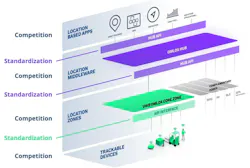
PI North America announced its support for the Federal Communications Commission’s release of a Notice of Proposed Rulemaking addressing Ultra-Wideband spectrum rules that it said could provide new opportunities for industrial UWB deployment.
UWB has become a key technology on factory floors and in warehouses, where it tracks equipment, vehicles, robots, and workers with accuracy. Yet the FCC’s UWB rules have remained largely unchanged for more than two decades and have not kept pace with how widely the technology is now used in industrial settings.
Mobile robots, cobots, and humanoid robots are moving beyond separated automation cells into dynamic environments shared with people, automated guided vehicles, and other machines. For these systems to operate efficiently and safely, they need a reliable understanding of where other assets, and infrastructure are in real time.
“Interoperability only works if the rules behind it are stable and well understood,” remarked Matthias Joest, Flowcate, omlox President. “UWB, together with other technologies, can become part of a shared spatial infrastructure for the next generation of logistics and industrial automation. Physical AI, autonomous mobile systems, and humanoid robots need to understand and safely interact with the physical world around them.”
PI’s open location-tracking standard, omlox, aims to provide a vendor-neutral framework for combining different locating and identification technologies. Depending on the application, this can include UWB for highly accurate real-time positioning, Bluetooth Low Energy and Wi-Fi for infrastructure-based locating, GNSS for outdoor positioning, RFID for identification and location events, and camera- or SLAM-based systems for robots and vehicles.
“Modernizing the UWB framework is about more than the well-known UWB use-cases in the consumer world,” said Michael Bowne, the executive director of PI North America. “These applications are just the tip of the iceberg –in that they are highly visible in our daily lives. But there remain the less-conspicuous applications: the hundreds of use-cases for UWB in industrial settings.”
Accurate UWB-based positioning supports use-cases such as dynamic geofencing, proximity warning, collision avoidance, safe-zone monitoring, and contact tracing. Infrastructure-based positioning can complement onboard sensors and provide an additional source of spatial information about the surrounding operating environment.
According to PI North America, the proposal can open the door to new opportunities for industrial UWB deployment and could reduce the need for individual companies to seek case-by-case regulatory waivers to deploy proven applications.