How Emerson Applies Automation to Deliver Custom Pneumatic Valves within 5 Days
Key Highlights
- Emerson's Bonneville facility converts customer orders into production-ready CNC programs in about 10 minutes, eliminating two to four hours of manual engineering work per order.
- A fully automated workflow generates 3D CAD models, machining instructions and simulation files directly from customer configurations, with every design validated before a single cut is made.
- Smart shop-floor monitoring tracks compressed air consumption, pressure and system performance in real time, enabling rapid response to inefficiencies and keeping production scalable without adding labor.
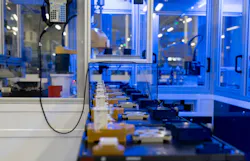
Modern production environments are defined by ever-tighter timelines, increasing product complexity and rising expectations for efficiency and sustainability. This reality is occurring while manufacturers face persistent labor shortages and associated skills gaps.
These issues are a few of the key drivers leading manufacturers to invest in automation and digitalized workflows that provide both speed and flexibility. But automation only delivers value when it is adaptable, scalable and tightly integrated with production processes.
This is true for end-user manufacturers as well as the manufacturers that supply automation hardware. A case in point can be seen at Emerson’s Bonneville manufacturing facility in the French Alps, where the team produces the Aventics XV pneumatic valve systems, part of Emerson’s automation portfolio. These valves are fully configurable to customer requirements, yet customers expect fast delivery — often within days, not weeks.
A fully digitalized, automated production workflow
At the Bonneville plant, Emerson implemented a fully automated, data-driven manufacturing workflow that converts customer configurations directly into production-ready components.
Once a customer submits an order, the system automatically generates:
- 3D CAD models of the valve base and modules.
- Machining instructions for cutting and drilling.
- Simulation files to validate tool paths and detect potential collisions.
Instead of requiring programmers to manually generate tool paths, post-processing software converts CAD assemblies into machine-readable programs. Every program is automatically simulated and validated before it reaches the machining center, eliminating costly errors before any material is cut.
Because the system is software-driven and modular, production capacity can scale up or down without adding labor or reconfiguring machines.
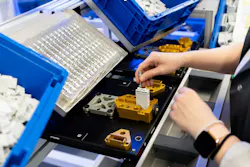
After validation, the data is sent directly to CNC machines for production of the aluminum valve bases and components. This removes engineering bottlenecks and allows new configurations to move into production within minutes instead of hours.
Smart automation on the shop floor
The Bonneville production lines use a mix of pneumatic actuators, valve islands, sensors and motion systems to handle material flow, positioning and assembly.
Throughout the plant, smart devices and flow sensors continuously monitor compressed air consumption, pressure stability and system performance. This allows the team to identify leaks, inefficiencies or wear early to improve uptime and energy efficiency.
Real-time monitoring software provides operators with live visibility into equipment status, throughput and resource utilization, enabling rapid response when conditions change. Because the system is software-driven and modular, production capacity can scale up or down without adding labor or reconfiguring machines.
Customized valves in five days or less
By combining automated configuration, simulation, machining and smart shop-floor monitoring, Emerson’s Bonneville facility can deliver fully customized Aventics XV valve systems in five days or less — a speed that was previously impossible for products with this level of complexity.
Instead of requiring programmers to manually generate tool paths, post-processing software converts CAD assemblies into machine-readable programs.
Key capabilities enabled by this automated process include:
- Faster production: Automated configuration and programming eliminate two to four hours of manual work per order, dramatically reducing engineering and setup time.
- Shorter order-to-production cycle: Orders configured online are converted into production-ready machine programs in about 10 minutes, enabling Emerson to commit reliably to short lead times.
- Consistent quality: Every design is simulated and validated before machining begins, eliminating human error and reducing scrap and rework.
- Scalable flexibility: The system can handle low-volume, high-mix orders and high-volume production using the same infrastructure and without adding labor or sacrificing speed.
Aventics XV Details
The Aventics XV platform is designed for extreme flexibility. With roughly 100 million possible configurations, customers can specify valve size, electronics, fieldbus protocol, pressure regulators, shut-off valves, flow modules and pressure-supply modules to match their exact application.
The system supports a range of industrial communication standards, including Profinet, EtherNet/IP, EtherCAT, PowerLink, Modbus TCP, IO-Link and AS-Interface, making it suitable for almost any machine architecture. Its compact, modular design allows pneumatic connections on the front, top or bottom of each module, enabling easy integration even in space-constrained machines.
Customers configure their systems using an online tool that defines every valve, fitting and module. The result is a unique, application-specific product.
About the Author
 Georges Mankarious
Georges Mankarious
Georges Mankarious is segment marketing director, Factory Automation at Emerson, where he leads global growth and marketing strategies focused on advancing digital transformation and smart manufacturing. Since joining Emerson in 2021, he has held leadership roles in product marketing and strategic planning within the Discrete Automation business, helping shape long-term growth initiatives. Prior to Emerson, he worked at Signify (formerly Philips Lighting) in the Middle East and holds a B.S. in Mechanical Engineering from the American University in Dubai.
 Leaders Logo
Leaders relevant to this article: