Siemens Unveils Three Major AI Initiatives: Physical AI Deployment with Nvidia, Digital Twin Composer Release and Nine New Copilots
Siemens is making three significant moves to integrate artificial intelligence into industrial manufacturing operations:
- Expanding its strategic partnership with Nvidia to develop AI-driven adaptive manufacturing sites.
- Launching its Digital Twin Composer software to create scalable industrial metaverse environments.
- Deploying nine AI-powered copilots across its product lifecycle management platforms.
These initiatives are aimed at improving engineering productivity, optimizing factory operations and enabling manufacturers to simulate and validate changes in virtual environments before physical implementation.
Looking more closely at the expansion of Siemens' strategic partnership with Nvidia, the companies said they plan to bring AI into the industrial world using physical AI technologies.
Here, Nvidia will provide AI infrastructure, simulation libraries, models, frameworks and blueprints, while Siemens will commit hundreds of industrial AI experts and relevant hardware and software.
The goal is to build what the companies claim will be the world’s first fully AI-driven, adaptive manufacturing sites via AI-assisted capabilities such as layout guidance, debug support and circuit optimization to boost engineering productivity while meeting strict manufacturability requirements. These capabilities will use AI-native engines for design, verification, manufacturability and digital twin approaches to shorten design cycles, improve yield and deliver more reliable outcomes.
Siemens said several customers are already evaluating some of the capabilities, including Foxconn, HD Hyundai, Kion Group and PepsiCo.
The project begins this year with the Siemens Electronics Factory in Erlangen, Germany, which will serve as the first blueprint for the two companies’ plans. The application at this factory will center on balancing next-generation, high-density computing demands for power, cooling and automation while ensuring the technologies are positioned to optimize the factory’s operations from planning and design to deployment and production.
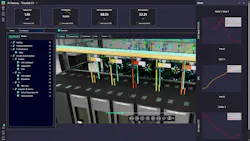
The second move being made by Siemens is to bring its industrial metaverse vision to life with Digital Twin Composer. This new software builds industrial metaverse environments at scale, allowing manufacturers to apply industrial AI, simulation and real-time physical data to make decisions virtually, at speed and at scale.
Digital Twin Composer enables industrial companies to combine 2D and 3D digital twin data from Siemens’ comprehensive digital twin with physical real-time information in a managed, secure real-time photorealistic visual scene, built using Nvidia Omniverse libraries.
According to Siemens, the Digital Twin Composer provides contextualized, real-time insights and intelligence enabling companies to visualize, interact with and iterate on any product, process or factory in its real-world context before physical design or construction. The Digital Twin Composer is part of Siemens Xcelerator.
The technology is already being used by PepsiCo in select U.S. manufacturing and warehouse facilities by converting them into high-fidelity 3D digital twins that simulate plant operations and the end-to-end supply chain to establish a performance baseline.
Siemens and PepsiCo said that, within weeks of using Digital Twin Composer, teams optimized and validated new configurations to boost capacity and throughput, giving PepsiCo a unified, real-time view of operations with flexibility to integrate AI-driven capabilities over time.
According to PepsiCo, the company can now recreate every machine, conveyor, pallet route and operator path with physics-level accuracy, enabling AI agents to simulate, test and refine system changes — identifying up to 90% of potential issues before any physical modifications occur. This approach has already delivered a 20% increase in throughput on initial deployment and is driving faster design cycles, nearly 100% design validation and 10-15% reductions in capital expenditure by uncovering hidden capacity and validating investments in a virtual environment.
The third move by Siemens involves the deployment of nine new AI-powered copilots for its Teamcenter, Polarion and Opcenter software. These copilots are designed to streamline product data navigation by reducing errors and accelerating time to market as well as automating compliance by helping to ensure faster regulatory approvals and lower risk.
More AI in manufacturing insights from Automation World: