Universal Robots Embeds New Accessibility Features, Cybersecurity Platforms
Key Highlights
- Universal Robots showcased its Gen 7 robotics platform and PolyScope X software, combining robotics, machine vision and a unified interface designed to simplify automation deployment for new users.
-
The platform emphasizes accessibility, connectivity and physical AI, enabling easier integration of vision systems and peripheral equipment while reducing implementation complexity.
-
Built-in cybersecurity features support compliance with the EU Cyber Resilience Act, with certifications including ISO 10218, UL 1740 and IEC 62443-4-1 secure development practices.
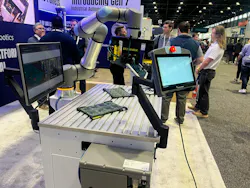
Universal Robots showcased its technologies at PACK Expo in Chicago last month, including its Gen 7 robotics platform for deployment of physical AI on factory floors and its Polyscope X software platform with built-in cybersecurity elements.
At PACK Expo, Universal Robots showcased how the Gen 7 platform combines the company's CB7 Core controller, TP7 Core teach pendant, the SP7 Smart Panel tool-flange interface and the PolyScope X software platform.
The platform also uses Cognex 2D and 3D industrial vision systems, which operate directly on the Gen 7 platform, demonstrating how machine vision and robotics integrate
"This new [technology] is intended to be appealing to manufacturers who have never deployed automation before, to be able to embrace it and own it and understand it," said Silas Neale, the regional sales manager with Teradyne Robotics, which owns Universal Robots.
"This drastically reduces the complexity there, so it's opening up more and more doors for anybody to be able to do the automation," he said.
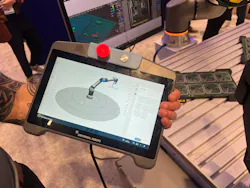
The company demonstrated how, with new cabling architecture, they can attach their new teach pendant—which establishes a direct connection between the operator and the robot to support programming and operation—to their cobot.
The demonstration showed how the industrial vision systems, teach pendant and Gen 7 and Polyscope platforms are used with the cobot.
"What that does is it gives anyone implementing the robots a single unified interface," Neale said. The demonstration was geared for semiconductor manufacturing settings, but Neale said it can be used in many other applications.
Industry trends
Other trends taken into consideration for the technologies include accessibility, connectivity, and physical AI deployment. For example, the unification of industrial vision systems with their platforms can help reduce complexity and lead to faster deployment of the technologies.
"When we talk about the physical AI piece [...] we make that handshaking with our equipment and theirs virtually seamless. That's improved tremendously. Now that we have all the communication and additional power on board, we can power and communicate with a lot more peripheral equipment," Neale said.
He said that from a larger trend perspective, the platform's design aims to allow smooth deployment of the technology for manufacturers.
"As a manufacturer, you can take ownership of that automation. It's rapid to deploy and easy to take ownership," he said.
Cybersecurity considerations
These products also have cybersecurity embedded into their design.
"The Polyscope X platform has been built from the ground up to comply with Cyber Resilience Act, which is being implemented in Europe in 2027, and we suspect that'll soon follow here," Neale said.
The European Union’s Cyber Resilience Act, which took effect last year, marked a significant change in how manufacturers in the EU manage cybersecurity for connected products.
As digital parts are included in everything from industrial machines to smart sensors, the CRA creates a consistent framework to make sure these products remain secure during their entire lifecycle.
The safety functions of the Universal Robots platform run on a PLd Category 3 safety system, Neale said, and is TUV certified to ISO 10218 and UL 1740. Teradyne Robotics is certified to IEC 62443‑4‑1 maturity levels, which evaluate how well a product manufacturer implements secure development lifecycle practices.
These features are released as manufacturers continue to struggle with ransomware and cyberattacks, as concerns rise in supply chain risks, business ecosystems, financial impacts of attacks, and overall safety issues when preparing for such incidents.
About the Author
Sarah Mattalian
Staff Writer
Sarah Mattalian is a Chicago-based journalist writing for Smart Industry and Automation World, two brands of Endeavor Business Media, covering industry trends and manufacturing technology. In 2025, she graduated with a master's degree in journalism from Northwestern University's Medill School of Journalism, specializing in health, environment and science reporting. She does freelance work as well, covering public health and the environment in Chicagoland and in the Midwest. Her work has appeared in Inside Climate News, Inside Washington Publishers, NBC4 in Washington, D.C., The Durango Herald and North Jersey Daily News. She has a translation certificate in Spanish.
Related


 Leaders Logo
Leaders relevant to this article: