Legacy Fluid Power Retrofits for Industry 4.0 Connectivity
Key Highlights
- A layered architecture that keeps real-time control local while exposing data via OPC UA or MQTT enables IoT analytics without disrupting proven machine behavior.
- Sensor selection for harsh industrial environments demands rugged hardware, such as magnetostrictive position sensors, stainless steel pressure sensors and IP67-rated I/O blocks to ensure long-term data reliability.
- Directly integrating anomaly detection into a CMMS platform transforms raw sensor data into actionable predictive maintenance.
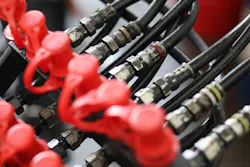
In many industrial environments, legacy pneumatic and hydraulic systems feel like the most reliable mechanical assets on the plant floor, yet also some of the least digitally visible. Their lack of visibility stems from being designed for mechanical longevity rather than Industry 4.0 connectivity. As a result, fluid power devices often lack the sensors required for modern IoT platforms and digital twins.
This means that, as manufacturers seek to improve overall equipment effectiveness (OEE), they have to decide whether to rip and replace reliable components or find a technical path to retrofit connectivity onto aging infrastructure.
The industry consensus suggests that the best options come from treating these systems as operational assets first and data sources second. By using targeted retrofits, standardized communication protocols and edge intelligence, manufacturers can bridge the gap between legacy fieldbuses and modern enterprise networks without disrupting proven fluid power control behavior.
Retrofit assessment considerations
The decision to modernize legacy fluid power begins with a fundamental assessment of the system's structural integrity and remaining lifespan.
"I see the metal [first]," said Bob Gourley, CTO at OODA. "If the actuators maintain pressure, the valves repeat and components persist, replacement is postponed.” Selcuk Sahin, product marketing manager at Emerson, echoed this statement by noting that retrofitting is preferred when "core mechanical components remain reliable" or "downtime risk makes full replacement impractical.”
"It always starts with understanding the failure first,” and very rarely should a machine be replaced "simply for the reason of IoT connectivity,” added Michael Labhart, director of Smart Operations at Schneider Electric.
However, financial justification for such retrofits remains a point of tension. Gourley advocates for a "harsh cutoff," recommending that plant managers "retrofit only if it pays back in 24 months and lands under 30-35% of full replacement value.”
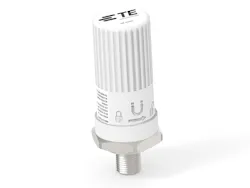
When pursuing the retrofit path, component selection must account for harsh industrial environments. For this reason, Gourley recommends "dull and durable" hardware, such as magnetostrictive location sensors, stainless steel pressure sensors and sealed IP67 I/O blocks.
Choosing materials like Grivory plastic and stainless steel ensure long-term stability, noted by Brian Wages, sales engineer at Transducers Direct, who added that manufacturers should also take careful note of IP ratings, shock and vibration, temperature extremes and washdown requirements.
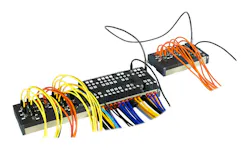
And when looking at Ethernet-based systems for use in harsh conditions, connectivity should utilize M12 Ethernet connectors rather than standard RJ45, said Lavanya Manohar, general manager at TE Connectivity.
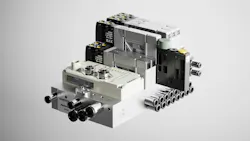
Furthermore, Ethan Duke, technical marketing engineer at AutomationDirect, recommends ProSense or Endress+Hauser IP67-rated sensors for pressure, flow, and vibration to add IIoT capabilities with minimal equipment impact. Emerson highlights its Aventics Series XV pneumatic valve system as a high-flow, IO-Link-ready platform for retrofit applications.
Key IoT integration aspects
A repeated architectural principle for fluid power integration is that real-time control must stay local. The challenge, however, lies in how to make this data accessible for higher-level analytics without compromising local performance.
Industry experts advocate for a layered architecture where deterministic control and cloud-bound analytics coexist without interference. Calvin Hamus, digital factory consultant at SkyIO, summarizes the design principle, saying, "Real-time control stays local. Analytics and visibility are added alongside it, not embedded into it" with data exposed through OPC UA or protocol gateways.
Because of this caution, industry experts advocate for a layered architecture where deterministic control and cloud-bound analytics coexist without interference.
Frank Latino, global product manager at Festo, pointed out that "MQTT running on the same backbone as EtherNet/IP or Profinet is very effective," noting that a well-designed real-time Ethernet infrastructure possesses sufficient bandwidth to support lightweight cloud connectivity without affecting machine control.
To bridge traditional OT protocols, like Modbus RTU or Profibus, to modern IT networks, DigiKey recommends the use of protocol-conversion gateways. And platforms like AutomationDirect’s Nitra PAL (pneumatic automation link) can consolidate pneumatic valves, digital communications and electrical I/O into a single hub to feed data where needed.
R2 Labs, a robotics and industrial automation firm founded by Dr. Roby Lynn, provides the R2 Autonomy Controller (RAC). This retrofit connectivity platform uses a code-free GUI to enable users of legacy systems to easily add intelligence to their equipment.
Digital twins are much more than 3D CAD models, they are digital representation of real physical objects that bundle technical data, documentation and behavior models. These models must include technical metadata such as B10 failure values.
There are also wireless connectivity options to consider, such as Bluetooth Low-Energy (BLE), Bluetooth 5 and cellular that provide an easy on-ramp to IoT monitoring, especially where the emphasis is safety, monitoring, maintenance or analytics. Devices like Regal Rexnord’s Perceptiv Universal Gateway are a way to quickly deploy IoT monitoring while reducing the potential impact to the facility’s existing network. While this approach keeps network management within the purview of operations, it does require a reliable wireless signal.
See more about the Perceptiv Universal Gateway in this Automation World video interview.
Fluid power retrofit sensor implementation
When initiating a robust proof-of-concept (POC) for sensor data gathering from fluid power systems, Labhart emphasizes that the strategy must move beyond a "cart blanche" data grab and instead "start with understanding the failure first." To do this, focus should be placed on signals describing the health of known failure points on critical assets.
While some industry experts prioritize pressure, temperature and flow as the foundation for fluid power system health, others note that vibration is typically an early indicator of health problems as well.
Eric J. Halvorson, senior marketing technology manager at DigiKey, added that fluid-level monitoring in hydraulic applications should be a primary requirement to prevent damaging cavitation.
To move from basic monitoring to predictive insight, a sensor data gathering POC should also capture actuation performance and mechanical health. Here, Latino identified actuator reaction time as critically important for identifying growing issues in valves, cylinders and flow restrictions.
Similarly, Gourley monitors for response-time crawl — a gradual delay in command-to-response behavior — to detect rising internal leakage. Dr. Lynn suggests that for hydraulic systems, monitoring fluid quality and particulates is essential to establish a baseline for long-term reliability.
Managing sensor drift in fluid power environments requires a combination of physical ruggedness, operational rigor and signal filtering. While Dr. Lynn recommends using algorithms like exponentially weighted moving averages (EWMA) or finite impulse response (FIR) filters to smooth noise, many modern sensors now feature built-in compensation techniques and rugged housings to control drift at the source.
Merely dashboarding problems doesn't appear to work because maintenance teams rarely have time to check isolated screens. Instead, integrate IoT platforms directly into the CMMS to ensure that an anomaly score or signal threshold generates a work order as a traceable record automatically.
Regular preventative maintenance procedures for calibration also remain essential, as all sensors will eventually drift over time. To differentiate between electronic drift and mechanical wear, Halvorson suggests using linear variable differential transformers (LVDTs) to catch mechanical wear that might otherwise be misdiagnosed as electronic sensor drift. Finally, Latino notes that advanced AI-based analytics should be utilized to identify and compensate for drift automatically, while Duke recommends applying redundancy at critical points as a final check to ensure data integrity.
Sensor data integration for predictive maintenance
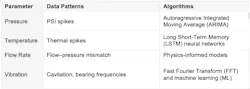
Experts advise that turning raw data into a predictive strategy should focus on behavioral analysis rather than simply monitoring static thresholds. While threshold violations can catch problematic events, the transition to anomaly detection and machine learning (ML) models allows for early identification of subtle performance changes that can be negative indicators.
Mickey Harp, senior reliability applications engineer at Regal-Rexnord’s Perceptiv, suggests a specific set of data patterns to monitor for within critical fluid-power system parameters as well as a set of algorithms that are typically useful for identifying trends in these data sets:
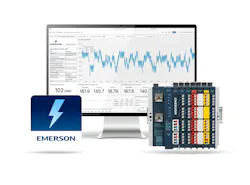
For non-data scientists, Festo provides applications like Festo AX Motion Insights Pneumatic, which detects faults in actuators without requiring deep coding expertise. Emerson complements this with its Energy and Compressed Air Manager, an edge-based system for visualizing air usage and benchmarking performance.
When you get to the point of integrating these data points with existing maintenance systems, Labhart noted that "merely dashboarding problems doesn't appear to work" because maintenance teams rarely have time to check isolated screens. Instead, he recommends integration of IoT platforms directly into the computerized maintenance management system (CMMS). This ensures that an anomaly score or signal threshold generates a work order as a traceable record automatically.
Digital twins for fluid power
Digital twins are much more than 3D CAD models — they are digital representations of real physical objects that bundle technical data, documentation and behavior models. These models must include technical metadata such as B10 failure values, which Latino described as a statistical analysis of the probability of a component's failure over millions of cycles.
Labhart added that the primary starting point for any digital twin should be data contextualization. "Making your data make sense and understanding what it belongs to from the start in some type of structured fashion is really the key," he explained.
To make sensor data accessible to higher-level analytics without compromising local performance, fluid power analytics and visibility should not be embedded into the control layer with data exposed through OPC UA or protocol gateways.
When it comes to the development pathway, views differ: Hamus and Harp recommend starting with a "data-driven operational twin"—a lightweight representation built from real sensor data like pressure, temperature, and flow. This approach can be supported by tools like Festo AX Data Access, which collects data via MQTT from Festo devices.
Other experts advise taking a narrower, but deeper, approach beginning with fundamental physics modeling followed by live sensor coupling, wear and leakage overlays, and maintenance scheduling focused entirely on the costs and failure points of a single asset.
To aggregate these disparate kinds of data, Festo notes that its Asset Administration Shell (AAS) can serve as a standardized digital infrastructure that creates interoperability between different providers by providing manufacturer-independent access to machine-readable technical data. For simulation applications, Festo advocates for the non-proprietary Functional Mockup Interface (FMI) and Functional Mockup Unit (FMU) standards, which allow for the exchange of simulation files between different vendor tools, such as Festo FluidDraw.
Dr. Lynn identifies three pillars to digital twin maturity: data, insights and autonomy. Beginning with fully instrumented equipment, users can develop accurate physical models of static and dynamic phenomena and begin tasking the system with generating insights based on real data. Once a user has long-term confidence in the insights generated by a twin, they can advance to a stage where the equipment is partially responsible for its own operation—such as an oil quality monitoring system that automatically signals a facility's purchasing system to order a fluid change.
Harp suggests that the progressive development of a digital twin generally follows a six-step pathway:
- Instrumenting with essential sensors.
- Building the data pipeline and asset model.
- Developing an operational digital twin.
- Adding predictive maintenance models.
- Incorporating physics-based simulation.
- Integrating control logic.
Whatever the approach, if a digital twin does not directly influence how decisions are made or money is spent, it is unlikely to deliver meaningful ROI.
About the Author
 Josh Eastburn
Josh Eastburn
Josh Eastburn earned his degree in computer science from California Polytechnic University and spent over a decade as a control systems integrator, automation engineer and project manager. His engineering work has included a wide range of DCS, SCADA, PLC and HMI projects across multiple sectors, including semiconductor, petrochemical, food and beverage, and life sciences.
 Leaders Logo
Leaders relevant to this article: