Why Manufacturers Are Demanding Smarter, More Adaptable Industrial Robots
Key Highlights
- Robot suppliers are simplifying flexibility through standardized interfaces, modular gripper systems and low-code/no-code platforms that eliminate the need for custom programming or robotics expertise.
- AI, advanced vision systems and force/torque sensors are enabling robots to handle real-world variability through their ability to adjust to material differences, part tolerances and unexpected conditions with minimal manual intervention.
- With 22% of manufacturers planning to adopt physical AI within two years, robotics is expanding beyond large-scale operations into small and mid-sized manufacturers tackling high-mix, low-volume production.
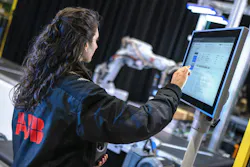
Industrial robots have long exceled at precision-oriented, repetitive jobs like welding, painting and assembly tasks in the automotive space or pick, place and packing applications that dominate material handling and logistics.
Faced with shorter product lifecycles, higher part variability and the need for more frequent product changeovers, manufacturers are moving past the standard rubric for high-precision, consistent performance and seeking out robotic systems that offer a higher degree of flexibility and adaptability that don’t require a reliance on integration partners or internal robotics experts. Their goal in this high-mix, low-volume manufacturing environment is to reduce equipment downtime and increase production efficiencies while future-proofing operations.
In response, a new generation of robotics and automation technologies have emerged sporting standardized interfaces, low-code/no-code programming capabilities, modular gripper systems, an array of new force/torque sensors and AI-driven perception.
Gathering high interest in this area is physical AI, which includes automation technologies capable of transporting, sorting and part installation, with 22% of manufacturers confirming plans to adopt the technology within two years, according to a survey conducted by the Manufacturing Leadership Council.
At the same time, robotics suppliers are targeting specific tasks to be automated, leveraging standardization, third-party product ecosystems and off-the-shelf robots to drive greater flexibility and adaptability for use in industrial automation applications.
The combination of enhanced vision systems, new force sensing tech and AI are helping robots get better at handling real-world variations rather than just the static operations they’ve long been used for.
“We’ve gone from thinking the robot is the center of the world to a growing recognition that the robot is just a component in an overall application,” said James Taylor, chief commercial officer at OnRobot. “Flexibility isn’t just about robot flexibility, but rather how to get an overall solution done for the customer.”
Simplifying product changeovers
One way to boost robot flexibility and adaptability is by providing an extensive catalog of adds-on and end effector choices while simplifying end-of-arm tooling (EOAT) changeovers. To do so, robot suppliers have begun to incorporate standardized mechanical coupling and pneumatic pass throughs to accommodate different EOAT enabling them to be swapped out more quickly than traditional methods. In addition, modular gripper systems, including interchangeable fingers, vacuum modules and servo-driven tools, are now designed to fit common interface patterns, furthering ease of adaptability.
“Because these systems are built around industry-standard connections rather than custom designs, changeovers are typically fast,” according to Geoff Dawson, sales director, FANUC America. “In most modern robotic cells, switching between tools can be completed in a few minutes, depending on the complexity of the tooling and how much calibration is required.”
Universal Robot’s UR+ ecosystem model plays a pivotal role in its flexibility and adaptability story. The company’s portfolio of third-party products are certified to work with UR cobots — a promise UR achieves through a hardware design architected to offer seamless integration as well as end-effector control integrated into the UR control interface. In addition to standard hardware, UR works with partners to develop apps that facilitate easier EOAT changes without the need to write custom code.
“You can change from a welding torch to a gripper and just turn off the welding app and turn on the gripper app and everything works out of the box,” said Chris Savoia, global head of the UR+ Ecosystem.
Designed Mouldings, an Australian injection molding specialist producing plastic caps and seals for the packaging industry, uses OnRobot’s Quick Changer EOAT and flexible gripper technology to create an automation system that can be redeployed as needed across multiple tasks. Installation and programming of the system took a matter of days, said Paul Neumeyer, managing director for Designed Mouldings, adding that, after a successful initial implementation, the company expects to achieve ROI in six months by delivering the robot a constant stream of jobs.
Democratizing robot programming
Other trends underway to simplify robot programming and reduce reliance on custom code can be seen in the embrace of open-source frameworks by companies like FANUC and Yaskawa Motoman. Examples of this include the open-source middleware Robot Operating System (ROS) and use of native Python support to allow developers to build more adaptive and modular robot applications.
One customer running this robotic palletizer for more than three years has palletized 10 million packages with the system while easily accommodating frequent changes based on its own retail customer demands.
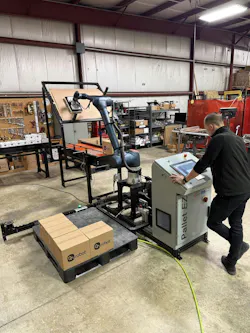
There is also a move to embrace low-code/no-code platforms that allow internal teams and system integrators to more easily create, monitor, run and re-deploy robot applications without the need for custom programming or robotic expertise.
OnRobot’s D:Ploy is an example of this kind of low-code/no-code robotics platform. It automatically discovers installed hardware, provides a GUI (graphical user interface) to establish workspace obstacles and outline cell boundaries. It also automatically generates and optimizes program logic signal exchanges and path planning for the entire application. When changes are necessary, the platform ensures the robot can be updated or redeployed.
D:Ploy is being tapped by OnRobot partners to build off-the-shelf robotics platforms such as palletizers and CNC systems, Taylor said. These pre-built and pre-configured systems are available immediately, unlike many turnkey robot systems that are only partially pre-engineered and thus typically require more lead time for custom programming, he added.
Doig Corp., a family-owned business that started as a pneumatics distributor, uses D:Ploy to build an off-the-shelf palletizer system designed for smaller manufacturers with frequent product line changes.
One Doig customer running this palletizer for more than three years has palletized 10 million packages with the system while accommodating frequent changes based on its own retail customer demands, noted Eric Kraus, president of Doig. “With D:Ploy, our customers don’t program, they just set it up by manipulating boxes in a 3D space however they want them,” he explained. “No modifications need to be made to the robot and no code has to be written, they just fill out the GUI form and graphically build the changeover.”
AI, vision systems and new force/torque sensors
The combination of enhanced vision systems, new force sensing tech and AI are helping robots get better at handling real-world variations rather than remaining focused on the static operations they’ve long been used for. Force and torque sensors add a layer of flexibility by letting robots feel their way through tasks like assembly or polishing, adjusting motions on the fly based on actual contact instead of rigid paths. Add AI into the mix and robot systems can interpret sensory data and make decisions.
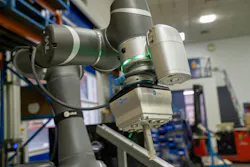
“Together these tools allow robots to adjust to materials differences, part tolerances and unexpected conditions with far less manual intervention,” said Dawson. “When manual intervention is required, robots are able to learn those conditions for future exceptions.”
An example of this can be seen in how ABB is upping the vision game for its Autonomous Versatile Robotics (AVR) through use of AI. To do this, ABB is collaborating with LandingAI to integrate its vision AI capabilities into ABB Robotics’ software suite. LandingAI’s LandingLens platform enables the rapid training of vision AI systems to respond to objects, patterns or defects using generative AI rather than complex programming.
Meanwhile, numerous robot providers are partnering with Nvidia to embed AI modules into robotic systems to achieve real-time perception and reasoning. FANUC, for example, is integrating the Nvidia Jetson edge AI modules along with simulation tools to create high-fidelity digital twins where manufacturers can test new workflows, retrain robot behaviors and optimize layouts. Dawson said: “This improves how they quickly robots can adapt to new parts, processes, or conditions.”
Robot suppliers have begun to incorporate standardized mechanical coupling and pneumatic pass throughs to accommodate different EOAT enabling them to be swapped out more quickly than traditional methods.
Yaskawa Motoman’s open robotics platform called Next leans into enhanced machine vision, sensors and AI to address high-mix production scenarios and uses Nvidia’s Jetson Orin. According to the company, this platform serves as the basis for an expanding category of standard applications, including a palletizing platform that can be set up and configured using simple wizards and deployed with little to no robotics programming experience.
This focus on autonomous adaptivity is expanding robot deployment into historically unautomated areas as well as to smaller manufacturers that have previously found it difficult to adopt robotics.
“There are growing expectations for robots to be deployed in a much wider variety of applications and for users that don’t have high-volume production needs,” said Chris Caldwell, senior product manager for material handling applications at Yaskawa Motoman.
With this expansion of robotics into the small and mid-sized manufacturing space, OnRobot’s Taylor noted that many manufacturers start with the most complicated tasks because there’s potential for the biggest payoff. But there’s also a lot of risk, especially for small- and mid-size companies. “Don’t bank your entire company on one automation project,” he advised.
More robotics coverage from Automation World:
About the Author
 Beth Stackpole, contributing writer
Beth Stackpole, contributing writer
Contributing Editor, Automation World
 Leaders Logo
Leaders relevant to this article: