Robotic Welding Cells: Why the Robot Shouldn’t Be Your First Area of Focus
Key Highlights
- Traditional robotic cells suit high-volume serial production, while collaborative robot cells are purpose-built for small and mid-sized shops that need faster programming, no safety fencing and the flexibility to handle frequent part changes.
- Full cell costs range from $120K to $500K+, but the real risk isn't the upfront price, it's a poorly integrated system that underperforms, requires constant troubleshooting and can't scale.
- The manufacturers who succeed with robotic welding think system-first, robot-second and obsess over integration details like power source communication, fixturing tolerances and wire feed consistency before they choose a robot brand.
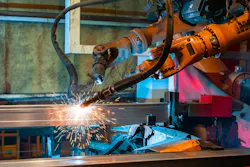
Your business is hitting a plateau because it’s harder than ever to meet the demand and quality expectations, and you are looking at robotic welding cells. While robotic welding can transform your business, the cell requires more than just a robot arm.
Every robotic welding cell component, including the power source and software, can affect the success of welding automation. Successful, long-term automation requires proper integration and deployment from day one.
That’s why it’s critical to understand how robotic welding cells are organized, the types of robotics and cell types.
What is a robot welding cell
A robotic welding cell is an integrated automation system that combines a robotic arm, welding equipment, safety infrastructure and control software to perform welding operations with minimal human intervention.
The cell creates a controlled environment where the robot can repeatedly execute programmed weld paths while other components manage everything from arc control to operator safety. While the robot arm is a critical component, its automation capabilities fully depend on every other system component.
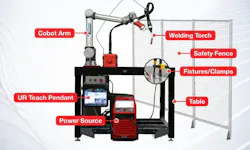
Every functional welding cell includes several core components that must work together seamlessly:
- Robotic arm with six-axis motion and sub-millimeter repeatability.
- Welding power source determines the welding process and controls weld characteristics.
- Welding torch. A MIG/TIG/laser/plasma torch must be designed for heavy-duty robotic welding and allow sufficient access to the joint.
- Wire feeder delivers filler metal synchronized with robot motion.
- Welding table supports the welded parts, fixtures and can be configured to support the robot arm and other equipment for a compact cell.
- Fixturing and positioners hold and orient workpieces during welding.
- Safety system includes the physical guarding, emergency stops and interlocked gates.
- Control software manages motion, parameters and quality monitoring.
Other cell elements may include a welding fume extraction system, cameras and sensors for process monitoring and real-time program adjustment and stations for torch-spatter removal.
Critical components beyond the robot
Many manufacturers focus almost entirely on the robot itself when researching robotic welding for the first time. However, the robot brand, payload and reach are far less important than the power source for robotic welding.
The robot arm is the most commoditized part of the cell. Put any robot on a table with a basic MIG system and you don’t really have automation. You have an expensive sculpture that looks good in presentations but fails in the real world.
The robot arm is the most commoditized part of the cell. Put any robot on a table with a basic MIG system and you don’t really have automation. You have an expensive sculpture that looks good in presentations but fails in the real world.
What makes or breaks welding automation is the integration quality. Key questions to ask here include:
- Does your power source communicate effectively with the robot controller?
- Can your fixturing hold tight enough tolerances for the robot to find the joint where the program expects it?
- Can the robotic system auto-update the program if fixturing can’t maintain tight tolerances in certain cases?
- Does your wire feeder maintain consistent delivery during rapid torch movements?
- Is your programming sophisticated enough to handle real-world part variation?
- Can your robotic system communicate with a positioner to work in coordinated motion?
These are just some example questions to help you think system-first, robot-second.
The manufacturers who succeed with robotic welding obsess over these integration details. The ones who struggle bought a robot and expected magic.
Collaborative vs. traditional robotic welding applications
While robot applications are diverse, there are two primary robotic welding application branches to consider:
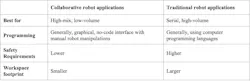
- Traditional robotic cells use large industrial robots that operate at speeds high enough to require safety fencing to prevent human injury. They are generally more challenging to program and have a large footprint. They are best for large-scale, serial production where serial runs offset lengthy programming times.
- Collaborative robotic cells use collaborative robots (cobots) to create a human-robot collaborative environment if the system is designed to meet the ISO 10218-2:2025 robotic safety requirements. This means no guard fencing and a safe human presence while the cobot is welding. Cobot welding systems are also much easier and intuitive to program. Cobots are best for frequent part design changes and the daily realities of small-and-medium-sized shops.
A MIG/TIG/laser/plasma torch must be designed for heavy-duty robotic welding and allow sufficient access to the joint.
These advantages make cobot welding costs much lower than traditional robotic cells. Plus, with no need for expert robotic staff and the ability to quickly change weld programs, small to medium-sized manufacturers using cobots in day-to-day jobs can achieve incredible ROIs.
The cell creates a controlled environment where the robot can repeatedly execute programmed weld paths while other components manage everything from arc control to operator safety.
Robotic welding cell costs
A full robotic welding cell cost can range from $120,000 to $500,000 or more, depending on the robot type (traditional vs. collaborative) including systems and integration costs. Upfront hardware cost is only part of the equation. Integration quality determines long-term value. A poorly integrated $150,000 cell that requires constant troubleshooting, inconsistent welds and can’t adapt to any cell modifications in the future costs you far more than a well-engineered $200,000 system that runs reliably from day one.
Well-engineered robotic welding cells have less unpredictable long-term costs and a far lower chance of ending up collecting dust in the real manufacturing environment.
You should also consider the installation downtime, operator training, ramp-up until the team gains full confidence, and the long-term cost of the system’s expansion, repairs and maintenance.
For more info on this, see THG Automation’s guide on robotic welding costs.
More robot welding insights from Automation World:
About the Author
 Matt Hendey
Matt Hendey
Matt Hendey is CEO at THG Automation, a system integrator focused on welding automation.
 Leaders Logo
Leaders relevant to this article: