Kamax Replaces Manual Counting with Real-Time Production Data Using Edge-to-Cloud Sensors
Key Highlights
- Light grid sensors mounted at machine outfeeds automatically detect every bolt produced, eliminating periodic manual weighing and fragmented data collection.
- An IO-Link, Belden CloudRail and AWS IoT Greengrass stack bridges shop floor sensors to cloud analytics without disrupting existing automation or ERP systems.
- Automated counting freed up to 3.5% of operator time and created a reusable, scalable template for future modernization across lines and plants.
For years, manufacturers have struggled to turn what happens on the shop floor into information that can drive better decisions for their production operations and business in general. The persistent challenge in doing this successfully is that the right data is often not being captured, contextualized and delivered in time to shape critical decisions and influence the next steps for better outcomes.
Why does this challenge persist? Because information about production counts, order status and inventory status are still often being pulled from clipboards, spreadsheets and daily reports in an attempt to stitch together a picture of performance.
But what good is a view that doesn’t reflect the current reality?
Delays in collecting and consolidating information leave employees with one choice — to react after an issue occurs and after performance metrics like throughput, resource utilization or delivery promises have gone awry.
Piece counting is a good example of how this visibility gap plays out. In high-volume operations at automotive suppliers like Kamax, containers fill quickly. Kamax produces high-strength bolts, form and precision parts, and assemblies. To estimate how many units are being produced in these kinds of production operations, teams typically fall back on periodic weighing or manual tallying. While each check takes only a few minutes, interruptions and delays add up fast when these checks must be repeated across multiple machines and shifts.
The result is fragmented, out-of-date information that rarely matches what’s happening on the line at any given time.
To break out of this pattern of manual data collection, manufacturers need to start with a mindset shift and reframe a narrow pain point as a strategic data problem. For example, instead of asking, “How can we speed up this task?”, the question changes to, “How can we make sure accurate, real-time information is available when and where it’s needed?”
This reduces the burden on local maintenance teams, giving them a platform on the shop floor that feeds near real-time production data into cloud services and existing systems like ERP for planning and logistics.
Once the problem is framed in that way, it encourages teams to consider foundational solutions, such as edge-to-cloud architectures, standardized data models and reusable patterns, which can address a single bottleneck but also scale across lines, plants and applications.
Why a camera-first approach fell short for piece counting
To address this counting challenge, Nexineer Digital (formerly Kamax’s digital unit) initially considered using a camera-based system. Their plan was to use cameras to monitor material flow and derive piece counts from image data. On the surface, it was a solid approach technically capable of delivering transparency for production and planning teams.
But a closer look revealed significant drawbacks. For example, camera installation in harsh production environments requires careful positioning, suitable lighting and regular cleaning to maintain reliable operation. This leads to higher engineering and maintenance costs and effort over time.
Another issue with this approach is that Kamax uses a mix of cold-heading machines spanning generations and types, each with its own mechanical layout and space availability around the outfeed area. This made implementing a uniform, camera-based concept difficult to achieve without costly structural modifications.
These constraints prompted Nexineer to reassess this choice. Instead of capturing and interpreting image data, the team opted to use sensors to detect every bolt that left the machine. This simple, privacy-friendly, scalable approach could be implemented across a range of machines while also serving as a template for future technology projects.
Using sensors to detect small parts and high speeds
Nexineer evaluated several sensor technologies before selecting a high-resolution light grid to detect small parts at high speeds. Mounted at the end of the cold-heading machine, it forms a physical light curtain that each bolt must pass through on its way into the container. Every light-beam interruption is registered as an event, which is then interpreted as a piece count.
At each machine, the light grid sensor connects via IO-Link to an IO-Link master, which feeds the edge gateway responsible for data preprocessing and forwarding.
Importantly, this sensor-based light grid could be used on different types and ages of machines with few mechanical changes needed, making it practical to roll out a standardized solution across many lines and locations with a uniform setup.
The process of setting up this light grid consisted of three steps:
- Place a sensor at the outfeed.
- Connect the sensor to an IO-Link master.
- Provide a common data interface toward the edge gateway.
By taking this approach, Kamax was able to lay the foundation for higher-level insights, such as real-time order progress. Information captured about production events at the source can now be made available to applications and systems beyond the cold-heading machine, unlocking new possibilities for how production, planning and logistics teams work together.
Building an OT-cloud bridge for real-time production data
To turn real-time counting into actionable insights, the counting data needed to leave the cold-heading machines in a structured, reliable way. To achieve that without custom integration, nexineer defined an edge pattern that bridged OT and the cloud using a combination of standardized interfaces and managed services.
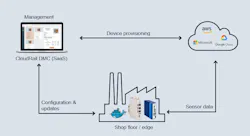
Here’s how it works: At each machine, the light grid sensor connects via IO-Link to an IO-Link master, which feeds the edge gateway responsible for data preprocessing and forwarding. The industrial network plays a central role, transporting data from sensors and machines to edge gateways and on to cloud services without disrupting production traffic.
Belden’s CloudRail serves as the edge connectivity and device management layer, ingesting data from machines and into AWS while keeping gateways configured and up to date from a central location.
The edge gateway runs AWS IoT Greengrass, allowing the team to aggregate sensor signals, apply simple logical functions and convert raw events into structured messages close to the machine.
With this setup, instead of sending every sensor pulse to the cloud, the edge gateway groups information about piece counts and machine status per interval to optimize bandwidth and prepare data for downstream analytics. These structured messages are then sent to AWS IoT Core, where they’re routed to services that calculate order progress and OEE-related KPIs from the counting data.
Belden’s CloudRail enables Kamax to:
- Configure, monitor and update its fleet of edge gateways from a central interface.
- Detect industrial sensors automatically and establish a contextualized data stream to AWS IoT.
- Ensure secure connections from multiple machines to AWS without building an extensive in-house IoT infrastructure.
This reduces the burden on local maintenance teams, giving them a platform on the shop floor that feeds near real-time production data into cloud services and existing systems like ERP for planning and logistics. And it does so without changing how those systems operate or introducing additional load to production controllers.
The IO-Link, CloudRail and AWS IoT Greengrass combination creates an OT-cloud bridge that Kamax can leverage for other applications in the future without redesigning the entire stack — from additional sensor signals on the same machines to new use cases that rely on consistent, machine-level OEE and order-progress data.
This sensor-based light grid could be used on different types and ages of machines with few mechanical changes needed, making it practical to roll out a standardized solution across many lines and locations with a uniform setup.
Because the connectivity and network layer are standardized, new data sources can be added without re-engineering the underlying infrastructure. This non-invasive retrofitting approach runs alongside existing automation and IT systems, minimizing performance impact and reducing security risk.
How better counting data reshapes work for the better
Instead of having to weigh containers and manually enter estimated quantities, operators now have automatic, continuous counts that show how many parts have been produced and how far along each order is. This change freed up valuable time on the shop floor, releasing roughly 2.5% to 3.5% of operator time for higher-value tasks such as quality checks and setup optimization. It also helps planners align output more closely with customer demand.
In the future, maintenance and scalability will be easier to manage as more machines are brought online because the same concept can be re-deployed on each new machine, reducing the need for one-off engineering.
3 lessons to apply in your next modernization project
If a similar modernization project is in your future, there are several takeaways to be learned from Kamax’s journey:
- Focus on the most critical tasks first. Manual weighing or reporting can create daily pain that justifies investments and builds momentum for broader efforts.
- Prioritize privacy. Especially in regulated or unionized environments, use process data instead of image data to avoid resistance and accelerate deployment.
- Keep standardization in mind. Using the same edge gateways, interfaces like IO-Link and cloud integration can create a scalable platform that makes new technology easier to deploy. Standardized data structures enable seamless integration into cloud ecosystems.
When you approach automation improvements by starting with the problem first, respecting the realities of the shop floor and building on repeatable patterns, you’ll not only be able to improve how work gets done, but also build a foundation for ongoing improvements in visibility, performance and flexibility.
More sensor insights from Automation World:
About the Author
 Philip Weber
Philip Weber
Philip Weber is a global product line manager for OT data applications at Belden.
 German Fernandez
German Fernandez
German Fernandez is the vice president of global strategy and ecosystems at Belden.
 Leaders Logo
Leaders relevant to this article: