How Quanta Is Accelerating Electronics Production Through Digitalization
Key Highlights
- Quanta, Techman Robot, and Siemens demonstrate how manufacturers can break siloed engineering and production systems through one digital backbone.
- Quanta uses Process Simulate to achieve 30% faster on-site commissioning due to more issues being resolved virtually
- Integrated digital workflows deliver up to 95% data consistency and traceability from engineering changes to work instructions.
- See how Quanta achieves 15% higher end-to-end efficiency through stronger digital process integration.
As electronics manufacturing grows more complex, manufacturers face increasing pressure to accelerate production, manage product variants, improve traceability, and maintain quality across global operations. Quanta Computer Group, Techman Robot, and Siemens demonstrate how manufacturers can address these challenges by connecting engineering and production through a single digital backbone.
Quanta Computer has long been recognized as a global leader in computing and has expanded into high-growth markets including AI servers and automotive electronics. Today, the company designs and manufactures advanced automotive electronic platforms ranging from ADAS and autonomous driving systems to electronic control units (ECUs) and power electronics. These software-defined products combine hardware, electronics, and software, creating significant manufacturing complexity.
During a recent interview, leaders from Quanta and Siemens discuss how digitalization and automation help manufacturers reduce risk, accelerate production readiness, and create more resilient operations.
Howard Tsai, Senior Director of the Automotive Division at Quanta, explained that managing automotive electronics requires a connected digital thread built on a trusted source of information. Modern automotive programs often involve more than 30 departments, over 400 documents, more than 4,500 components, and upwards of 30 suppliers across multiple manufacturing sites, all supporting products with lifecycles extending to 15 years.
By integrating digital twin technology, process simulation, low-code workflow orchestration, and Manufacturing Execution Systems (MES), manufacturers can validate production digitally before equipment is installed. The result is reduced risk, faster ramp-up, improved operational resilience, and a stronger foundation for future-ready electronics manufacturing.
Today's manufacturing environment demands closer collaboration across engineering, production, and supply chain teams. By connecting digital engineering with factory execution, manufacturers can validate production earlier, respond faster to change, and improve decision-making throughout the product lifecycle.
A Turning Point: Building a Shared Digital Foundation
According to Howard Tsai, the breakthrough was not improving a single software tool, it was creating a shared digital foundation that connects engineering and manufacturing from the beginning. Rather than treating design and production as separate activities, Quanta focused on validating manufacturing processes before physical equipment was installed. Achieving this requires technology partners capable of connecting digital engineering with shop-floor execution. That collaboration brought together Quanta's transformation expertise, Siemens' digital twin technologies, and Techman Robot's automation capabilities.
Dr. Kolja Zakrzewski, Head of Strategy Electronics & Semiconductors at Siemens, explained how the solution connects the engineering Bill of Materials (BOM), manufacturing BOM, and Bill of Process into a single digital thread. Working from a trusted source of information enables teams to validate production digitally before execution begins. Techman Robot complements this digital ecosystem with collaborative robots (cobots) and AI vision technology that translate validated manufacturing processes into flexible shop-floor operations.
Delivering Measurable Business Results
Quanta has already achieved measurable operational improvements through this integrated approach, including:
- 15% higher end-to-end efficiency through stronger digital process integration.
- 30% faster on-site commissioning due to more issues being resolved virtually.
- 25% less documentation effort by partially auto-generating documents.
- Up to 95% data consistency and traceability from engineering changes through production work instructions.
“More importantly, the way we work has changed. By using digital twins, scaling across factories becomes more predictable. Looking ahead, this is how we industrialize innovation globally,” explains Howard Tsai, Senior Director of the Automotive Division at Quanta.
Creating a Digital Backbone for Traceability
Robert Huber, VP Global Portfolio Development at Siemens Digital Industries Software, emphasized that a connected digital backbone is essential for managing continuous engineering changes, multiple product variants, and multidisciplinary development.
This is crucial because managing revisions, variants, and frequent changes and diverse disciplines (electrical, electronics, mechanical, software) simply isn’t feasible with emails and spreadsheets. With Siemens Teamcenter, every engineering revision remains fully traceable.
Virtual Validation Before Production
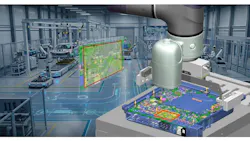
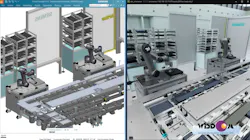
Once the digital backbone is established, digital twin technology enables manufacturers to validate production virtually before commissioning equipment. Siemens simulation software creates virtual models of both products and manufacturing processes. Engineers can simulate robot motion, evaluate reachability, verify safety zones, optimize cycle times, and confirm inspection coverage before production begins.
For example, if a larger capacitor is added to a printed circuit board, engineers can quickly determine whether the change blocks an inspection camera's field of view. Instead of discovering issues after installation, manufacturers can identify and resolve them within minutes during simulation.
“We connect the digital validation to physical execution. Simulation allows us to validate everything before production starts,” says Howard Tsai, Senior Director of the Automotive Division at Quanta.
Using Process Simulate software helps manufacturers avoid costly production interruptions, equipment modifications, and unnecessary scrap while supporting flexible production across multiple product revisions. This collaborative approach enables engineering and manufacturing teams to solve problems earlier and manage complexity more effectively.
Connected Automation on the Shop Floor
Kuan Lin, Senior Director at Techman Robot, described how collaborative robots extend the value of the digital twin into daily operations. Combined with Workflow Canvas, Techman cobots enable manufacturers to build connected automation workflows without requiring extensive programming expertise. Real-time production data flows back into the digital twin, improving traceability while ensuring that validated processes are executed consistently on the factory floor.
Orchestrating Manufacturing with Workflow Canvas
Workflow Canvas serves as a low-code orchestration platform that connects robots, cameras, PLCs, machines, and IT systems into unified manufacturing workflows.
The platform allows engineers to:
- Validate virtually by using Process Simulate to verify workcell layouts, robot motion, reachability, safety zones, inspection access, ergonomics, and cycle times before installation. Early validation identifies potential collisions and production risks before commissioning.
- Orchestrate execution through drag-and-drop workflow creation that connects automation devices without extensive infrastructure changes. Standardized workflows support version control, exception handling, and repeatable deployment across production lines and manufacturing sites.
- Close the loop and improve by synchronizing inspection results with MES and dashboards for complete traceability. Robot positions, timestamps, and execution data flow back into Process Simulate, keeping the digital twin aligned with actual production performance and continuously improving future validation cycles.
Quanta opened a new factory site in Germany where it will have its first productive operation in Summer 2026. The future looks bright, with plans to expand deployment across global manufacturing operations through digitally validated processes and standardized workflows.
The collaboration between Quanta, Techman Robot, and Siemens demonstrates how manufacturers can connect engineering, simulation, automation, and execution through a unified digital thread. By combining digital twins, process simulation, low-code workflow orchestration, and connected automation, manufacturers can reduce operational risk, accelerate production readiness, improve traceability, and build more resilient electronics manufacturing operations.