How Pfizer and Shell Are Digitally Transforming Their Operations

Many technology supplier events focus predominantly on the features and capabilities of the software and hardware offered by the supplier, as well as providing insights into new or forthcoming features. The recent Aveva World event in San Francisco was no exception to this rule, but there was a noticeable difference—a concentrated focus on users of Aveva’s software.

Another reason behind the event’s focus on end users of Aveva’s software is Aveva’s intent to “bring users together to collaborate and share their experiences with the software,” Herweck added.
Pfizer combats COVID with data
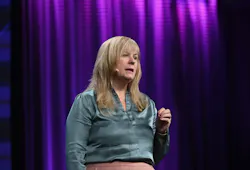
Marylene de Winter, global automation director, and Sinead McDonagh, enterprise historian program lead, at Pfizer explained how the 2019 launch of a global historian program at the company helped position Pfizer to ramp up COVID vaccine development in 2020.

Then COVID arrived.
In response, once the mRNA vaccine had been tested and approved, Pfizer’s initial target was to produce 100 million doses. In 2021, that goal was raised to 1.3 billion doses before being revised again to 2.5 billion doses. McDonagh said the company eventually produced 3.2 billion doses in 2021 by refocusing efforts from 18 sites to four main vaccine development sites.
Three additional capabilities provided by Aveva’s software to Pfizer’s development and distribution of the COVID vaccine, included:
- Cold chain integrity: To support storage of the vaccine at the required -70° C temperature, Pfizer linked its freezer farm operations to Aveva Data Hub analytics.
- Enabling mRNA concentration prediction via Aveva Data Hub analytics and machine learning to continuously monitor more than 1,000 tags.
- Reduction of production cycle times with real-time scheduling capabilities.
Shell’s digital twin plans
Bart-Jan Ruules, Shell’s product line manager for engineering and maintenance, told the Aveva World audience that Shell’s plans for digital twin use is not just to have a means of real-time operations visualization built on a system of digitized records, but to create a “system of engagement via the integration of bi-directional dynamic workflows to enable autonomous operation with digital twin technology.”

One of the main challenges to building this foundation was the existence of non-standard data models across the company due to siloed operating procedures. The company is now using Aveva Data Hub to create asset data models that integrate industry standards and corporate standards, drive maintenance based on digital engineering asset data, and transition from operational data siloes to company-wide data flows by moving from document-centric reviews and approval to data-centric methods to ensure validity of the data rather than assuming validity based on existing documents.
“It’s almost impossible to think about all the potential needs for digital twin technology before you start using it,” said Ruules. “For example, before starting with digital twins, we envisioned 50 applications for it. Once we started working with it, however, we realized we had 150 applications for it.”
Utlimately, Shell wants to “work in one [software] environment for consistency of data and delivery of it,” Ruules said. “And we want to be able to invite external parties to work with this data [in the system] too.”
All about the data
Citing an Aveva study conducted with Wakefield Research, Caspar Herzberg, Aveva’s chief operations officer, said 84% of industrial companies are currently making decisions with incomplete data because, even though they have collected a wealth of data over the years, it often remains difficult to make sense of it all.
In response, Aveva’s internal goal is to “bring together decades of innovation across its acquired technologies, such as the OSIsoft PI data historian system and Wonderware software, into one end-to-end, artificial intelligence-infused software for engineering and operations,” Herzberg said. “Were in the midst of bringing these together to enable the visualization of all data in context via one pane of glass.”

Specific industrial challenges Aveva is looking to address with its software include supply chain capital projects, labor shortages via more efficient autonomous operations and a connected workforce, commodity price fluctuations via operations efficiency and optimized energy use, and environmental/sustainability regulations.
In addition to the high-profile presentations by Pfizer and Shell, other customer experiences with Aveva software highlighted at the event included:
- Dominion Energy shares data about its green energy mix via Aveva Data Hub to help its customers meet their own sustainability goals. Aveva Data Hub enables Dominion to share its energy source and performance data with its utility customers, allowing them to track Dominion’s sustainability commitments and prove the company is using energy from low-carbon sources. This information provides Dominion’s customers with data to support their own net-zero commitments to investors and auditors. It also helped Dominion develop a new revenue source from this information sharing ability.
- The city of Salem, Oregon’s water treatment facilities are protecting drinking water supplies by sharing data via Aveva Data Hub to predict when harmful algae blooms will occur, enabling them to take proactive remediation measures. Data Hub provides the city of Salem with the ability to aggregate various sources of data—such as algae levels, water depth, weather data, water turbidity, satellite imagery, and lab samples—into one central, cloud-based hub of information.
- Aker Carbon Capture engineers use Aveva’s Unified Engineering software to create replicable designs for the company’s carbon capture units. This helps Aker engineers in Norway and India to collaborate via Aveva Data Hub to bring their carbon capture technology to market 50% faster than before.
- Henkel, a supplier of consumer goods and chemicals, improved overall equipment effectiveness by 15% and is saving 8 million euros annually in energy savings using Aveva’s MES software.
About the Author
 David Greenfield
 Leaders Logo
Leaders relevant to this article: