From Scrap to Self-Correction: How Edge AI is Transforming Manufacturing Performance
Key Highlights
- Latency, connectivity gaps, security concerns and high costs can make cloud-based AI impractical for factory floors where real-time, millisecond-level feedback loops are essential.
- Industrial PCs with dedicated AI acceleration processors outperform GPU- and cloud-based approaches by delivering low-latency inferencing, rugged durability, energy efficiency and longer hardware lifecycles suited to harsh manufacturing environments.
- A thermoplastic pipe supplier replaced inconsistent human inspection with an on-premises AI vision system, achieving 100% inspection coverage and near-total elimination of wrapping-related scrap.

Increasing globalization, workforce shortages, supply chain snags and sustainability pressures are all colliding in a perfect storm of complexity for manufacturers. In response, manufacturers need to improve quality, reduce scrap and emissions, and maintain productivity, but they often lack the personnel and expertise necessary to accomplish those goals.
The obvious solution is to turn to digital tools. Artificial intelligence (AI) and machine learning (ML) technologies can close certain gaps organizations face as they pursue operational excellence. However, many of the most visible AI tools rely on the cloud due to their need for high processing power and unlimited scalability. The typical cloud path is often impractical for industrial environments due to latency issues, poor connectivity, security constraints and cost. The most efficient production lines demand real-time feedback loops, and cloud connectivity simply cannot deliver the required performance (see Figure 1 below).
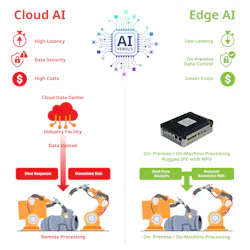
Yet, benefiting from AI and ML in manufacturing is not about having the right experts on site or relying on remote cloud processing. Instead, teams need the right partner and the right localized platform. That’s why a new approach is emerging to help companies navigate the complexity of AI without onsite AI experts and without exposing data to the cloud.
These organizations are running fit-for-purpose industrial AI tools locally on industrial PCs (IPCs) equipped with dedicated AI acceleration enabling true, real-time autonomy for physical AI systems operating on the factory floor.
On-site AI is no longer optional
Real-time operational technology (OT) workloads operate differently from the information technology (IT) workloads around which generic AI solutions are designed. In their most common form, real-time industrial AI loops capture data, analyze that data, make decisions based on the outcome and feed correction back into a controller or other device to form the closed feedback loops that define modern physical AI systems operating on the factory floor.
AI detects deviations instantly and triggers machine corrections automatically, resulting in near elimination of scrap.
For reference, one of the most common applications of this technology is vision. If a camera on a manufacturing line is capturing 30 to 100 images per second, processing that data and then driving a reaction from a controller, milliseconds matter. This reality compounds when considering the use of multiple cameras across multiple lines. Cloud transmission delays and connectivity issues can lead to latency that results in scrap, downtime or unsafe operations.
Connectivity issues are further exacerbated by facility location, because many industrial environments — such as mining or oil and gas — are located far from population centers and commonly have limited options for cloud connectivity. In some cases, these facilities rely on connections that are notoriously unreliable. As a result, if critical AI tools in the production line depend on cloud inference and the link drops, production stops.
Yet, even for facilities with optimal cloud connectivity, issues persist. Many manufacturers cannot risk sending proprietary production data to the cloud, either for regulatory or intellectual property preservation reasons. Many of these organizations consider cloud technology to simply be “someone else’s computer,” which creates security risks they cannot accept.
The costs of cloud computing and data transfer can also be a significant concern. High-bandwidth industrial imaging and video streaming to the cloud can quickly become very expensive.
Because all processing is performed on-site, data does not need to leave the facility. This reduces latency, lowers operational costs and addresses data privacy and security requirements.
Ultimately, cloud-hosted AI applications can quickly become a burden or even a liability for OT applications. That’s why many organizations are skipping cloud AI altogether, opting instead to implement industrial AI applications on fit-for-purpose IPCs with integrated AI acceleration.
Purpose-built AI processors — designed for edge inference — are optimized for the workloads that matter most on the factory floor. They are built specifically for industrial AI, leveraging the right neural processor and platform to deliver measurable value across manufacturing.
The right processors for industrial AI
AI is often considered the domain of graphics processing units (GPUs). Designed to offload workloads from the computer’s processor to an alternate chipset, GPUs used with AI can significantly increase performance. While GPUs are well positioned for efficiently training AI models, dedicated edge AI processors are optimized for inferencing — when the trained model moves from learning to continuous task execution.
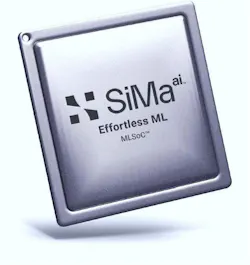
Given limited power budgets, GPUs cannot process the item-per-second volume needed in industrial AI environments, such as when a camera is processing dozens of images per second. Dedicated edge AI processors handle high-speed computer vision and large language model inferencing with far greater efficiency (see Figure 2 at left). They meet the need for instant feedback to the controller with predictable, low-latency performance.
In addition, modern IPCs equipped with dedicated AI acceleration are significantly more power-efficient than traditional GPU-based approaches. They can operate without cooling fans and can accomplish large amounts of AI data processing with minimal power draw and effective heat dissipation, which is critical for 24x7 edge systems. As teams pursue more efficient operations with AI, dedicated edge AI processors play a critical role in reducing energy use and cost.
The right platform for industrial AI
In addition to needing the right processors, industrial AI needs the correct platform. Commodity computers struggle to meet the strict operating standards necessary on the manufacturing floor.
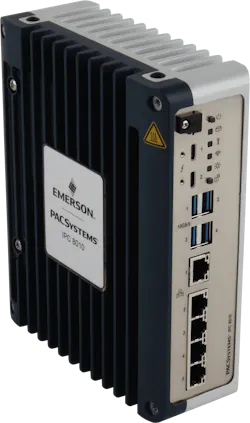
Many industrial AI applications exist in harsh environments where heat, vibration, dust, humidity and other environmental conditions shorten the lifespan of traditional hardware. IPCs are engineered to withstand these difficult environments, with ruggedized cases, fanless cooling and soldered CPU and memory that help maintain nonstop operation regardless of installation location (see Figure 3 at right).
In addition, IPCs offer predictable, deterministic performance with lower heat generation and lower power draw, making them a better choice for the factory floor.
Another benefit of IPCs over commodity computers is their longer lifecycles. When an organization designs and certifies a piece of equipment, they want it to last. If the team uses commercial servers and needs to replace equipment, such as in the case of hardware failure, the originally qualified equipment is often no longer available due to the short lifecycles of IT hardware. IPCs have significantly longer lifecycles. Once they are certified, organizations can continue purchasing the same hardware for years.
The combined value of the right processor and platform
AI-accelerated processors combined with IPCs provide a robust platform for industrial edge AI. This architecture enables real-time, closed-loop intelligence, allowing machines to detect deviations and correct processes before defects occur.
The AI processing engine delivers high-performance inferencing, while the IPC’s multi-core x86 processor handles complementary tasks such as data pre- and post-processing, protocol implementation (e.g., industrial Ethernet and fieldbus systems), database storage, visualization and other functions.
Because all processing is performed on-site, data does not need to leave the facility. This reduces latency, lowers operational costs and addresses data privacy and security requirements.
Overall, this approach supports autonomous, continuously operating systems built on a scalable, long-term industrial platform for AI-driven applications.
AI in action in a pipe wrapping vision system
The use of AI in industry is not science fiction. A thermoplastic pipe supplier recently implemented an industrial AI vision system to monitor a process for wrapping pipes with tape before superheating them to increase their strength. In this process, the tape placement on the pipes must be precise, as gaps and overlays weaken structural integrity. For years, the organization relied on human inspection. However, that system was slow, inconsistent and increasingly limited by workforce shortages. Moreover, human inspectors could only identify issues after failures occurred, leading to significant scrap.
The operations team knew AI could help but needed the solution to operate entirely on premises to enable the closed-loop control required for their high-speed operations. Ultimately, they implemented a custom, open-design inspection station for AI vision analysis. The AI inspects the pipe after it is wrapped and sends analysis results to the controller quickly enough to adjust operations before they exceed acceptable thresholds. The system can check multiple pipe diameters and adds minimal physical footprint to the production line.
Modern IPCs equipped with dedicated AI acceleration are significantly more power-efficient than traditional GPU-based approaches. They can operate without cooling fans and can accomplish large amounts of AI data processing with minimal power draw and effective heat dissipation, which is critical for 24x7 edge systems.
The results exceeded the expectations of the operations team. The system provides 100% inspection, regardless of operator fatigue or staffing issues. AI detects deviations instantly and triggers machine corrections automatically, resulting in near elimination of scrap due to wrapping issues. Moreover, the AI solution provides video records for compliance and quality certification, delivering end-to-end validation and value.
Perhaps the most exciting element of the organization’s results is that they could be replicated across an array of other industries including:
- Laser welding alignment and quality.
- Automotive adhesive placement.
- Life sciences packaging and infusion bag inspection.
- Oil and gas flare monitoring and leak detection.
- Mining ore analysis.
- Recycling conveyor and sorting optimization.
More AI insights from Automation World:
About the Author
 Gene Juknevicius
Gene Juknevicius
Gene Juknevicius is senior solution architect for Emerson, recognized for shaping next-generation communication platforms and architectures, with a strong focus on industrial computing and edge-based solutions. With deep expertise in edge computing, control networks, machine learning and modern computing architectures, Gene is trusted for staying at the forefront of industry evolution and translating complex technologies into scalable, market-ready solutions. Gene holds a Master of Science in Electrical Engineering from Stanford University and a Bachelor of Science in Electrical Engineering from San José State University.
 Stephan Reichenauer
Stephan Reichenauer
Stephan Reichenauer is the sr. director EMEA sales at SiMa.ai, a leader in physical AI solutions. He is responsible for scaling the company’s business across the EMEA region, driving market expansion and strategic customer engagement. With more than 30 years of experience, Stephan has held strategic technical sales, business development and global key account management roles at leading semiconductor and embedded computing companies. Stephan holds a diploma in communications engineering from the Technological High School in Munich, has extensive experience in communications and electronics engineering, and has led major business development initiatives across all major vertical market segments, including the industrial sector.